

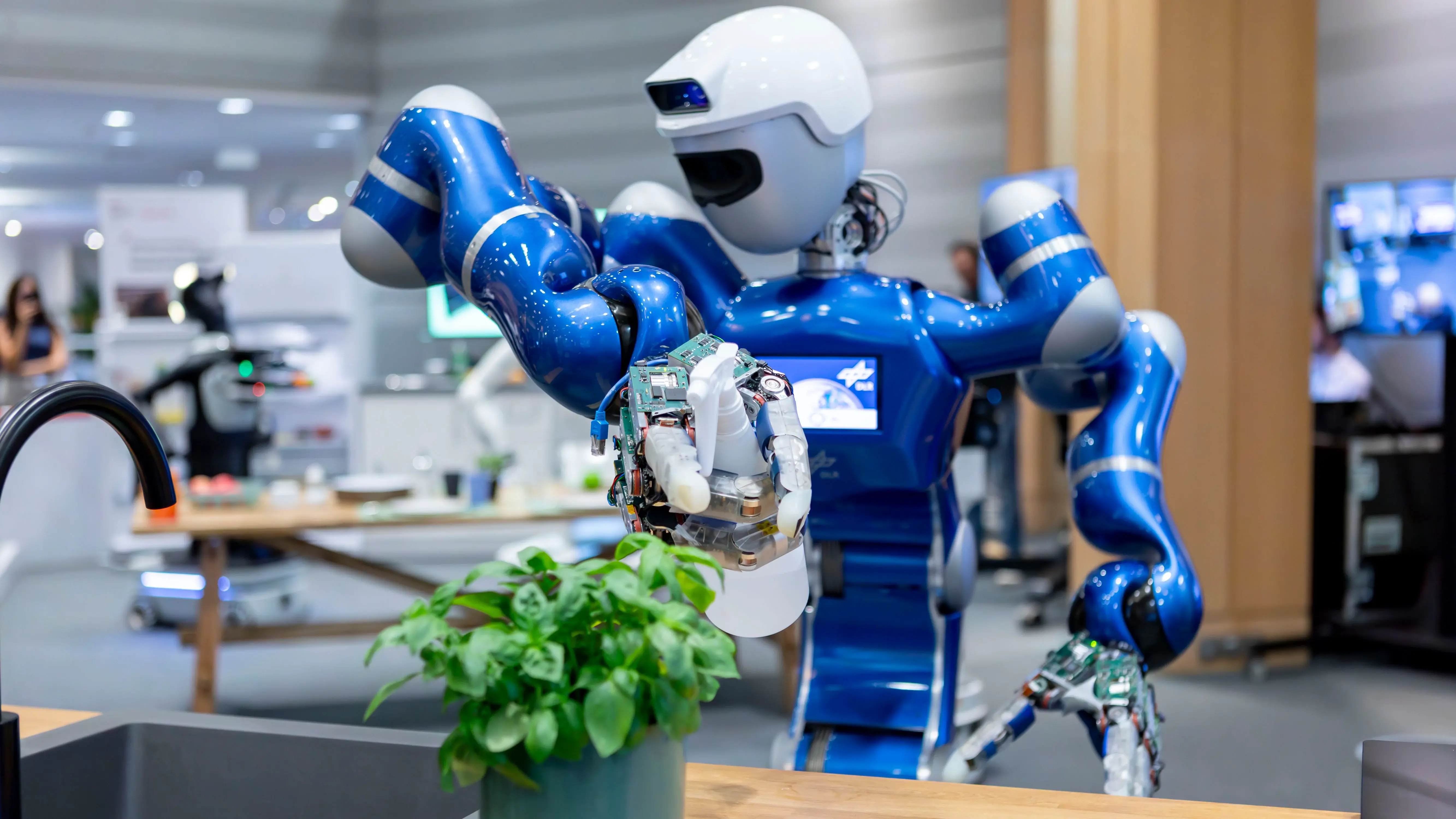
On September 2, 2026, fifteen AI-powered robots took over part of the European Parliament in Brussels to demonstrate a series of cooperative tasks, from dismantling electronics and clearing a breakfast table to delivering parcels. The showcase was organized by the EU-funded euROBIN robotics network, a research initiative designed to foster collaboration among European robotics institutions. Among the robots were humanoids, quadrupeds, drones, and industrial systems, all presented before an audience of roughly 170 representatives from politics, industry, and academia.
A Demonstration of Shared Autonomy
The most compelling example of cooperation came from four household robots working together on a breakfast-table task. According to the German Aerospace Center (DLR), the four systems operated autonomously while accounting for one another as they identified objects randomly placed on a table. The robots picked up plates and a cereal box, then sorted items between a dishwasher, cupboard, fridge, and rubbish bin. The DLR humanoid Rollin' Justin was one of the four systems, demonstrating how different robots can collaborate on the same physical chore without explicit, centralized coordination.
Karlsruhe Institute of Technology (KIT) also participated with its ARMAR-7 humanoid robot, which uses a cognitive architecture with episodic memory designed to store, retrieve, and share past experiences. This capability allows the robot not just to perceive its immediate surroundings but to apply prior learned knowledge to new situations, a crucial attribute for adaptable human-robot and robot-robot collaboration. The breakfast-table scenario put a practical spin on the growing trend of "physical AI," where robots are moving beyond walking and balancing toward everyday manipulation tasks. In recent months, robot demonstrations worldwide have increasingly focused on autonomous ladder climbing, real-world service jobs, and dexterous object handling, signaling a shift from laboratory novelties to practical applications.
Beyond Side-by-Side Operation
The Brussels event was more significant than the robot count alone might suggest. The four household robots were not merely operating beside one another; each independently performed parts of the same task while actively taking the other robots into account. This kind of multi-robot coordination introduces complex challenges that do not arise when a single robot completes an entire task. Task allocation, collision avoidance, handling changing object locations, and recovery when another robot alters the environment are all nontrivial problems. Successfully navigating these issues in real time demonstrates a level of collaborative autonomy that is still rare in the field.
For organizations evaluating cooperative robotics, this distinction matters. Coordinating several autonomous machines around shared objects and workspaces requires sophisticated planning and communication, especially when the robots are heterogeneous. The fact that four different systems, likely built by different research teams, could execute a shared chore suggests that the field is maturing. However, the public material from the event does not confirm that the robots exchanged learned skills or operated through a common cross-platform control layer. That gap is important because euROBIN's broader scientific goal is to make robotic knowledge and skills transferable between different robots, tasks, and environments. The ability for one robot to learn a manipulation skill and another robot to seamlessly reuse that capability would represent a significantly more advanced step than having several machines programmed to cooperate in a prepared scenario.
Manufacturing, Disassembly, and Outdoor Tasks
The other demonstrations covered two additional euROBIN research areas. In a manufacturing scenario, five teams participated in tasks such as refurbishing laptops, dismantling a robotic vacuum cleaner, performing mobile disassembly, handling advanced manipulation, and running simulations. These tasks reflect the growing industrial interest in robots that can adapt to complex, unstructured environments rather than being fixed to a single assembly line. Disassembly and refurbishment are particularly challenging because they require robots to handle variability in product condition and component arrangement.
A separate industrial robot cell developed by the Technical University of Munich, the Jožef Stefan Institute, and the University of Bremen demonstrated cable routing for wiring-harness assembly. This is a delicate and highly relevant task for automotive and electronics manufacturing, where cables are still predominantly inserted by hand. The ability to automate such intricate work could significantly reduce production costs and improve consistency.
For outdoor robotics, teams demonstrated autonomous parcel delivery using a centaur-style robot, a wheeled quadruped, and a drone equipped with an arm. These systems showcased how different mobility and manipulation designs can be applied to logistics tasks, a sector increasingly exploring drone and ground-robot collaboration. The combination of a wheeled base with a humanoid torso, as seen in the centaur-style robot, is a particularly interesting design for navigating urban environments while still being able to manipulate objects.
Cooperation Is Here, But Portability Remains Harder
The September 2 demonstration does not yet prove universal robot interoperability. While the four household robots successfully cooperated under controlled conditions, the project did not publicly document how software, learned behavior, or task knowledge could be transferred across robot platforms from different developers. That distinction is critical for manufacturers and systems integrators. Multi-robot deployments can already divide work among specialized machines, but moving a skill learned on one robot to another requires significant interface design, safety validation, and integration work. The euROBIN network aims to make such transfer seamless, but the technology still appears to be under development.
This gap between cooperative autonomy and true portability was one of the event's more subtle yet important themes. In the audience were representatives from industry, many of whom are evaluating when cooperative robotics will become a practical, cost-effective solution. For them, the Brussels demonstrations offered a glimpse of what is already possible: robots that can share a workspace and coordinate to produce a desired outcome. But the harder test for euROBIN is whether a robot trained to manipulate one type of object can transfer that knowledge to a completely different robot without significant reprogramming.
Discrepancy in Robot Count
The final lineup of 15 robots resolved an apparent discrepancy in earlier publicity. A European Commission event listing originally advertised 20 to 30 robots, while euROBIN's later materials specified 15. The German Aerospace Center confirmed that exactly 15 systems ultimately demonstrated at the Parliament. The difference highlights the logistical challenges of organizing large-scale robot events, where technical failures, safety requirements, and travel issues can change the participant list at the last minute.
Potential for a European Robotics Industry
Organizers argued that AI-powered robotics could become a European industry comparable in scale to today's automotive sector within 10 to 15 years. This claim is ambitious, but the underlying investment and research momentum are real. Europe has long been a leader in industrial robotics, with companies such as ABB and KUKA originating in the region. However, in the race for humanoid and service robots, Europe faces stiff competition from North America and Asia, where major tech firms and aggressive startups are pouring billions into physical AI.
Events like the Brussels showcase are designed to demonstrate that Europe's research community can collaborate as effectively as its rivals. euROBIN represents a network of dozens of laboratories, universities, and companies working on different aspects of robotics, from mechanical design to artificial intelligence. The focus on knowledge sharing is meant to overcome the fragmented nature of European robotics research, which historically has produced excellent individual breakthroughs but struggled to commercialize them at scale.
The economic potential is substantial. Robotics is expected to transform manufacturing, logistics, healthcare, and home assistance over the next two decades. If Europe can develop a unified framework for robotic interoperability, its companies could gain a competitive edge. The 15 robots in Brussels were a small but tangible representation of that ambition. They demonstrated that European robotics research is not confined to simulations and white papers; it is building systems that can work together in the messy, unpredictable physical world.
Source: eWeek News