

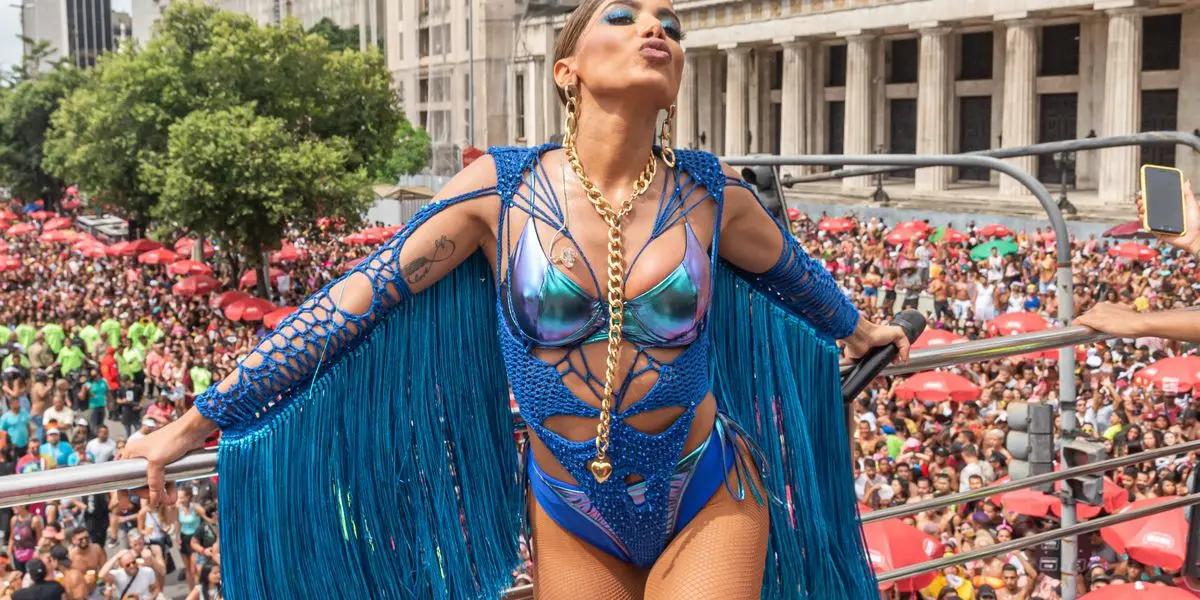
From the Favela to the World Stage
Born Larissa de Macedo Machado in Rio de Janeiro, Anitta grew up in a favela where opportunities were scarce. Her mother worked as a seamstress, her father sold car batteries. As a child, she sang in the church choir and dreamed of becoming a singer. “I hate to lose,” she says. “Everyone said I wouldn't make it, and that drove me.”
She began posting videos online and soon became a Brazilian pop sensation. Her 2013 hit “Show das Poderosas” made her a national star, and she later conquered Latin America and the United States with collaborations with Cardi B, Madonna, J Balvin and others. In 2020, Forbes ranked her among the most influential women in Brazil. With more than 50 million Instagram followers, she has become a cultural force far beyond music.
Yet her success did not come from a world of privilege. “If you grow up in that reality in Brazil, you have no access to education, to art,” she says. “It is hard even to develop ambition. You think it is impossible, not doable for people like us. You are born into that, and then you think in circles. You first have to learn to believe that you can succeed. It is a huge mental task.”
Feminism on Her Own Terms
Anitta has become known for her hyper-sexualized image. She has said that she sees her body as a source of power and freedom. When asked what feminism means to her, she rejects a single definition. “It is about the freedom for everyone to be who they want to be, without caring about society's expectations,” she says. “Women should not think that they have to do anything. They just have to do what matters to them. There is not just one feminism, not just one right way to be a feminist.”
The question remains: Why is a bare bottom in a thong feminist? “There are women who do not like showing their bodies. Some want to marry and be mothers. Others want a great office job and a career. But there are also women who want none of that, who simply want to be free and live differently,” she answers. “Everyone should do with their body what they want. If I feel good with my body and with showing it off and being sensual, then I do that. I am very free. I would never judge women who do not like that. It makes me sad when other women judge my lifestyle.”
“Girl from Rio,” her recent single, is a clear example of her approach. The song references Antonio Carlos Jobim's famous bossa nova classic “The Girl from Ipanema,” which describes a girl on the beach, her body, her elegant walk. Anitta flips the perspective. She sings from the point of view of the girls: “Where I come from, we don't look like models.” The lyrics mention curves, tan lines, life in the favela, and childhood siblings that one meets because a father had other children. “I am favela,” she sings. She tries to turn the male gaze around and make it her own, yet she still seems trapped in it.
Cosmetic Surgery and Uncomfortable Truths
Anitta has undergone numerous cosmetic procedures. She says they were recommended to her at the beginning of her career. “Yes, I was told that it was necessary, that I should do it,” she says. “I had never thought about it. But then I loved the idea. I hated my nose my whole life.”
She believes in being transparent about such operations. “The people nowadays, especially teenagers, look at photos on social media and become depressed or feel bad about their bodies.” At the same time, she refuses to treat her cellulite. “Many people tell me I should do something about it. That is a huge effort, and I don't feel like it. So I simply accept that I have it. If someone doesn't like it, that's not my problem, but theirs.”
“He Is Responsible for This Result”
Anitta currently lives in Miami, working on her international career. But the travel restrictions caused by the pandemic have kept her away from Brazil. She hears from her mother and friends about the situation at home. “Our president did not manage the pandemic well,” she says. “I know how wonderful and how big Brazil is, and the politics is so bad. It is extremely frustrating.”
In 2021, Brazil's coronavirus death toll passed 400,000. A congressional inquiry was investigating the government's response. Former health ministers testified that President Bolsonaro had ignored warnings, delayed vaccine contracts and promoted unproven treatments. Anitta had previously avoided political statements, but she later took a sharp turn. Asked if she would call Bolsonaro's actions genocide, she says: “Yes. Because when someone has the opportunity to prevent something, or to stop it, or to contain it, but then decides not to do any of that, then I agree with that word. Bolsonaro denied the virus, denied the pandemic, then he did not want to buy vaccines. He did not do his best. If someone says 'I don't care,' then yes, he is responsible for this result. Then it is his fault.”
Bolsonaro and his supporters have attacked her online. “They call me a slut and say I should shut my mouth,” she says. She has never met the president. “No, fortunately not.”
Learning Politics in Public
Anitta initially refrained from criticizing Bolsonaro during the 2018 election campaign. Many Brazilians were disappointed. She apologized, saying she had too little understanding of politics. Over time, she paid for tutoring and learned English, Spanish and later political science. “I did tutoring during the pandemic and streamed it live on Instagram once a week so my fans could learn with me,” she explains. “It's about simple questions: What does a president do? What does a mayor do? You have to make it very simple so that everyone can keep up. If people are not interested in politics, then politicians can simply lie to them and trick them.”
With the next presidential election approaching in 2022, Anitta plans to intervene again. “I definitely want to get involved. I want my audience to be informed and to understand who is electable and who is not. The people in Brazil must understand that the election is important. Because if they elect the wrong person, then it can have serious consequences for their lives in the next moment.”
No Makeup, No Apologies
Like many women during the pandemic, Anitta has reconsidered her daily beauty routine. “It is true! I don't wear any makeup right now, only a little lipstick and powder,” she says. “And it feels so good. During the pandemic we had many Zoom calls, and at first I would still get dressed up for them, but at some point I stopped and thought, oh well, I'll just show myself as I am. I feel free with that.”
That sense of freedom, she insists, is at the core of everything she does – from the way she dresses to the way she speaks about her body and her politics. She is determined to define her own version of empowerment in a country still shaped by deep inequality and conservative gender norms.
Source: Spiegel News