

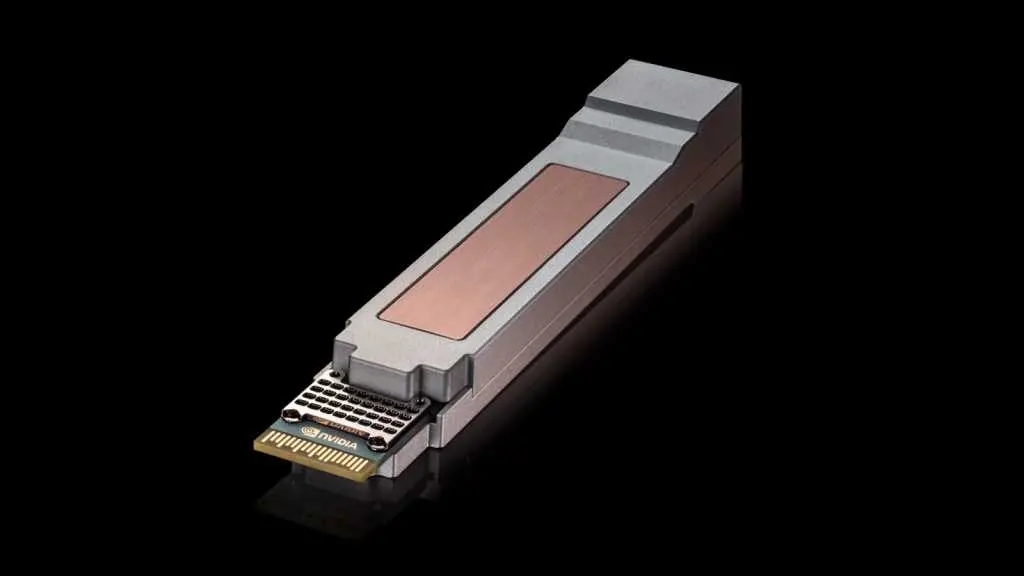
Ultra-dense optics target AI fabric bottlenecks
Cisco and Nvidia have introduced a new high-capacity pluggable optical system aimed at helping data-center operators build Ethernet-based AI fabrics more quickly and with fewer physical constraints. The Ultra-Dense Small Form Factor Pluggable, or USFP, module was unveiled at the Open Compute Project Global Summit 2026. It is designed to carry 400 Gb/s per lane electrical signals and can scale to 12.8T of aggregate capacity, giving network architects a denser building block for systems that connect GPUs, switches, security appliances, storage, and other AI infrastructure.
The companies argue that AI workloads are placing extraordinary pressure on the links between compute and networking equipment. Large training clusters and inference environments require enormous amounts of east-west traffic, and the number of connections per switch continues to rise. When a switch reaches capacity, expanding the network often means adding more switch layers and optical links, which can increase latency, power consumption, and cost. USFP is intended to address that problem by increasing bandwidth density without proportionally increasing the footprint of connectivity hardware.
What USFP changes for Ethernet fabrics
The USFP module supports 200G and 400G SerDes-based systems and ASICs, giving customers a path to scale from today's 1.6T fabrics. A 16-lane version operating at 400 Gb/s per lane delivers 6.4T of aggregate capacity, which the companies say is four times the bandwidth density of current 1.6T pluggables. The architecture can also extend to 32 lanes, providing a route to 12.8T of aggregate capacity. That progression is important because AI infrastructure designs increasingly depend on high-radix switches and dense optical interconnects to support large numbers of accelerators.
Beyond raw capacity, the module is designed to improve power efficiency. Cisco and Nvidia estimate approximately 1.3x greater power efficiency through the use of 400G SerDes technology. That matters as AI data centers confront growing power and cooling demands. Higher-density optics can reduce the number of components, cables, and rack-level connections required for a given amount of bandwidth, which can simplify deployment and lower operational overhead. The companies position USFP as a way to preserve the serviceability of pluggable optics while moving to higher-speed lanes.
USFP modules are intended to be field-replaceable, so operators can continue using familiar deployment and maintenance practices. Instead of requiring a wholesale overhaul of data-center infrastructure, the technology is designed to let customers adopt next-generation optical capacity while retaining operational consistency. Cisco and Nvidia said the approach combines higher-capacity fabrics and improved efficiency with interoperability and flexibility at scale. That combination is central to the pitch: AI builders need more bandwidth per connection and more connections per switch, but they also need to avoid introducing fragile or unfamiliar operational models.
Open specification and partnership context
Cisco and Nvidia plan to create an open industry specification for USFP through an upcoming community-led multi-source project. The goal is to encourage an ecosystem of compatible components rather than a single-vendor optical module. An open specification could help multiple suppliers build USFP products, giving customers more choice and reducing the risk of lock-in as AI fabrics scale. The companies said the effort is guided by a shared objective of accelerating AI adoption while maintaining flexibility, openness, and choice.
The USFP work is not considered part of the current Cisco and Nvidia partnership, according to the companies. Their existing collaboration has focused on Spectrum-X Ethernet networking technology and related switch silicon integration. USFP is a broader ecosystem effort involving Cisco, Nvidia, and other participants that believe the module design is the right direction for high-density optical connectivity. That distinction matters because it shows the companies are willing to collaborate on optical standards even beyond their existing go-to-market and silicon integration work.
Why bandwidth density is becoming a design constraint
AI fabrics are different from traditional enterprise networks. They are built to move massive amounts of data between accelerators with predictable latency and high utilization. In a large AI cluster, a single training job may span thousands of GPUs, and every additional switch layer can add latency and complexity. Network designers therefore try to increase the number of ports per switch, the speed per port, and the efficiency of the optical links that connect racks and clusters. Pluggable optics are a critical part of that equation because they determine how easily switches can be connected to servers, other switches, and security or storage systems.
Traditional pluggables have improved steadily, but AI workloads are pushing against the limits of space, power, and thermal budgets. Higher-capacity modules can reduce the number of optical components needed for a given bandwidth target. That can free up rack space, reduce cabling complexity, and lower the number of failure points. At the same time, denser optics must remain serviceable. Operators need to replace modules in the field, monitor their health, and maintain compatibility with existing deployment practices. USFP's design attempts to balance those requirements by increasing lane speed and lane count while keeping the pluggable form factor familiar.
Silicon One G302 extends the AI switching portfolio
In addition to the USFP announcement, Cisco expanded its Silicon One portfolio with a new top-of-rack Ethernet switching chip aimed at high-density AI and cloud data-center networks. The Silicon One G302 is a 51.2-terabit-per-second top-of-rack chip that delivers 102.4T capacity and supports Cisco 1.6T optics along with direct-to-chip liquid cooling integration. The chip is designed to sit at the rack level, gather traffic from servers, and connect that traffic efficiently into the larger data-center network.
The G302 extends the 102.4 Tbps Silicon One G300 portfolio. Cisco said the G300 family is shipping now and includes Intelligent Collective Networking, a set of capabilities that supports shared packet buffers, path-based load balancing, and proactive network telemetry. Those features are intended to handle large-scale, bursty data-center traffic produced by AI training, inference, and real-time agentic workloads. As AI clusters grow, the top-of-rack switch becomes a critical aggregation point, and its ability to buffer, balance, and observe traffic can influence overall cluster efficiency.
The G302 is at the heart of two new fixed-form 64-port switches. The first is the 3RU air-cooled 8133. The second is the 2RU 8132, which Cisco describes as its first commercially available water-cooled switch. The introduction of a water-cooled switch reflects the growing thermal density of AI networking equipment. Liquid cooling is increasingly being considered for high-performance data centers because air cooling alone can struggle with the heat generated by dense compute and switching hardware. By offering both air-cooled and water-cooled options, Cisco is giving customers deployment flexibility as they weigh power, cooling, and space constraints.
Operational implications for AI factories
The broader significance of these announcements is that AI infrastructure is becoming a networking problem as much as a compute problem. AI factories require more bandwidth per connection and more connections per switch. When a switch reaches its capacity, further expansion can require additional switch layers and optical links, which can increase latency, power consumption, and costs. Denser optics and higher-capacity switch silicon are two ways to push those limits outward. They allow operators to pack more bandwidth into the same physical footprint and to design fabrics that can scale without excessive layering.
For customers, the appeal of USFP is likely to depend on availability, interoperability, and the pace at which an open specification emerges. An open multi-source project could accelerate adoption by allowing multiple vendors to supply compatible modules. It could also make it easier for network operators to qualify components and plan multi-year deployments. At the same time, higher-speed optics introduce new testing and validation requirements. Operators will need to ensure that 400G SerDes-based systems work reliably with existing fiber plants, switch ASICs, and management tools. The field-replaceable design is intended to reduce disruption, but adoption will still require careful planning.
Cisco and Nvidia are positioning USFP as a practical path from 200 Gb/s per lane to 400 Gb/s per lane Ethernet AI fabrics. The module's 16-lane and 32-lane configurations give network architects a way to think about capacity in increments, rather than forcing an immediate forklift upgrade. That matters in AI data centers where infrastructure is often deployed in phases and where different clusters may use different generations of hardware. A pluggable approach can allow newer high-capacity links to coexist with older infrastructure, provided the ecosystem delivers interoperable products and clear specifications.
The Silicon One G302 adds another layer to the story. A 51.2 Tbps top-of-rack chip with 102.4T capacity is aimed at the growing density of AI and cloud racks. Its support for 1.6T optics and direct-to-chip liquid cooling shows that switch silicon, optics, and thermal design are becoming tightly linked. As racks pack more accelerators and higher-speed ports, the network hardware must evolve alongside compute. The new 8133 and 8132 switches illustrate how that evolution is showing up in product form factors, with air-cooled and water-cooled options for different data-center environments.
Cisco said the G302 is planned to begin shipping to customers before the end of 2026. The companies also plan to create an open industry specification for USFP through an upcoming community-led multi-source project. Together, the announcements point to a networking roadmap in which optical density, switch capacity, and cooling efficiency are developed as part of the same AI infrastructure challenge.
Source: Network World News