

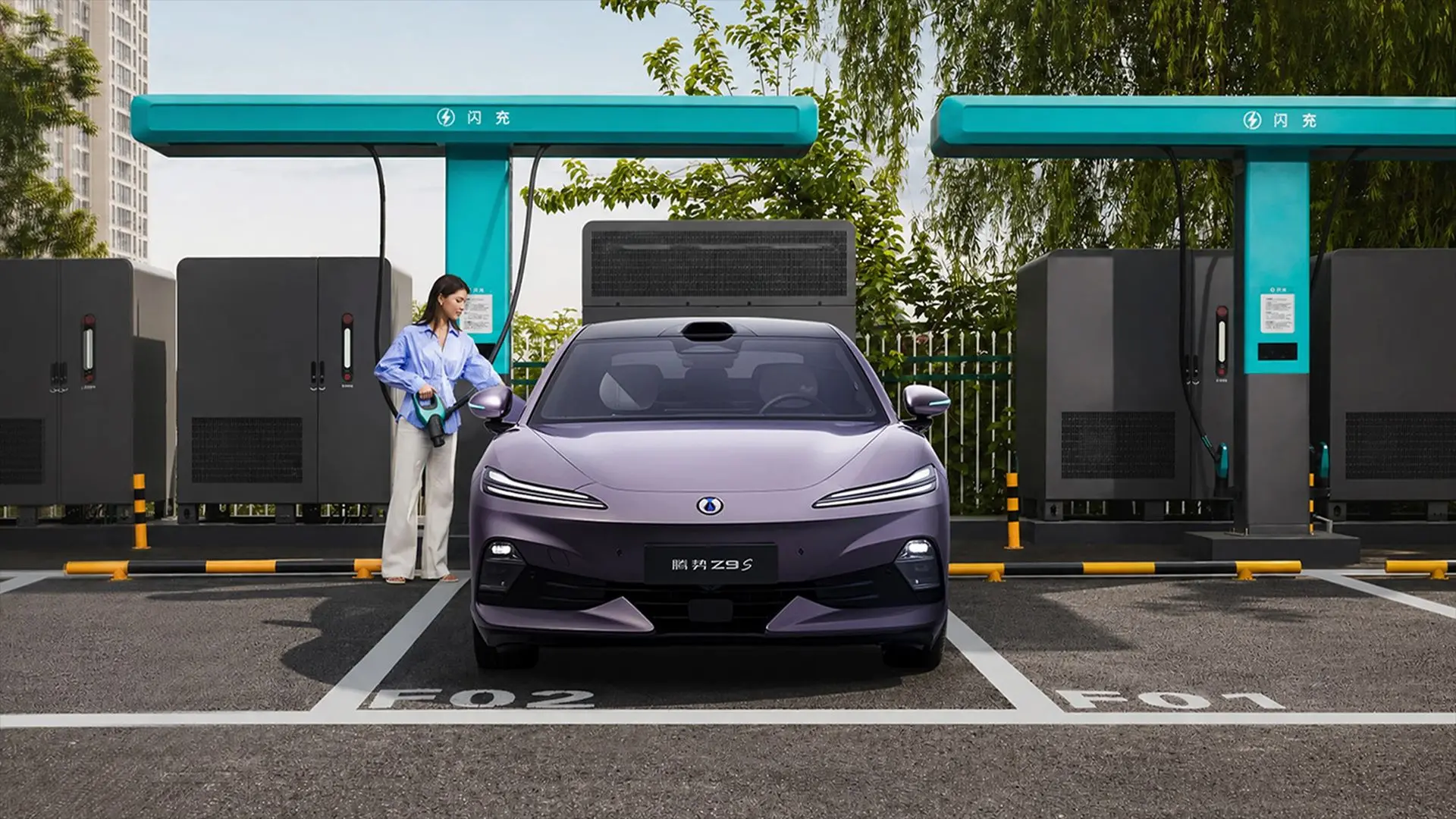
Chinese automaker Denza has made an ambitious claim: its newest model, the Z9S, is the world's longest-range electric vehicle, capable of covering more than 1,000 kilometers on a single charge. The company says that is enough for a driver to travel from New York City to Detroit without stopping for power, a distance of about 990 kilometers by highway. The statement is part of Denza's effort to position itself as a serious technology leader in the premium EV market, rather than a lower-cost volume brand.
What Denza is claiming
Denza did not merely aim to improve on existing EV range figures. It said the Z9S under the CLTC testing cycle reaches up to 1,100 kilometers, or roughly 683 miles. If those numbers are representative, the model would far exceed the range of every production EV currently sold in major markets. The claim would put the Z9S ahead of models such as the Lucid Air Grand Touring, which offers around 830 kilometers under U.S. EPA testing, and Tesla's long-range models, which typically fall near 650 kilometers.
The New York-to-Detroit comparison is a useful way to make the figure understandable. The route between the two cities is roughly 990 kilometers, depending on starting and ending points. Most EVs would require at least one charge on such a trip, and some would need two during winter conditions. Denza says the Z9S can handle the entire journey without a stop, even with enough reserve to account for traffic and weather.
A dramatic step in battery and aerodynamics
Several technologies help explain how Denza reached this number. The Z9S is built on BYD's latest architecture, which includes the company's high-energy-density blade battery. The blade battery uses LFP chemistry, offering safety and durability advantages while allowing relatively high energy storage. Denza has also focused on the car's drag coefficient, one of the most important factors in high-speed range. A sleek silhouette and active aerodynamic aids help the car slip through the air with minimal resistance.
Another factor is the electric powertrain's efficiency. Denza says the Z9S uses advanced silicon-carbide power electronics, low-friction bearings, and an integrated heat pump that recovers waste heat from the motor and battery. The result is a system that converts more of the battery's stored energy into forward motion, reducing losses during acceleration, cruising, and even cold-weather driving. The combination of a large battery and high efficiency is what allows the claimed range figure to be so high.
Why range claims are never simple
Range figures must be treated with care. The CLTC test used in China is generally more optimistic than the EPA test used in the United States and the WLTP test used in Europe. A car that records 1,100 kilometers on CLTC might return perhaps 850 to 950 kilometers in real-world mixed driving, depending on speed, temperature, and terrain. Highway driving at 120 km/h consumes energy more quickly than a city cycle, so the actual New York-to-Detroit range could be shorter than the official number.
Denza has not yet published an EPA range estimate, and it is unclear if the Z9S will be sold in the United States. The company is thought to be preparing for expansion beyond China, with Europe and Southeast Asia as likely targets. If the Z9S is eventually certified under U.S. rules, the official EPA figure could differ significantly from the CLTC number. Still, even a conservative conversion would likely leave the Z9S among the longest-range EVs on sale in the world.
The battle for range supremacy
Range has become the most visible metric in the EV market. Automakers know that range anxiety remains a major barrier for consumers, especially in regions with sparse charging infrastructure. This is why manufacturers from Tesla, Lucid, Mercedes-Benz, and Nio have all fought to push past the 600-mile mark in different testing cycles. Lucid currently holds the U.S. EPA crown with the Air Grand Touring, which is rated at around 830 kilometers. Tesla's Model S Long Range is another benchmark, though its EPA number has shifted over the years.
Nio has also entered the conversation with its ET7 sedan. Equipped with a 150-kilowatt-hour semi-solid-state battery pack, the ET7 has claimed a CLTC range of 1,000 kilometers. If Denza's Z9S delivers its promised 1,100 kilometers, it would leapfrog Nio and become the first production model from a mainstream player to cross that mark. The rivalry between Chinese EV makers is intense, and range numbers have become a way for brands to grab headlines.
What is Denza?
Denza is a premium electric vehicle brand founded as a joint venture between BYD and Mercedes-Benz. The brand has gone through several phases, starting with early electric vehicles that did not achieve strong sales. In recent years, under BYD's full operational control, Denza has reinvented itself as a technology-focused luxury marque. It has launched MPVs, SUVs, and sedans that share BYD's core technology but add more upscale design and features.
The Z9S is an extension of that strategy. It is not just a car with a large battery; it is intended to be a showcase of what BYD's latest systems can do. Denza says the Z9S also includes advanced driving assistance, a refined interior, and fast charging capability. The company has not yet released full specifications, but it says the car is designed for buyers who want an electric luxury vehicle without range compromise.
The role of charging infrastructure
A long range does not remove the need for a robust charging network. Even the Z9S, with its extra battery capacity, will eventually need to be plugged in. But a longer range does give drivers more flexibility. It allows them to skip some charging stations, wait out temporary outages, and take advantage of slower overnight chargers rather than expensive fast chargers. In places where chargers are unreliable, a car with 1,100 km of range can be a practical advantage.
However, large battery packs have downsides. They cost more, add weight, and consume resources. A battery that provides 1,100 km of range is heavier than one with a 600 km range, and the car must carry that weight everywhere, reducing efficiency at city speeds. Denza's product planners have likely accepted this trade-off to win the marketing battle. For many buyers, the question is whether they actually need this much range on a daily basis. The answer might be no, but the perception of range as security is powerful.
Key facts at a glance
- Denza says the Z9S can travel up to 1,100 km under CLTC, the longest claimed range for a production EV.
- The route from New York to Detroit is about 990 km, meaning the Z9S could complete the trip without charging.
- The Z9S uses BYD's blade battery architecture and silicon-carbide power electronics.
- CLTC range figures are usually higher than EPA and WLTP numbers, so real-world range may be lower.
- The Z9S has not yet announced a U.S. launch, but Denza is expected to expand its presence in global markets.
- Competitors such as Nio and Lucid have also claimed or delivered ranges above 800 km, but none have yet matched Denza's figure.
Aerodynamics and weight: the engineering story
Engineers behind the Z9S had to balance several competing goals. To achieve a very long range, they needed a large battery, but a large battery adds mass. The Z9S is therefore built around a lightweight body structure and uses high-strength steel and aluminum in key areas. The car's roof, hood, and side panels are shaped to reduce turbulence. Details, such as hidden door handles and smooth wheel designs, also help lower energy consumption at speed.
The car's thermal management system is another important piece. Batteries do not like extreme temperatures. In cold conditions, an EV can lose 20 to 30 percent of its range because the battery must be kept warm and the cabin needs heating. Denza says the Z9S uses a heat pump that can absorb heat from the outside air, the powertrain, and the battery itself. This helps preserve range in winter, which is especially important for a model that is being promoted for long-distance driving.
What this means for the broader EV market
If the Z9S succeeds, it could change consumer expectations. Today, most mainstream EVs offer between 400 and 600 kilometers of range. That is enough for daily commuting and many road trips, but not everyone trusts those numbers in real conditions. A car that promises more than 1,000 kilometers would remove range anxiety from the conversation entirely for many buyers. It would also pressure competitors to either increase battery size, improve efficiency, or find other ways to reassure customers.
There is also a strategic dimension. Denza is not the only Chinese EV brand pushing the boundaries. BYD itself has become the world's largest EV maker when counting plug-in hybrids, and Denza is one of several sub-brands designed to capture different segments. By introducing a model with the world's longest claimed range, Denza can grab international attention and build the kind of brand recognition that is difficult to achieve with conventional marketing.
The question now is whether the Z9S will deliver the promised range in independent testing. The automotive industry has seen many bold claims that turned out to be optimistic in everyday use. Denza is aware of that skepticism, which is why the company is emphasizing the technologies inside the car rather than just the final number. The Z9S represents a clear statement of intent: the company wants to be recognized not just for affordable EVs, but for engineering and innovation at the highest level.
Source: TechRadar News