

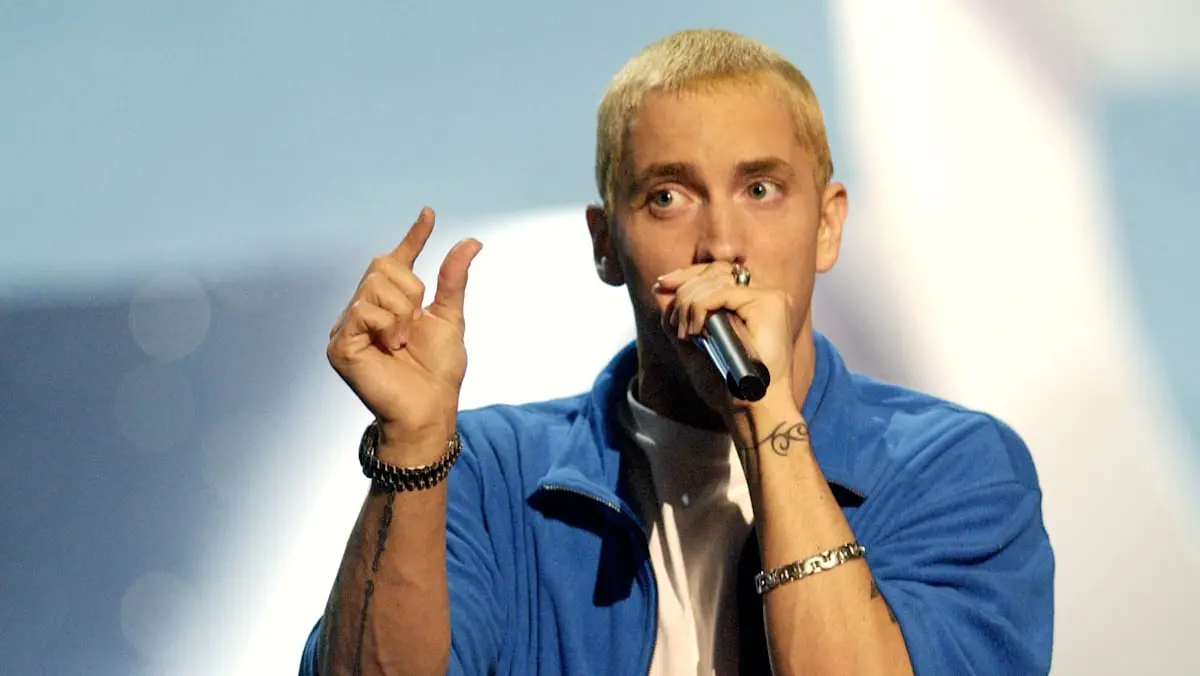
It is an image that tells us everything about how Eminem was perceived at the dawn of the millennium: the rapper in blue overalls, holding a chainsaw, wearing a hockey mask, deliberately styling himself as a hybrid of Jason Voorhees, Chucky, and Leatherface. This pop-cultural personification of evil was not just a shocking photo op—it was a declaration. Now, more than twenty years later, this image has resurfaced, not because of a nostalgia trip, but because of a new book that forces us to revisit an old but essential question: Where do the limits of art lie?
The book in question is Antonia Baum’s contribution to the KiWi-Musikbibliothek, a series in which writers explore musicians who have shaped them. Baum, one of Germany’s most talented authors, has chosen Eminem, the self-proclaimed greatest rapper alive. But her book is not a conventional biography or a fan tribute. At its core, it is a record of an inner struggle—a conflict between her long-standing love for Eminem’s music and her growing discomfort with its content. She describes the rapper’s lyrics as misogynistic, homophobic, violent, and human-despising, and she openly questions whether, as an enlightened feminist, she can still justify listening to him.
An Old Debate, New Urgency
This is not the first time Baum has confronted her musical past. In the German weekly newspaper Die Zeit, she once wrote that it was time to distance herself from German rap, which she had loved in her youth, because she and others had been too naive about its woman-hating texts. Now she applies the same critique to Eminem. But unlike many critics who dismiss hip-hop from the outside, Baum knows the genre intimately. She understands its codes and its traditions. She belongs to a generation of writers and journalists who deliberately demand that the normative moral standards we apply to society be mirrored in art.
This is where the real controversy begins. Is it legitimate to have a problem with Eminem because his songs feature portrayals of murdering his wife or raping his mother? Or is that a category error, a confusion of art with reality? The article, like the book, grapples with this distinction. Marshall Mathers is not Eminem, and Eminem is not Slim Shady, the fictional alter ego responsible for the most extreme lyrics. This layered construction is a fundamental principle of artistic creation. It allows an artist to explore the darkest corners of the human psyche without being held accountable for the views of his fictional creations.
The Authenticity Trap in Hip-Hop
Why does this debate keep recurring in hip-hop more than in other genres? The answer lies in the genre’s obsession with authenticity. Since its inception, rap has sold the idea that the lyrics are autobiographical, that the gap between the lyrical "I" and the private person is minimal or nonexistent. Fans expect real street stories, real pain, real anger. This expectation has been cultivated by the artists themselves, who use authenticity as a mark of credibility.
But it is largely a fiction. Even in the late 2000s, it became clear that many rappers were performing exaggerated versions of themselves. Take Rick Ross, the American superstar who built his career on claims of being a global drug lord and gangster boss. When it was revealed that he had worked as a prison guard—the very antithesis of his persona—his career did not implode. Fans continued buying his albums and streaming his songs, perfectly aware that they were consuming a fictional narrative, an auditory action film. Hip-hop has long understood this implicit contract: what is rapped is not necessarily real, and the violence and misogyny are often hyperbole meant for entertainment.
Those who fail to understand this are often outsiders who only view hip-hop superficially. Antonia Baum is not one of them. Yet she represents a newer trend among cultural critics who argue that art can no longer hide behind the shield of fictionality. They insist that the values of a society—respect for women, non-violence, tolerance—must also apply to the content of art, regardless of whether it is framed as fiction or performance.
The Unassailable Consensus of Culture
This position is dangerous, the article argues, because it undermines the very essence of art. Art has a unique function: to challenge, to provoke, to speak the unspeakable. It is not supposed to conform to the mainstream or to political correctness. If art merely reinforces what we already believe, it becomes decoration, not art. The artist as a social critic must have the freedom to cross boundaries, to hold a mirror up to society that reveals its double standards and hypocrisies. Eminem rapping from the perspective of a school shooter is not an endorsement of violence; it is an exploration of a phenomenon that is deeply disturbing and nearly impossible to understand. Art is one of the few spaces where such darkness can be represented and thus made tangible.
The argument is not about provocation for its own sake. It is about provocation as a means of stimulating discourse. Eminem’s songs have sparked debates about violence, misogyny, and free expression—debates that are necessary for society to confront its own problems. To silence such art because it offends our moral sensibilities would be to retreat into a sanitized world where only safe, comfortable ideas are allowed.
Historical Precedents: Art Has Always Provoked
This is not a new conflict. The history of popular culture is full of moral panics over artistic provocation. In the 1970s, rock and roll, in its harder and more glamorous forms, horrified churches and conservative society. David Bowie challenged fixed gender roles, Kiss celebrated hedonistic escapism, and Black Sabbath turned working-class despair into heavy, slow hymns. In the 1980s, splatter films—like George A. Romero’s zombie movies—are now recognized by critics as biting social commentary on consumerism, but at the time they were dismissed as mere bloodshed.
In the 1990s, the debate about violent video games, the so-called "Killerspiel" debate, raged in Germany. Today, even the most frenetic shooters like Doom are analyzed in the arts sections of major newspapers as cultural phenomena. In the 2000s, Marilyn Manson and then rap music became the new enemy figures. And today? Today the focus has shifted from individual media products to the entire framework of how we evaluate art. The question is no longer whether a specific song or film is acceptable, but whether art as a whole must be subordinated to the political and social expectations of the present moment.
Art Loses Its Own Space
The article argues that this shift is problematic. Art is being denied the space it needs to be art. The artist is no longer accepted as an avatar, as someone who creates fictional worlds and characters. Instead, the artist is pulled into the socio-political present and expected to reflect the mainstream consensus in their work, rather than to contradict it. Art is no longer judged by its own standards, but by the momentary sensitivities of the day.
This is not only dangerous but paradoxical. It was the progressive left that once championed the freedom of art, including in hip-hop. Now that this freedom has become a standard, the same forces want to dismantle it. The entire debate about so-called "cancel culture" gets a false slant because it is not fundamentally about the status of art. Of course, art must be open to criticism—it demands it. But criticism should aim at the work of art, not at the person who creates it. A social media outrage is only a good sign if it focuses on the art and not on the artist’s private life.
Blurred Lines Between Person and Persona
Why is it becoming increasingly difficult to accept this framework? One reason might be that the digitalized society, through constant social media activity, destroys the boundaries between reality and fiction, between the artist and the private person. It is often unclear where a personal opinion ends and artistic freedom begins. Xavier Naidoo, a German soul singer, spread conspiracy theories about satanic elites drinking children’s blood as a private person—that is a problem. Dan Brown wrote thriller novels containing similar conspiracy narratives, and that was not a problem, because Brown did not claim to believe in these things; he fictionalized them. Yet even Brown’s work would be received differently today than twenty years ago.
In this context, one could argue that Antonia Baum’s book itself is a work of art in which she speaks not as the private person Antonia Baum, but as a lyrical "I" questioning the boundaries of art within the realm of art. It would be desirable if Baum’s book could spark a debate about our understanding of art that is conducted properly—with nuance and discursiveness, rather than in 140-character tweets. Baum herself handles these questions in a refreshingly differentiated manner.
And Eminem himself? Baum writes that he has become "just an old white man with a gadget"—his last trick being the ability to rap extremely fast. That is only half the story. Eminem is now in the late phase of his work, consistently referencing himself and thus positioning himself against the zeitgeist, which demands melodic, slow, and progressive music. This refusal to evolve is itself a artistic statement—if one is willing to accept Eminem as an artistic figure at all.
Source: DIE WELT News