

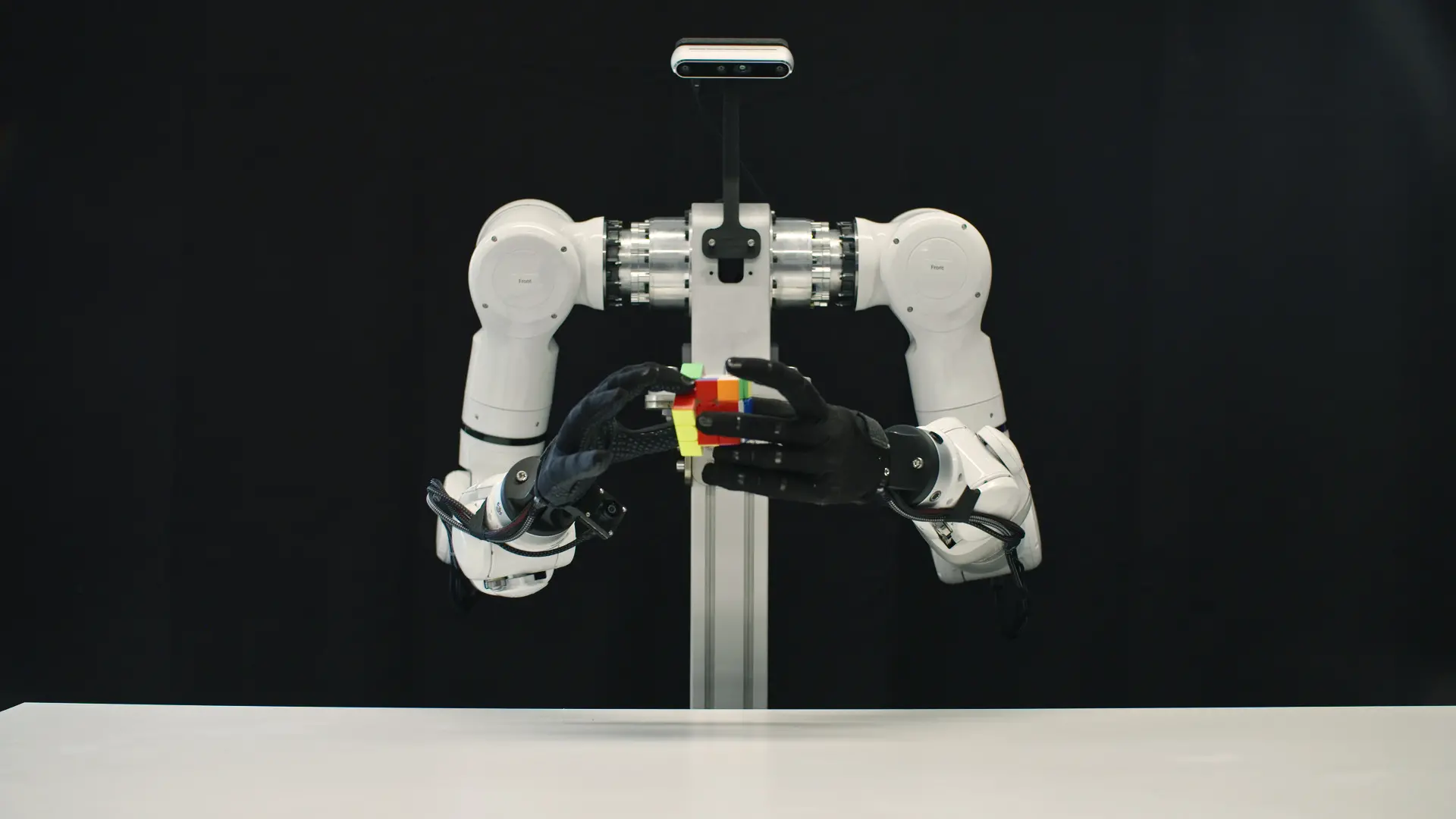
French robotics-focused startup Genesis AI has made its debut in the artificial intelligence landscape with the release of its first foundational model, GENE-26.5, accompanied by a human-like robotic hand developed entirely in-house. The hand is designed to execute complex operations, from preparing a meal to solving a Rubik's Cube, signaling the company's ambition to bridge the gap between digital intelligence and physical action.
The launch marks a significant milestone for the company, which completed a $105 million (£77.2 million) seed funding round in July last year. According to co-founder and CEO Zhou Xian, the original mission was to develop a model capable of powering real-world robotics. However, the team quickly realized that controlling the entire stack would require owning the hardware as well. This realization led to the construction of their own robotic hand, giving them greater precision over data collection, model training, and real-world deployment.
Design philosophy: human-like form factor
One of the most striking aspects of Genesis AI's robotic hand is its design. While many robotics companies have developed grippers with two or three fingers optimized for specific industrial tasks, Genesis has chosen a form factor that closely mirrors the human hand. This anthropomorphic approach is not merely aesthetic; it enables data collected from human demonstrations to be transferred more directly to the robotic system. The company argues that this resemblance is critical for tasks that require dexterity, nuance, and adaptability.
Human hands are incredibly complex instruments, with 27 bones, numerous joints, and a dense network of sensors and muscles that allow for a vast range of motion. Replicating that complexity in a robotic appendage is a formidable engineering challenge. Genesis AI's in-house design aims to capture not just the gross motor skills but also the fine motor control needed for delicate operations. The result is a hand that can grasp, manipulate, and interact with objects in ways that more simplistic robotic grippers cannot.
The decision to build the hand themselves also reflects a broader trend in robotics. Companies are increasingly recognizing that off-the-shelf hardware may not be sufficient for cutting-edge AI research. By controlling the design and manufacturing, Genesis can iterate quickly and optimize the hardware-software interface. This vertical integration is a competitive advantage in a field where the gap between simulation and real-world performance is a major hurdle.
From hands to data: sensor gloves
In addition to the robotic hand, Genesis has introduced lightweight sensor gloves designed to be worn by human workers. These gloves are intended for environments such as pharmaceutical manufacturing and industrial production, where capturing precise hand movements is valuable. The data collected from these gloves can be fed into the AI model, helping it learn from human demonstrations. The company states that glove data can also be combined with video footage of workers performing tasks, providing a richer dataset for training.
This approach is part of a broader methodology known as imitation learning, where AI systems learn by observing and mimicking human behavior. For robots to become truly useful in homes, hospitals, and factories, they must be able to perform tasks that humans find intuitive but machines find incredibly difficult. By amassing high-quality demonstration data, Genesis aims to accelerate the learning curve of its models.
However, the introduction of sensor gloves raises an important social question: would workers be willing to contribute to the training of robotic replacements? The prospect of wearing devices that effectively teach a machine to do one's job is understandably fraught. Genesis acknowledges this concern but argues that the technology is still in its early stages and that the goal is to augment human capabilities, not necessarily replace them. Nonetheless, the debate over automation and job displacement is central to the robotics industry's future.
Demonstrating dexterity
In a demonstration video released by the company, Genesis's hands are shown performing intricate tasks that require a high degree of coordination. The hands prepare a smoothie, manipulate ingredients, and even play the piano. These demonstrations are intended to showcase the versatility and precision of the system. While such videos are often carefully staged, they provide a glimpse into the potential of general-purpose robots.
The ability to perform both domestic and artistic tasks is a hallmark of general-purpose robotics. Unlike specialized machines designed for a single function, a general-purpose robot must adapt to a wide range of environments and challenges. The piano-playing demo, in particular, highlights the need for precise timing, force control, and finger independence—qualities that are extremely difficult to engineer.
Leadership and transatlantic presence
Genesis AI was founded by a team with deep roots in both academia and industry. Co-founder and president Theophile Gervet previously worked at France's Mistral AI, one of Europe's most prominent artificial intelligence startups. This background gives Genesis a strong connection to the European AI ecosystem. The company maintains a significant presence in Europe, citing the continent's rich talent pool and the potential for industrial customers across manufacturing, healthcare, and logistics.
The team of 60 employees is split roughly evenly between the United States and Europe, with a slightly larger group based in San Carlos, California. The company also maintains offices in Paris and London. This transatlantic structure allows Genesis to tap into two of the world's leading AI research hubs while staying close to potential markets in both regions. Europe, in particular, has a strong industrial base that could benefit from robotic automation, and Genesis is positioning itself to serve that demand.
Toward a full-body robot
While the robotic hand is a significant achievement, Genesis has made it clear that this is only the beginning. The company is currently working on supplementing the mechanical hand with a full-body, general-purpose robot. Such a robot would combine the dexterity of the hand with mobility, enabling it to navigate real-world environments and perform tasks that require whole-body coordination. This is an ambitious goal that will require advances in locomotion, manipulation, and AI planning.
The development of full-body robots is one of the most exciting frontiers in robotics. Several companies are racing to build humanoid machines that can operate in spaces designed for humans. The challenges are immense, from balance and stability to energy consumption and safety. However, the potential applications are equally vast, ranging from home assistance to disaster response and elderly care.
Genesis's strategy of starting with a hand and then expanding to a full body is notable. Many robotics companies begin with bipedal locomotion and then add manipulation capabilities. By focusing first on the hand, Genesis is prioritizing the most complex and nuanced aspect of physical interaction. This could give it an edge in developing robots that are truly useful for delicate tasks, which are often the most difficult to automate.
Strong financial backing
The company's $105 million seed round is among the largest ever for a robotics startup. The round was co-led by Eclipse and Khosla Ventures, two prominent venture capital firms known for backing transformative technology. Additional backing came from Bpifrance, HSG, former Google chief Eric Schmidt, telecoms entrepreneur Xavier Niel, MIT Computer Science and Artificial Intelligence Laboratory director Daniela Rus, and Apple distinguished scientist Vladlen Koltun. This impressive list of investors reflects the high expectations surrounding Genesis AI.
Having such substantial funding at the seed stage gives Genesis the resources to pursue a capital-intensive strategy. Building custom hardware, training large-scale models, and hiring top talent all require significant investment. The backing of strategic investors like Eric Schmidt and Daniela Rus also provides invaluable expertise and connections in the AI and robotics communities.
The investment landscape for AI and robotics has been exceptionally active in recent years. Foundation models that power physical systems are seen as the next major growth area after large language models. Genesis is positioning itself at this intersection, aiming to create what some researchers call the "operating system" for general-purpose robots. While the road ahead is long and filled with technical hurdles, the combination of a strong team, substantial funding, and a clear vision makes Genesis a company to watch.
The company's emphasis on human-like form, data collection, and full-stack control distinguishes it in a crowded field. As it continues to develop its technology and expand its team, the robotics community will be watching closely to see whether its approach pays off. For now, Genesis AI has taken a significant first step with the launch of GENE-26.5 and its remarkable robotic hand.
Source: Silicon UK News