

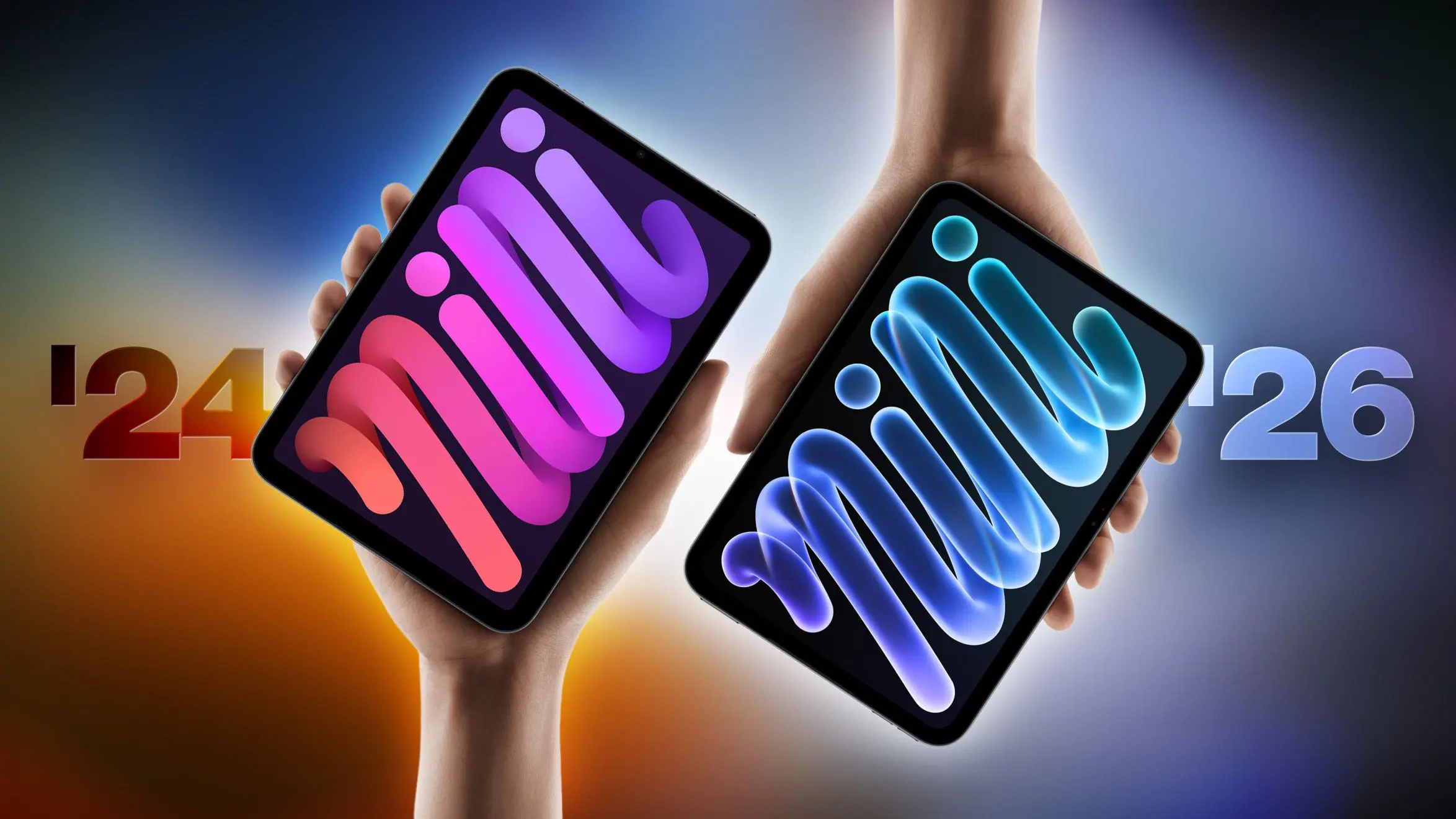
iPad mini 2024 vs. 2026: What Changed and Should You Upgrade?
Apple has announced the eighth-generation iPad mini, shifting the compact tablet to a larger OLED display, a thinner and lighter design, the A20 Pro chip, and IP67 water and dust resistance. The new model starts at $699 for 128GB Wi-Fi and $849 for cellular. With the previous generation discontinued, buyers must weigh the new features against remaining A17 Pro stock or second-hand options. The two devices share storage capacities, advertised battery life, Touch ID authentication, and USB-C transfer speeds, so the 2026 model is not a clean sweep across every specification.
Key Facts
- The 2026 iPad mini has an 8.5-inch Super Retina XDR OLED display, while the 2024 model uses an 8.3-inch Liquid Retina IPS LCD panel.
- The new display has 2316-by-1512 resolution, 600 nits SDR and full-screen HDR brightness, 1,200 nits peak HDR brightness, and a 2,000,000:1 contrast ratio.
- Display borders are 24 percent thinner on the 2026 model.
- Nano-texture glass is optional on 256GB and 512GB models for an extra $100 and includes a polishing cloth.
- The A20 Pro chip uses a 2-nanometer process, has a 7-core GPU, and offers CPU and Neural Engine configurations that vary by storage capacity.
- Apple claims up to 60 percent faster multithreaded CPU performance, up to 2.7 times faster graphics, and up to 4.5 times faster AI performance over the A17 Pro model.
- The 2026 iPad mini is about 14 percent thinner, and the Wi-Fi model is about 13 percent lighter.
- It adds IP67 water and dust resistance, a landscape Center Stage front camera, Wi-Fi 7, Bluetooth 6, Thread networking, and Apple's C2 5G modem on cellular models.
- Battery capacity is slightly lower at 18.9Wh versus 19.3Wh, but advertised battery life is unchanged. Fast charging reaches about 50 percent in around 30 minutes with a 35W or higher USB-C adapter.
- Prices start at $699 for Wi-Fi and $849 for cellular, compared with the previous model's original $499 starting price and later $599 Wi-Fi starting price.
Display and Design
The most visible change is the screen. The 2024 iPad mini uses an 8.3-inch Liquid Retina display with LED backlighting and IPS technology. The 2026 model moves to an 8.5-inch Super Retina XDR OLED panel. That shift should bring deeper blacks, higher contrast, and better HDR viewing. The resolution rises from 2266-by-1488 to 2316-by-1512. Brightness also increases: the older model peaks at 500 nits, while the new model reaches 600 nits for SDR and full-screen HDR content, with up to 1,200 nits peak HDR brightness. The contrast ratio is listed at 2,000,000:1, and minimum brightness is 1 nit.
Apple has reduced the display borders by 24 percent, giving the tablet a more modern front view without changing the overall height much. The 2026 model measures 7.69 inches tall, 5.22 inches wide, and 0.21 inch thick, compared with 7.69 inches tall, 5.3 inches wide, and 0.25 inch thick for the 2024 model. The Wi-Fi version weighs 0.56 pound (255 grams) instead of 0.65 pound (293 grams). The cellular version weighs 0.58 pound (263 grams) instead of 0.66 pound (297 grams). That makes the new tablet roughly 14 percent thinner, about 13 percent lighter in Wi-Fi form, and about 11 percent lighter with cellular.
Buyers who want less glare can choose nano-texture display glass on the 256GB and 512GB models for an additional $100. The option comes with a polishing cloth. Apple also adds an extended external display mode with iPadOS 27.2, a feature that did not appear on the previous model. The 2026 device carries IP67 water and dust resistance, rated for a maximum depth of 1 meter for up to 30 minutes. The 2024 model does not list that protection.
Performance and Chip Details
The 2024 iPad mini uses the A17 Pro chip on a 3-nanometer process with a 6-core CPU, two performance cores, four efficiency cores, a 5-core GPU, and a 16-core Neural Engine on every storage tier. It has 8GB of unified memory and 51.2 GB/s of memory bandwidth.
The 2026 iPad mini moves to the A20 Pro chip on a 2-nanometer process. Its configuration depends on storage. The 128GB and 256GB models have a 5-core CPU with two super cores and three efficiency cores, while the 512GB model has a 6-core CPU with two super cores and four efficiency cores. All versions have a 7-core GPU with dedicated Neural Accelerators in each GPU core. The Neural Engine is 16 cores on the 128GB and 256GB models, while the 512GB model gets a dual 16-core Neural Engine for 32 cores total. Apple says unified memory capacity has increased but has not disclosed the exact amount. Memory bandwidth doubles to 115.2 GB/s.
Apple's claimed maximum improvements over the A17 Pro model include up to 60 percent faster multithreaded CPU performance, up to 2.7 times faster graphics performance, and up to 4.5 times faster AI performance. Those figures are peak claims, not guarantees for every app or workload. The storage-based chip split is unusual for an iPad mini and gives the 512GB model a clear hardware advantage beyond capacity alone.
Cameras, Audio, and Connectivity
The front camera moves from portrait orientation to landscape orientation, which is better suited to video calls while the tablet is docked to a keyboard or held horizontally. Both models use Center Stage, but the new camera has an f/2.0 aperture instead of f/2.4. The rear flash changes from True Tone to Adaptive True Tone.
Audio also changes. The 2024 model uses landscape stereo speakers with external speaker holes. The 2026 model uses Acoustic Display technology with display-coupled woofers and concealed tweeters, removing the external speaker holes. Wireless connectivity moves from a third-party module to Apple's N1 wireless networking chip, Wi-Fi 6E to Wi-Fi 7, and Bluetooth 5.3 to Bluetooth 6. The new model adds Thread networking technology.
Cellular models switch from the Qualcomm Snapdragon X70 5G modem to Apple's C2 5G modem. Apple says cellular data speeds can be up to 50 percent faster. The U.S. cellular model changes from A2995 with support for 5G band n76 to A3596 with support for LTE band 106. The older model lists UMTS, HSPA, HSPA+, and DC-HSDPA support, while the new model lists UMTS, HSPA, and HSPA+ support. Battery capacity dips from 19.3Wh to 18.9Wh, but advertised battery life remains the same. Fast charging is new and reaches about 50 percent in around 30 minutes with a 35W or higher USB-C power adapter.
Colors, Accessories, and Pricing
The 2024 iPad mini comes in Space Gray, Starlight, Purple, and Blue. The 2026 model is available only in Midnight and Starlight. The older polyurethane Smart Folio design gives way to a redesigned two-panel TechWoven Smart Folio with adjustable viewing angles. It is sold separately in Navy Blue and Taupe for $79. The new tablet has 35 percent recycled content overall, up from more than 25 percent on the previous model.
Pricing has moved upward. The 2024 iPad mini originally started at $499 for Wi-Fi and $649 for Wi-Fi plus cellular. The Wi-Fi starting price later increased to $599 before the model was discontinued. The 2026 iPad mini starts at $699 for 128GB Wi-Fi and $849 for cellular. Both generations share the same storage capacities and advertised battery life, and both support Apple Pencil and USB-C transfer speeds that are unchanged.
Should You Upgrade?
Most A17 Pro iPad mini owners can comfortably keep their current device. The new model offers the same advertised battery life, storage capacities, Apple Pencil support, and USB-C transfer speeds. If the existing tablet still meets everyday needs, there is little reason to upgrade for general performance alone. The A17 Pro remains capable for reading, browsing, note-taking, and video playback.
The larger OLED display is the strongest reason to consider replacing an A17 Pro model, especially for people who watch video or read frequently. The thinner and lighter design may also matter for anyone who holds the tablet for long periods. Nano-texture glass could appeal to users who face distracting reflections or read outdoors, but it raises the cost because it requires at least 256GB of storage and adds $100 to the price. The landscape camera, water resistance, and fast charging are useful additions, but they are unlikely to justify an upgrade on their own. A replacement makes more sense when several of these changes address specific limitations.
Which Model Should You Buy?
For most new buyers, the A20 Pro model should be the starting point. The OLED display and new design are its main advantages, and both affect daily use more than the chip for many people. The A17 Pro model may still be worth considering when it offers substantial savings. It retains many of the same capabilities and remains sensible for reading, browsing, taking notes, and watching videos, even though it uses an older design.
For the A20 Pro model, buyers should remember that the 256GB version unlocks nano-texture glass, while the 512GB version adds a CPU core and a second Neural Engine. The 128GB and 256GB models have a 5-core CPU and a 16-core Neural Engine, while the 512GB model has a 6-core CPU and a 32-core Neural Engine. That makes the top storage tier as much a performance choice as a capacity choice, and it is the final specification difference that separates the 2026 lineup from the single-chip configuration of the 2024 model.
Source: MacRumors News