

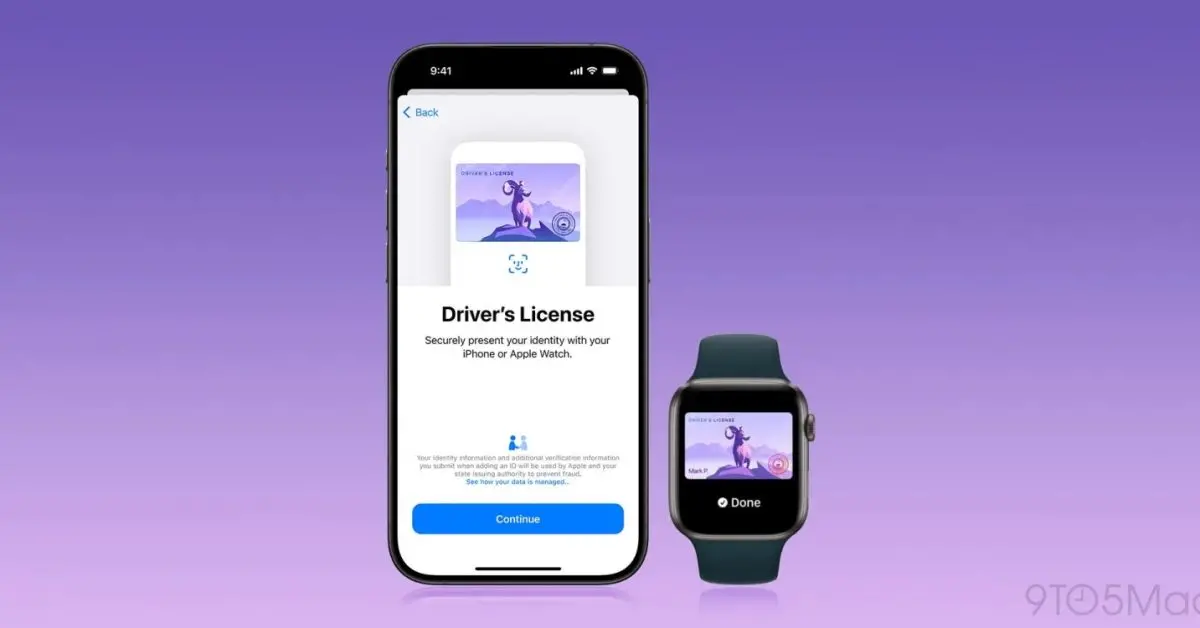
The ability to carry a digital version of your driver's license on your iPhone is about to expand to a 15th US state. Hidden assets discovered in the backend of Apple's systems suggest that Oklahoma will soon join the growing list of states that support this feature in the Wallet app.
Apple first introduced the concept of a digital driver's license and state ID in 2021 during its Worldwide Developers Conference. The company envisioned a future where users could store official identification documents securely on their iPhone and Apple Watch, eliminating the need to carry physical cards. Since then, adoption has been gradual, with states needing to pass legislation, integrate with Apple's system, and test the technology at official acceptance points such as airport security checkpoints.
Currently, Apple officially lists 14 US states and one territory where the digital ID feature is supported. These include Arizona, Arkansas, California, Colorado, Georgia, Hawaii, Illinois, Iowa, Maryland, Montana, New Mexico, North Dakota, Ohio, and West Virginia, plus the territory of Puerto Rico. The addition of Oklahoma would mark a significant milestone, bringing the total to 15 states and one territory.
How the digital driver's license works
To add a driver's license or state ID to the Wallet app, users open the app on their iPhone and tap the plus (+) button. They then select 'Driver's License or State ID' and follow the on-screen instructions. This typically involves scanning the front and back of the physical card using the iPhone's camera, followed by a series of facial movements to verify identity. Apple uses a secure enclave to store the data, ensuring that the information never reaches the cloud without user consent.
Once added, the digital ID can be presented at participating TSA checkpoints at airports. Users simply tap their iPhone or Apple Watch on the identity reader, and the required information is transmitted wirelessly. The system uses a dedicated communication channel that does not require the device to be unlocked, preserving security and convenience.
Privacy and security advantages
One of the most appealing aspects of the digital driver's license is the privacy it offers. When a user needs to prove their age—for example, when purchasing alcohol or entering an age-restricted venue—the iPhone can verify that the person meets the age requirement without revealing their exact date of birth or home address. This selective disclosure capability is built into the Wallet app's architecture, using cryptographic measures to share only the necessary data.
Apple has designed the system to be tamper-resistant. The digital ID is protected by the device's biometric authentication (Face ID or Touch ID), and the information is encrypted end-to-end. Even if the iPhone is lost or stolen, the thief cannot access the digital ID without the owner's biometrics.
Current limitations and future outlook
Despite its convenience, the digital driver's license is not yet a complete replacement for the physical card. Law enforcement agencies, car rental companies, and many other organizations are not equipped to accept digital IDs. Apple advises users to continue carrying their physical driver's license for most situations. The digital version is primarily useful at TSA pre-check lanes and for age verification at businesses that have compatible readers.
As more states come onboard, the acceptance infrastructure is expected to grow. Oklahoma's potential addition is a positive sign that momentum is building. Other countries, including the United Kingdom and Canada, are also exploring similar digital identity frameworks, though Apple's system is specifically designed for US state-issued IDs.
The gradual rollout reflects the complexity of coordinating with state governments and ensuring that the technology meets strict security standards. Each state must pass laws to authorize digital IDs, and then test the system with Apple. Some states, like California and Colorado, were early adopters, while others have taken longer to integrate.
Behind the scenes, Apple continues to improve the Wallet app's capabilities. Recent versions of iOS have added support for multiple IDs, better integration with airline apps, and enhanced privacy controls. The company is also working on expanding the use of digital IDs to other contexts, such as hotel check-ins and office building access.
For now, iPhone users in Oklahoma may soon be able to experience the convenience of a digital driver's license. The backend assets spotted by developers indicate that the state is in the final stages of preparation, with an official launch expected in the coming weeks or months. When it arrives, Oklahomans will join the growing number of Americans who can leave their physical wallet at home when traveling through participating airports or visiting businesses that support Apple's digital ID system.
The journey from a single state to fifteen has taken several years, but the pace of adoption appears to be accelerating. With each new state, the network effect strengthens, encouraging more retailers, airports, and government agencies to invest in compatible reader hardware. In time, the digital driver's license could become as ubiquitous as the physical card, but that day may still be years away.
Apple has also introduced other identity-related features in the Wallet app, such as storing hotel room keys, corporate badges, and student IDs. The driver's license is just one part of a broader vision to make the iPhone the single device that carries all of a user's essential credentials. Privacy advocates have praised the selective disclosure features, while security experts note that the system is more resistant to fraud than physical cards, which can be forged or tampered with.
On the technical side, the digital ID uses a combination of NFC, Bluetooth, and a dedicated chip that ensures the data is only transmitted when the user authorizes it. The phone must be authenticated via Face ID or Touch ID before any information is shared, preventing unauthorized access even if the device is stolen. Apple also provides a mechanism to remotely suspend the digital ID if the iPhone is reported lost, adding another layer of security.
At the state level, the adoption of digital driver's licenses often involves collaboration with the Department of Motor Vehicles or equivalent agency. The process includes testing the system with real users to ensure reliability. Some states have chosen to offer the digital ID as an optional supplement, while others are considering making it a primary form of identification once legal frameworks are updated.
The addition of Oklahoma is particularly noteworthy because it represents a central state that could serve as a model for other non-coastal states that have been slower to adopt the technology. If successful, it might encourage neighboring states like Missouri, Kansas, and Texas to consider similar implementations.
For consumers, the benefits are clear: reduced need to carry a physical wallet, faster airport security processing, and enhanced privacy when proving age or identity. However, it is essential to understand that the digital ID does not replace the physical card entirely. Most legal requirements for identification still mandate a physical document, and it will be some time before digital versions are universally accepted.
Apple's ongoing work with state governments and transportation authorities suggests that the company is committed to making digital IDs a standard feature. The discovery of Oklahoma in the backend assets is a strong signal that the list will continue to grow, bringing the convenience of a digital driver's license to more Americans.
In the meantime, users in the 14 current states and Puerto Rico can take advantage of the feature, while those in Oklahoma prepare for its imminent arrival. As with any new technology, early adopters will benefit from the latest capabilities, and over time the infrastructure will expand to make the digital ID a truly mainstream option.
Source: 9to5Mac News