

Key facts at a glance
- OpenAI has bought tens of thousands of Mac mini and Mac Studio systems during recent months, according to a report.
- The systems are used for reinforcement learning and training computer-use agents.
- OpenAI's purchases focus on configurations without displays or keyboards, so the Macs can run as dedicated infrastructure.
- Anthropic is reportedly renting Mac mini capacity through Amazon Web Services rather than buying machines outright.
- Apple's unified memory architecture and active cooling make Macs suitable for sustained AI workloads.
- Large-scale foundation model training still depends mainly on Nvidia GPU clusters; Macs fill a narrower agentic AI role.
- Apple's Mac business generated about $10.4 billion in the company's latest quarter, up 29% year over year.
- Nvidia reportedly sees Apple as a major competitor in local AI, while PC makers ASUS and MSI have exhausted early stock of Nvidia-based compact AI systems.
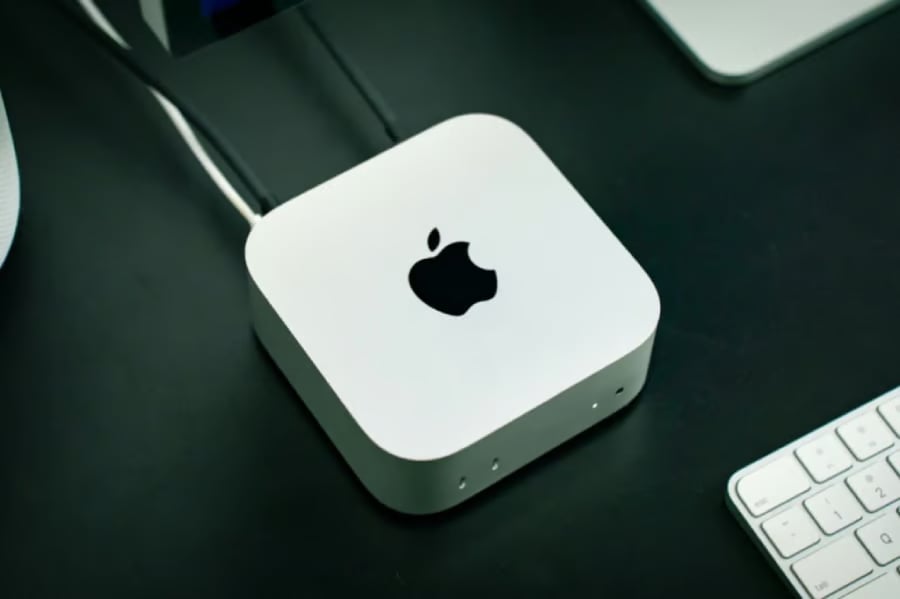
OpenAI has reportedly bought tens of thousands of Apple Mac mini and Mac Studio computers during the past several months. The machines are not destined for developers, video editors, or typical desktop users. Instead, they are being integrated into AI infrastructure for reinforcement learning and for training computer-use agents. The purchases are largely for configurations without displays or keyboards, enabling the computers to be treated as headless nodes in large automated systems.
Computer-use agents are AI systems designed to operate software the way a human would. They can move a cursor, open applications, type text, read what is on a screen, click buttons, navigate menus, and complete multi-step workflows. This is radically different from the large language model experience that most people are familiar with, where an AI produces text inside a chat window. In agentic AI, the model must understand what is happening on a screen, decide what action to take next, and then receive feedback from the operating system or the user. Over time, via reinforcement learning, the agent can learn which sequences of actions lead to success and which lead to errors.
Why Apple hardware matters for agentic AI
The choice of the Mac mini and Mac Studio can be explained by the hardware characteristics of Apple silicon. Most AI workloads have long been associated with Nvidia GPUs in server racks. But computer-use agents demand something different. An agent needs to interact with a full operating system, run applications, render screens, and execute actions through the OS. A conventional GPU server is not necessarily the best environment for those tasks because most large-scale AI systems are optimized for batches of pure compute, not for constantly switching between an AI model and a desktop interface.
Apple's unified memory is one major advantage. In a conventional PC or server, the CPU has one pool of system memory and the GPU has its own separate video memory. Data has to cross a bus between the two, which costs time and energy. Apple silicon uses a single memory pool that the CPU, GPU, and Neural Engine can all access. For workloads where a model is repeatedly invoked to produce output and then interact with system-level applications, this shared architecture reduces the need to copy data between separate memory spaces.
The Mac mini and Mac Studio also offer active cooling. A fan allows the chips to maintain sustained performance over hours or days of continuous use. Laptops are limited by heat dissipation and battery size. Desktop Macs can be stacked, mounted, or placed on shelves inside an AI operation, making them more practical for dedicated agent-training jobs. The exact split between Mac mini and Mac Studio purchases was not disclosed, but both systems can be ordered with high-memory configurations that make them useful for running multiple AI workloads at once.
Not a replacement for GPU clusters
This does not mean Apple is about to replace a giant Nvidia GPU cluster. Foundation model training remains far more compute-intensive and mostly depends on specialized accelerators. Training a frontier model requires thousands of GPUs working in parallel over weeks. The Mac mini and Mac Studio are not designed for that kind of massive distributed compute. But for workloads that require memory capacity, operating-system access, and the ability to run isolated virtualized environments, Macs are well positioned.
The Mac mini is a relatively small, quiet desktop that can run macOS, spin up virtual machines, and execute a wide range of programs. For AI safety and computer-use research, the ability to run many isolated environments is valuable. An AI agent may need to be tested in a clean virtual machine, and if it makes a mistake that corrupts the system, the environment can be discarded and replaced. This workflow is common in browser-agent research and software engineering tasks. By buying tens of thousands of units, OpenAI can create a large pool of endpoints capable of executing agent interactions in parallel.
Anthropic and the growing Mac farm trend
The appeal is not unique to OpenAI. Anthropic is reportedly pursuing a similar strategy, although it is renting Mac mini capacity through Amazon Web Services rather than purchasing the systems directly. That detail is important because it suggests cloud providers are beginning to include Mac mini instances or bare-metal Mac rentals in their AI offerings. It also points toward a secondary market for Apple hardware as an infrastructure product.
The reported trend shows that AI companies are willing to treat desktop hardware as a service. Rather than asking every researcher to own a Mac, these organizations centralize the hardware, connect it to their infrastructure, and use it for specific agentic AI tasks. This approach can be cheaper and more flexible than building a custom cluster of GPU servers for tasks that do not actually require massive GPU parallelism.
Supply pressure and Apple's Mac business
Apple is reportedly dealing with high demand for higher-memory Mac configurations. The Mac business generated about $10.4 billion in the company's latest quarter, up 29% from a year earlier. The growth is evidence that Macs are no longer driven solely by traditional consumers and creative professionals. Some of the increased demand may be coming from enterprises and AI labs that see Apple silicon as a way to run local models and complex agents on machines with lower power draw.
The reported surge in enterprise demand also appears to have changed Apple's product release schedule. The company is said to have announced new Mac mini and Mac Studio models earlier than it usually would. Those refreshed machines place extra emphasis on running AI models locally and connecting multiple systems. This shift in marketing and product direction is meaningful. Macs were once marketed mainly as creative workstations for video editors, music producers, and software developers. Now Apple is positioning the Mac as a local AI platform, and the hardware buying patterns of OpenAI and Anthropic suggest that the message is resonating with an unexpected customer segment.
Nvidia and the race for local AI infrastructure
Nvidia reportedly views Apple as a major competitor in local AI. Nvidia has been building out a portfolio of products for edge and desktop AI, including the DGX Spark, a compact AI system for developers. The emergence of Macs as AI infrastructure tools challenges the assumption that accelerated AI workloads have to run on Nvidia GPUs. Memory capacity and memory bandwidth are becoming some of the most important factors in local AI model performance. Apple has been expanding the maximum memory available in its desktop machines, while also optimizing its software stack for large language models.
The response from hardware manufacturers suggests that the demand for dedicated AI desktops is broader than just a cloud datacenter problem. ASUS and MSI, two major PC makers, have reportedly already exhausted their initial allocations of Nvidia-based compact AI systems and are seeking additional supply. This shows that the AI market is not only about frontier data centers. Developers, researchers, and enterprises need machines that can run agents, fine-tune small models, and process private data on site.
An unexpected infrastructure player
For Apple, the trend is both an opportunity and an enormous challenge. The company has historically sold Macs to individuals and to companies that need employee endpoint devices. Apple's enterprise sales traction has grown over the years, largely through the iPhone and a secure device-management ecosystem. But selling thousands of Macs to an AI lab as computational infrastructure is different from selling laptops to employees. Enterprise customers that buy Macs by the tens of thousands are likely to demand enterprise-grade remote management, API-based provisioning, specialized support SLAs, and software tools built for cluster-style Mac operations.
Apple has not always excelled at catering to raw infrastructure buyers. It prefers simple product lines, polished consumer experiences, and tightly integrated hardware and software. The scale of OpenAI's projected purchases could be lucrative, but it also raises questions about whether Apple is ready to support this new class of customer. AI labs are beginning to treat Macs not as personal computers but as bare-metal machines with macOS running many small virtualized sessions. If this adoption curve continues, Apple may need to make macOS and Apple silicon more friendly to orchestration, monitoring, remote boot, and automated provisioning. It may also need to develop a dedicated enterprise AI team or channel strategy.
The real significance of the OpenAI Mac purchase goes beyond a single company's hardware order. It is a sign that AI infrastructure is diversifying. For years, most AI scaling stories were about enormous data centers packed with Nvidia GPUs. But agentic AI introduces new requirements: operating system interaction, screen understanding, user-interface automation, and recovery from errors. These functions are best performed on systems that can run a full operating system and interact with software that has not been redesigned for AI.
Apple has stumbled into a potentially important opportunity. The company did not set out to build an AI compute platform analogous to Nvidia's DGX infrastructure. It built Macs for creative professionals, and the hardware's unified memory architecture turned out to be valuable for AI agents. If agentic AI continues to grow, the ability to supply thousands of Macs and support them in data center environments will matter as much as raw chip performance.
Source: TechRepublic News