

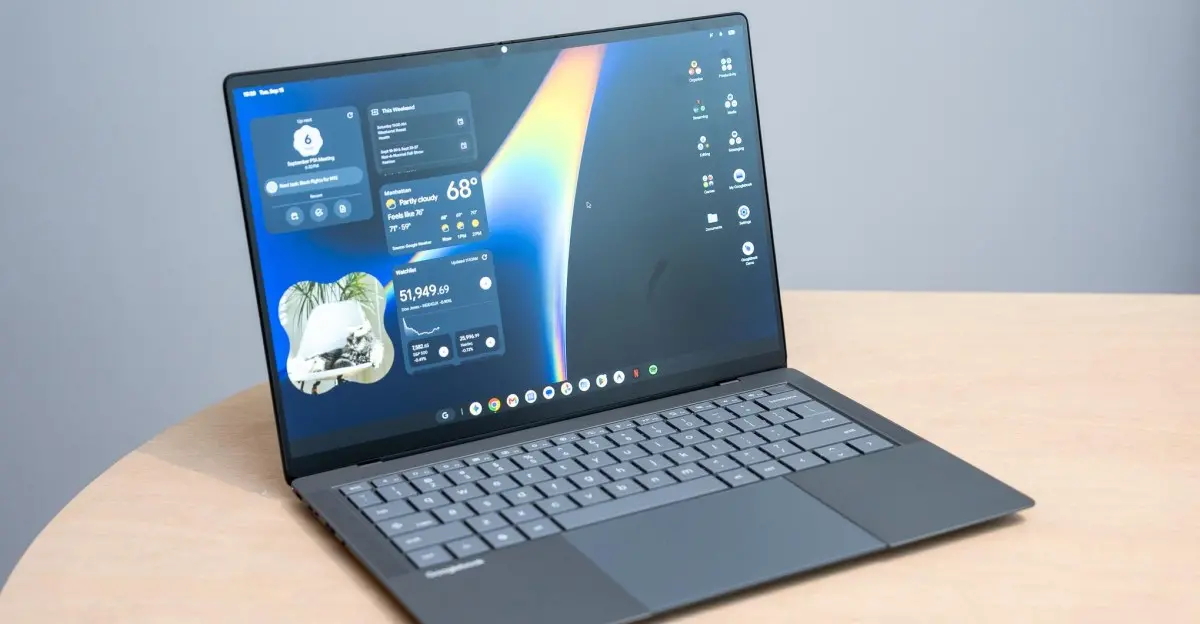
Googlebooks have arrived. The first models went on sale on Sunday, October 4, and review units of all five launch devices were in hand roughly 24 hours later. That short window was enough to begin putting the laptops through their paces and to form an early picture of what it is like to use an Android laptop built around a phone. The immediate takeaway is that Googlebooks are exciting for Android phone owners but still underbaked. They show real promise, yet they also reveal a long road ahead before the platform feels finished.
At first glance, Googlebooks feel very Chromebook-ish. In some moments they even feel a little janky. But Google has introduced some genuinely interesting ideas about how a laptop and a phone should interact. Windows laptops can already link to a phone for notifications, and macOS can mirror an iPhone, but Googlebooks let you take actions on your phone from your laptop in a way that feels natural. When it works, of course. Here are the early observations: the good, the bad, and the weird.
Android phone integrations are slick
Googlebooks revolve around using an Android phone, and Google's execution here is impressive. Setting up a Googlebook with an Android phone is simple and painless. The out-of-box experience is intuitive. It prompts you to pair your phone by scanning a QR code, sign into your Google account, and then download some of the apps you have already installed on your phone. The process is similar to recent Chromebooks, but it feels more focused and intuitive.
Casting apps from your phone, migrating a task from your phone to your laptop with a single click, accessing your phone files on your laptop, and getting your phone notifications on your laptop all work well. These are smart ideas that let you keep your focus on your laptop while you work. Some of them are rough around the edges, in some cases literally.
App casting allows you to use your phone apps directly on a Googlebook. It feels natural to launch them straight from an app drawer on the laptop instead of mirroring your whole phone screen. But it also means your two separate app drawers on a Googlebook will have duplicate apps. There is nothing to stop you from running a desktop version and a mobile version at the same time, even with Chrome. That should be easily ignorable, but clicking on synced notifications, such as Slack, can open a casted app instead of a web app or native app on the Googlebook. Casted apps sometimes have pixelated text or oddly proportioned UI. They also look and feel just a touch sluggish in animations and scrolling compared to native desktop apps.
Google's Continue On feature, which temporarily pins an app you are using on your phone to the Googlebook taskbar, is super neat. If you open a spreadsheet on your phone, you can easily transfer it over to the laptop with one click. That is brilliant. Except most apps tried did not sync over to the Googlebook with that functionality, not even Google Maps or Calendar. It seems mostly for Google Docs and Sheets for now, and it is awesome for those. Lastly, pulling files directly off your phone from your laptop just works. That part is great.
The Glowbar is fun but not incredibly useful
A little fanfare when you close the lid is nice, but the Glowbar does not do much. Google's Glowbars on these laptops offer Googlebooks a signature flair, but they are limited. The light strip is on the lid, facing away from you, and it is normally illuminated white while you use the laptop. It alternates colors when you talk to Gemini, and closing the lid temporarily displays a Google-y rainbow before it sleeps.
The most useful function is that it shows the laptop charge level. But it would be better with some cool animated lights to show a trickling charge while the lid is closed. Instead, it just pulses a few times with green, yellow, or red light to give an approximate charge level when you plug in or unplug a power cable. The Glowbar that actually faces you on Lenovo's optional AI Mouse is just a glorified RGB strip that you pick the colors for. It does not sync up to the lid lights.
These little light strips are just begging to be tinkered with. Google should do much more here. At minimum, it could start by showing a constant charge level that slowly fills up the strip.
Android apps are still a mixed bag, even with new desktop ratings
Google is now flagging Play Store apps with desktop ratings, which is a welcome idea. Browsing apps on a Googlebook classifies them in five categories: Made for desktop, Optimized for desktop, Compatible with desktop, Better on the website, and Built for mobile. Unfortunately, not many Made for desktop apps exist outside of core Google ones and a few other examples like CapCut Pad and BandLab.
The Optimized for desktop and Compatible with desktop designations seem a little loose. Apple Music is optimized, but it does not respond to right-clicks. Only a click-and-hold brings up a context menu. Firefox is compatible, which means it works with standard mouse and keyboard controls, yet it does not respond to keyboard shortcuts for creating, deleting, or switching tabs. As expected, Googlebooks are best used with Google's Chrome.
An app like Slack, which is acknowledged as Better on the website, is best used as a progressive web app install, just as it was on ChromeOS. But the web app could not be installed at first while following the usual procedure familiar from Chromebooks. After several attempts and starting from scratch by loading up slack.com, Chrome eventually prompted to install it. There was another inconsistency: on one Googlebook it saved with the Slack logo, while on another it saved with just a generic S icon.
It still feels like a speedy Chromebook with nifty new phone integrations
If you had never heard of Googlebooks and were dropped in front of one of these laptops, you might figure ChromeOS just got a nice upgrade. They feel very Chromebook-ish. That is not really a bad thing, because Chromebooks have been enjoyable for relatively fuss-free web use. But that also means Googlebooks come with some old trappings of ChromeOS.
Just like on Chromebooks, Chrome on Googlebooks does not support separate Google accounts. You can have multiple Google accounts signed into the Googlebook, but there is no wall between their browsing, bookmarks, and settings on Chrome like there is on Windows and macOS. That limitation may not matter to casual users, but it is a notable missing piece for anyone who shares a device or wants strong separation between work and personal profiles.
The quirks that really irk
App folders and right-click menus opened on the desktop do not overlay above your windows, so they are often partially hidden. They stay open until you click on the desktop. They act this way on all the Googlebooks tested, whether using the mouse or using touch. That is a basic interaction problem that makes the desktop feel unfinished.
Another frustration is keyboard remapping. It is not possible to remap the Caps Lock key to Ctrl on a Googlebook, even though that worked just fine on ChromeOS. In fact, none of the remappings for Ctrl, Caps Lock, Alt, or Action, the Google G key, seem to work on the built-in keyboard. They are only remapped on external keyboards, despite the fact that the OS setting for Modifier keys is listed under Physical keyboards. This was confirmed by plugging in a mechanical keyboard. Android does not seem to account for the keyboards built into these Googlebooks. For people with specific muscle memory, this is maddening.
One attempt to work around the problem involved having an AI coding tool create an Android app to remap Caps Lock to Ctrl. After several failed attempts and a software-bricked HP keyboard, the effort was abandoned. The HP Googlebook keyboard worked again after uninstalling the useless app and restarting the laptop.
What the early experience says about Google's broader strategy
Googlebooks are entering a crowded and complicated market. Chromebooks already own a large share of the education and budget laptop space. Windows laptops dominate productivity and gaming. MacBooks dominate premium creative work and retain a loyal following. Googlebooks are
Source: The Verge News