

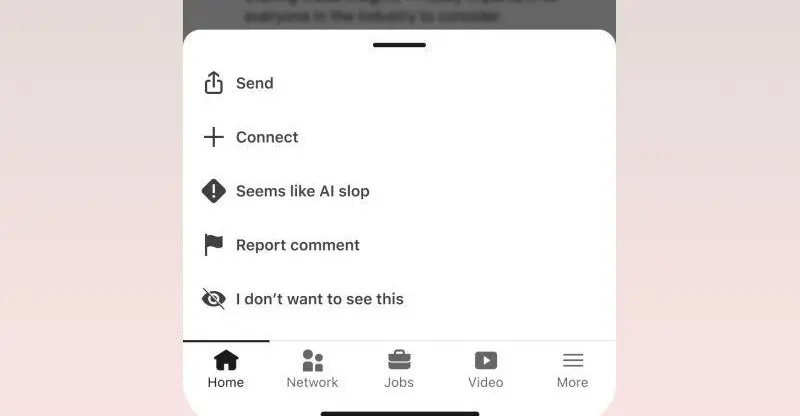
LinkedIn's "Seems like AI slop" button has been clicked by more than one million users since its launch. The feature, designed to flag posts that appear to be generated by artificial intelligence, was announced on July 30th. Chief product officer Hari Srinivasan confirmed the milestone in a Thursday post, noting that "over a million people" have used the button from the three-dot menu on individual posts.
The rapid adoption of the button reflects growing frustration with AI-generated content on professional networks. LinkedIn has become a hotspot for AI-produced posts in recent months, and the company's efforts to address the problem are now showing measurable results. Srinivasan also revealed that users are "now experiencing 40% less views on what we classify as AI slop" compared to just a few weeks ago.
What is AI slop?
"AI slop" is a term used to describe low-quality, mass-produced content created with little or no human involvement. On LinkedIn, this often takes the form of inspirational posts, career advice, and industry commentary that are generated by AI tools and posted by users looking to grow their audiences. These posts frequently contain generic language, repetitive structures, and a lack of specific personal experience, making them easy to identify but difficult to stop.
The problem has become particularly acute on LinkedIn because the platform rewards content that generates engagement. Posts that receive comments, reactions, and shares are shown to more users, creating an incentive for people to post frequently. AI tools make it cheap and easy to produce large volumes of such content, and some users have used them to build a consistent presence without putting in the effort to write original posts.
How the button works
The "Seems like AI slop" button is accessible from the three-dot menu that appears on every LinkedIn post. When a user clicks it, they are telling the platform that the post appears to be AI-generated. LinkedIn then uses this feedback, along with its own automated classifiers, to identify and demote content that is likely to be AI slop.
In addition to the button, LinkedIn introduced "new and improved" classifiers designed to detect AI-generated posts. The company also removed a feature that would "enhance your post" with AI, which had previously encouraged users to rewrite or improve their content using generative AI tools. These changes were part of a broader effort to reduce the amount of automated content appearing in users' feeds.
How bad was the problem?
Before the button was introduced, a study by AI detection service Pangram found that 41% of LinkedIn's longform posts were flagged as fully AI generated. That finding helped push LinkedIn into action, as did growing complaints from users who felt that their feeds were being flooded with content that added little value. Longform posts on LinkedIn, which are typically articles or extended updates, were particularly affected because AI tools are often used to generate text at scale.
The prevalence of AI-generated content on LinkedIn was not limited to posts. The platform also faced issues with AI-generated comments, many of which were designed to boost engagement on posts. Earlier this year, LinkedIn announced that it would be cracking down on comments that users create at scale "with little or no human involvement," signaling that the problem extended well beyond standalone posts.
Why LinkedIn users are clicking the button
The overwhelming response to the button suggests that LinkedIn users are tired of seeing AI-generated content in their feeds. For many professionals, LinkedIn is a place to share insights, build their personal brand, and engage with industry trends. AI slop undermines those goals by cluttering feeds with content that is often generic and unhelpful.
There is also a trust issue. When users discover that a post they found valuable was actually generated by AI, they may feel deceived. This is especially true on a platform where authenticity and expertise are highly valued. By flagging AI slop, users are not just cleaning up their feeds; they are also sending a message to LinkedIn and to other users about the kind of content they want to see.
What LinkedIn is doing with the feedback
LinkedIn is using the feedback from the button to train its classifiers and improve its moderation systems. The company is also adding a new message that will be shown to users when their post is flagged. The message says, "Some members told us this post seems like AI." This is intended to provide helpful feedback to the author while assuming good intent.
Srinivasan explained the approach in his post: "We approached this assuming good intent; I know I'm increasingly conscious on how to not sound like AI and the goal is to provide helpful feedback." This suggests that LinkedIn is not trying to punish users but rather to encourage them to be more thoughtful about the content they publish.
The impact on content creators
For content creators on LinkedIn, the new button and classifiers are already changing behavior. Some users who relied on AI tools to generate posts may now need to rethink their strategy. Those who continue to post AI-generated content may find their reach reduced, as LinkedIn is now actively demoting posts that are classified as AI slop.
At the same time, the changes could benefit creators who produce original content. With less AI-generated noise in the feed, their posts may get more visibility and engagement. This could lead to a healthier ecosystem where quality is rewarded over quantity.
The challenge for LinkedIn is to balance the need to reduce AI slop with the need to avoid false positives. Some users may write in a style that resembles AI, and the platform's classifiers may not always be accurate. The new feedback message is designed to address this by giving users a chance to adjust their content if they are accidentally flagged.
Broader implications for social media
LinkedIn's approach to fighting AI slop is being closely watched by other social media platforms. Many platforms have struggled to deal with the rise of AI-generated content, and most have relied on automated systems to detect and remove it. LinkedIn's use of a user-facing button is a more transparent approach, and it gives users a direct role in shaping their feeds.
The move also highlights the growing tension between AI-generated content and platforms that depend on human engagement. Social media networks are built around content created by people, but AI tools are making it easier than ever to generate posts at scale. If platforms cannot effectively moderate AI slop, they risk losing the trust of their users.
Some platforms have experimented with labeling AI-generated content, while others have chosen to remove it outright. LinkedIn's approach is unique in that it combines user feedback with automated classification to create a more nuanced system. It remains to be seen whether this approach will be effective in the long term, but early results are promising.
How LinkedIn is handling comments
In addition to posts, LinkedIn is also targeting AI-generated comments. Earlier this year, the company said it would crack down on comments that users create at scale with little or no human involvement. This is another front in the battle against AI slop, as automated comments are often used to inflate engagement numbers on posts.
AI-generated comments are typically short, generic, and designed to sound supportive. They may say things like "Great post!" or "Totally agree." While they may seem harmless, they can be misleading and contribute to the overall sense that the platform is full of fake interactions. LinkedIn's decision to address this issue is a sign that the company is serious about improving the quality of its content ecosystem.
The future of AI on LinkedIn
LinkedIn's top product leader has made clear that AI slop is a top priority for the company. While the button and classifiers are a step in the right direction, the platform is likely to continue evolving its approach as new challenges arise. As AI tools become more advanced, it may become harder to detect AI-generated content, and LinkedIn will need to invest in new technologies to keep up.
For now, the company's focus is on reducing the visibility of AI slop and giving users tools to curate their feeds. The fact that over one million people have already clicked the button shows that LinkedIn users are engaged and willing to participate in this effort. Whether the platform can maintain this momentum will depend on how well it balances user feedback, automated detection, and the need to encourage genuine human expression.
The company also has to consider the role of AI in its own products. While LinkedIn removed the feature that would "enhance your post" with AI, it may still use AI in other ways to help users create content. The key is to ensure that AI is used to assist human creativity rather than replace it entirely.
The actions taken by LinkedIn are part of a broader industry conversation about the role of AI in social media. As platforms struggle to maintain authenticity, the tools they create to manage AI-generated content will be critical. LinkedIn's AI slop button is one example of how platforms can respond to this challenge, and its success will be measured not just by the number of clicks, but by the quality of the content that remains.
Source: The Verge News