

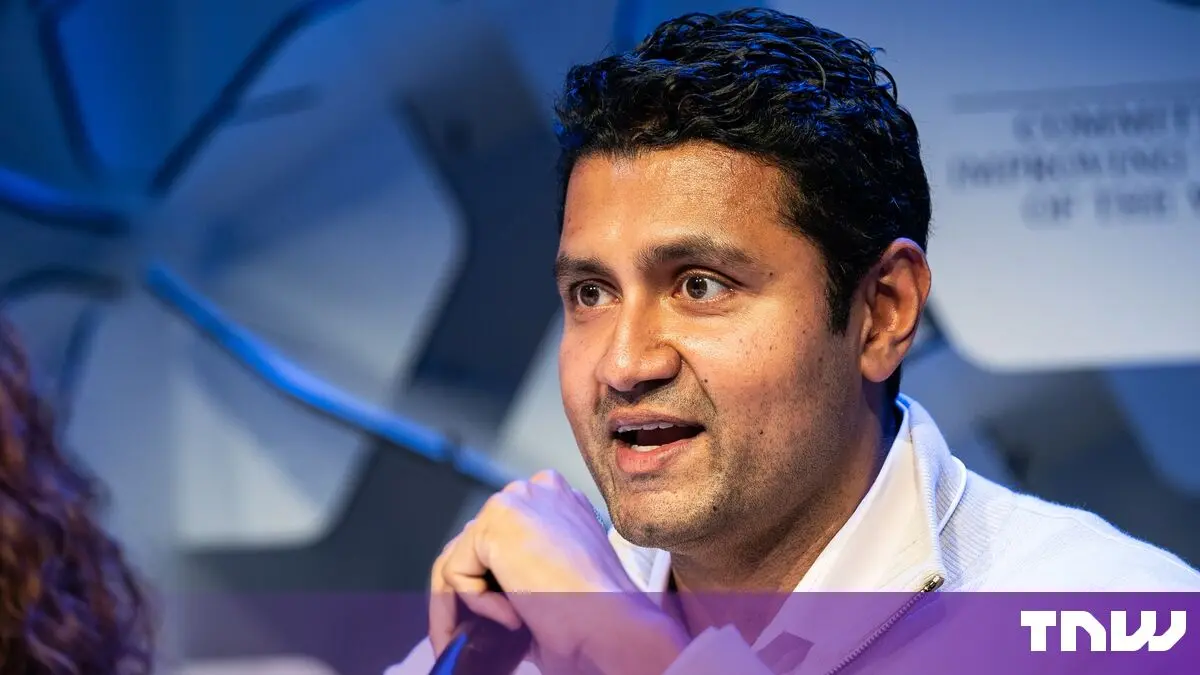
Palantir Technologies Chief Technology Officer Shyam Sankar said he does not regret the company’s work with Anthropic, even though Palantir was caught in the middle of the artificial intelligence developer’s clash with the US Department of War. In a wide-ranging interview published Thursday, Sankar described the episode as uncomfortable but not something he would undo, saying Palantir continues to work with Anthropic and other frontier AI labs.
The dispute put Palantir in an awkward position because Anthropic’s work for the US national security system ran through Palantir. When asked directly whether he regretted that arrangement, Sankar said: 'Yes, we were stuck in the middle. I don’t regret it. We still work with Anthropic, we work with both frontier labs.'
Key facts at a glance
- Palantir CTO Shyam Sankar said he does not regret working with Anthropic amid its dispute with the US Department of War.
- Sankar said Palantir was 'stuck in the middle' but still works with Anthropic and both frontier labs.
- He said many parties probably mishandled the dispute and that Palantir has since focused on enabling safe model switching.
- He said the Pentagon had already replaced Anthropic’s AI, according to remarks reported in October.
- Sankar criticized effective altruism’s influence on AI safety, saying it can turn technical debate into secular religion.
- He said most customers using AI mainly to cut staff and costs have failed, while successful customers aim to win markets.
- Palantir does not use DeepSeek itself but lets commercial customers choose models; he expects Chinese labs to stop releasing open-weight models once at the frontier.
The dispute and Palantir’s middle position
Palantir has built its business around integrating data, software and artificial intelligence for governments and large enterprises. That role often makes it the connective tissue between model developers and the agencies or companies that deploy their systems. Anthropic, meanwhile, has positioned itself as a safety-focused frontier lab, and its work for national security customers has drawn particular scrutiny because it sits at the intersection of advanced AI, defense procurement and public trust. When Anthropic became embroiled in a dispute with the US Department of War, Palantir was exposed to the fallout not because it had set the policy but because it had helped connect the technology to the mission.
Sankar’s response was notably unsentimental. He acknowledged that Palantir was stuck in the middle, a phrase that captures the awkward position of an integrator that must serve both a model provider and a national security customer. But he rejected the idea that the company should regret the work. Palantir, he said, still works with Anthropic and with both frontier labs. The stance reflects a practical view of the AI supply chain: model providers may compete and disagree, but the customers who depend on AI systems need continuity, choice and operational reliability.
Model-switching as strategic resilience
Sankar said many of the parties involved probably did not handle the dispute well. Since then, Palantir has put a lot of work into letting customers swap one AI model for another safely. That may sound like a narrow engineering task, but it is central to how governments and enterprises manage dependence on any single vendor. A model swap involves more than changing an API endpoint. It requires evaluating whether a different model performs reliably on classified or sensitive workflows, whether its outputs meet security and compliance rules, whether it can be audited, and whether the surrounding software can route tasks without disrupting operations.
The emphasis on safe model switching also fits a broader shift in the AI industry. Customers increasingly want optionality. They do not want their critical workflows locked to a single provider whose commercial priorities, safety policies or public disputes may change. Palantir’s role as an integrator gives it an incentive to build abstraction layers that let customers test, compare and replace models. In October, Sankar told a US broadcaster that the Pentagon had already replaced Anthropic’s AI. The remark underscored that government customers can move quickly when they believe continuity or policy alignment requires it, and that model providers cannot assume incumbency in national security work.
AI safety, effective altruism and technical claims
Before the interview, Sankar sent a list of topics he expected to discuss. One asked whether effective altruism has turned AI safety into a secular religion. 'Clearly I think so,' he answered. His argument is not that safety is unimportant. It is that some of the most sweeping claims about AI bringing either utopia or the end of humanity reject human agency, and with it the duty to engineer AI systems carefully. In his view, treating AI as a force that escapes human control can become a way of avoiding the harder, more practical work of building reliable systems, testing them and governing their deployment.
Sankar said he does not mind anyone’s beliefs. His concern is when those beliefs are presented to the public as technical critiques. That distinction matters in AI policy because philosophical commitments, risk estimates and engineering evidence often get blended together. A company may sincerely believe that powerful AI poses extreme risks, and those beliefs can shape its product decisions and its lobbying. But when contested moral or speculative claims are framed as settled technical findings, they can distort procurement, regulation and public debate. The debate over AI safety is not only about algorithms; it is also about which institutions get to define risk and who bears the cost of those definitions.
Customers: cost cutting versus market winning
Sankar also offered a blunt assessment of enterprise AI adoption. He said almost all the customers he has seen use AI mainly to cut staff and costs failed to reach even that goal. The ones succeeding, he said, want to use AI to win their markets. The distinction is important because cost-cutting projects often treat AI as a substitute for people rather than as a redesign of how work gets done. They may produce pilot programs, productivity dashboards and short-term savings targets, but they frequently stall when the technology meets messy processes, legacy systems and organizational resistance.
By contrast, market-winning projects tend to start with a commercial or operational problem: faster decision-making, better forecasting, more responsive logistics, improved intelligence analysis or the ability to offer a service that competitors cannot match. Those efforts can still reduce costs, but cost reduction is a byproduct rather than the organizing principle. For Palantir, whose customers include governments and large enterprises, that framing helps explain why the company emphasizes deployment and integration rather than selling AI as a standalone tool. The winners are not necessarily the customers with the most ambitious AI slogans; they are the ones that change workflows and measure outcomes.
China, DeepSeek and open-weight models
On China, Sankar said Palantir does not use DeepSeek itself, but lets commercial customers choose their models. He said Chinese labs are behind the frontier for now. He also predicted that they will stop releasing open-weight models once they feel they are at the frontier. The remark points to a tension in the global AI race. Open-weight models can accelerate adoption, lower costs and allow customers to run systems in controlled environments. But leading labs may become more restrictive as they approach what they regard as the cutting edge, particularly if they believe openness erodes commercial advantage or security.
DeepSeek has since released the code for its Super-Agent, a reminder that Chinese developers remain active in both model development and the surrounding agentic software stack. For Palantir’s commercial customers, the practical question is less about ideology than about fit. A model that is open, cheap and adaptable may be attractive for some workloads; a closed frontier model may be preferred for others. Sankar’s position suggests that Palantir wants to preserve that choice rather than commit its customers to a single geopolitical or vendor camp. At the same time, national security customers face stricter constraints, which is why model provenance, data handling and supply-chain trust remain central.
Business-model arguments and founder-led strategy
The interviewer pushed back on Sankar’s arguments, noting that they fit Palantir’s business model just as Anthropic’s safety warnings fit its own. It is a fair challenge. Palantir benefits when customers need integration, model flexibility and help deploying AI across complex institutions. Anthropic benefits when safety and trust become central purchasing criteria. Neither position is necessarily disingenuous, but both are shaped by commercial incentives. Sankar replied that founders lead both companies, and that each builds its strategy on what it believes. That answer places weight on founder conviction rather than on the claim that either company has escaped its own interests.
Anthropic has told investors its safety views could make it a political target. That disclosure is a reminder that AI safety is not only a technical posture; it is also a business and political risk. Palantir’s CTO, for his part, is betting that customers will reward optionality and operational reliability. The dispute with Anthropic may have been uncomfortable, but Sankar’s message is that Palantir does not intend to apologize for the integration work that put it in the middle. Instead, it is trying to turn that middle position into a product: the ability to switch models safely when politics, performance or policy demands it.
Source: TNW | Anthropic News