

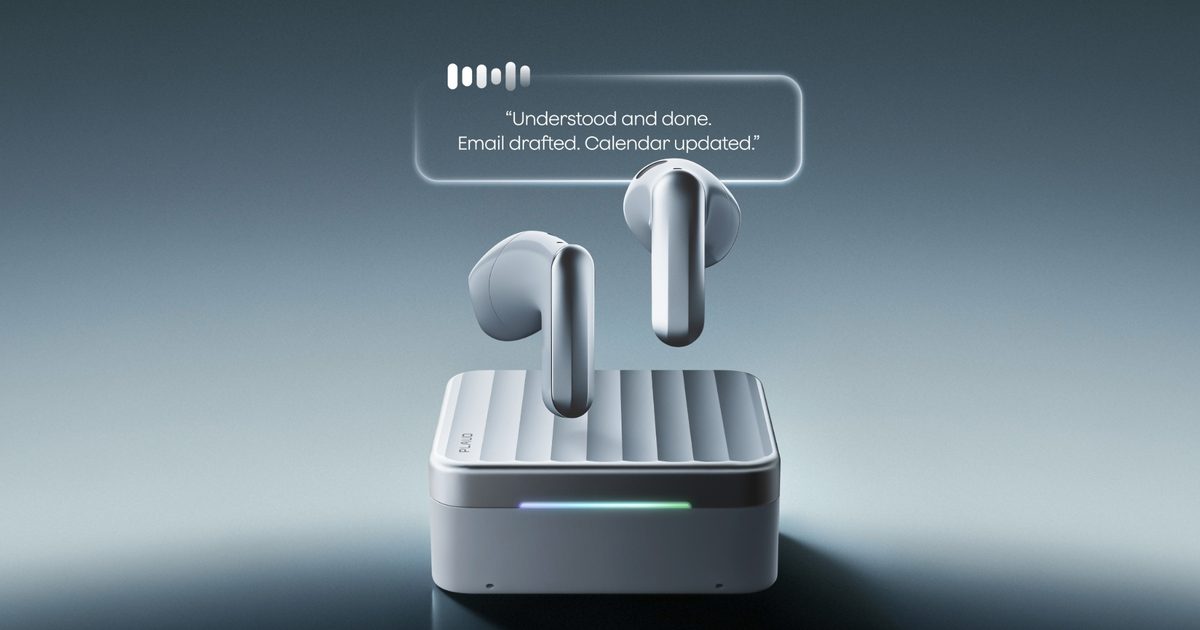
For years, artificial intelligence has promised to make meetings more productive, yet the most important information is often scattered across calendars, email threads, notes, and chat applications. A conversation ends, but the work it generated usually begins only after someone manually turns spoken commitments into digital tasks. Plaud wants to change that with an AI device designed around conversation itself.
Plaud has introduced the Plaud One Explorer Edition, a wearable AI product aimed at professionals whose work revolves around meetings, calls, ideas, and follow-up duties. The device brings together dedicated hardware and the company's Plaud Intelligence platform to capture what people say, understand what matters, and execute tasks across connected services. Rather than forcing users to type prompts into an app, the new tool is designed to listen in the background, identify meaning, and offer useful actions.
Earbuds and charging case for every kind of conversation
The Plaud One can be used as earbuds or placed inside its charging case, which also serves as a stand-alone recording device. That gives professionals a simple way to record phone calls, online meetings, face-to-face conversations, and quick voice notes without pulling out a laptop or phone. In a typical setup, someone might wear the earbuds for a video call, then put them back into the case for an in-person discussion, with the case turned toward the table to capture audio clearly.
The hardware includes an embedded eSIM and 4G LTE support, so it can stay connected even when a smartphone is not nearby. Recordings are uploaded automatically for transcription and summarization. That connection also allows the Plaud agent to process information after a meeting ends, turning raw audio into organized notes and actionable outputs while the user moves on to the next task.
Plaud Intelligence adds context and memory
Transcription is only the first step. The bigger change happens after the conversation is over. The redesigned Plaud Intelligence platform introduces persistent context and deeper memory, according to Plaud. Over time, the system can draw on previous conversations to better understand each user's projects, commitments, working style, and priorities. That enables what the company calls the Plaud Agent to prepare follow-ups, generate reports, and link actions to other services.
For example, a user who discusses a deadline with a colleague in the morning might see a calendar event appear in the afternoon. A client conversation might produce a draft email with proposed next steps. A brainstorming session could turn into a structured document shared in Notion. The goal is to shorten the distance between discussion and execution, eliminating many repetitive tasks that follow important meetings.
Integrations that let talk become action
Plaud's platform includes native integrations with Gmail, Google Calendar, Notion, and Slack, meaning users can connect conversation summaries directly to tools they already use. Instead of copying discussion points from one application to another, the system can interpret a mutual agreement and turn it into a task in the appropriate workspace. This is where Plaud's agentic positioning becomes most visible, because the AI is not merely reporting a summary; it is suggesting or performing a workflow.
The system also supports predefined workflows called Skills and collections of tools called Plugins. Skills are designed to automate repetitive processes, such as sending a detailed recap after a project update or organizing action items by priority. Plugins are aimed at specific roles, allowing users to load the particular knowledge and prompt logic most relevant to their jobs. Plaud says customers will be able to fine-tune these features over time as the platform learns from usage.
Built for people whose work is conversation
Plaud identifies several use cases that illustrate the device's potential. A sales leader could ask the assistant to write a client follow-up after a meeting. A consultant might turn a workshop into a polished report. An executive could request a recap of a conversation that happened weeks earlier, complete with relevant context and decisions. A chief of staff might set up a weekly routine that collects summaries from all of the week's discussions and delivers them in one place.
Each scenario relies on memory as much as on transcription. If the system remembers who attended, what was promised, and how those promises connect to earlier commitments, then follow-up tasks can be drafted with context. Plaud says the more information the system accumulates over time, the stronger its performance becomes.
Why conversation is becoming an AI interface
The launch highlights a growing belief among AI hardware companies that the next major interface will not be a screen. Many assistants today are activated by typing or by using a smartphone. But business communication still happens largely through voice, and humans are far more natural when they speak than when they describe their intentions to a machine. Plaud wants to make the conversation itself the input, with the output appearing in the calendars and collaboration tools that professionals use each day.
That vision requires a major change in how users think about AI. Instead of opening an app and asking a question, users can hold a normal meeting, then let a background agent capture what matters. The interface is not a chat window but the actual flow of work. This is a more ambitious proposition than simple note-taking, because the AI is expected to understand nuance, identify commitments, and operate across multiple applications. The move also reflects the broader industry trend toward AI agents that can perform tasks rather than just provide answers.
Memory and the shift from assistants to agents
One of the most important aspects of Plaud Intelligence is persistent context. Many AI tools treat every conversation as an isolated event. They create transcripts and summaries, but they do not remember a user's long-term objectives. Plaud's platform is intended to maintain memory over weeks and months so that each new conversation can be connected to earlier material. This is especially useful for recurring meetings, long-term client relationships, and complex projects with multiple stakeholders.
Without that kind of memory, an AI note-taker might be able to name the action items discussed today but not recognize that a similar action item was already completed last week. With memory, the agent can avoid duplication and make smarter recommendations. Persistent context also helps the system understand references to people, projects, and deadlines without asking the user to repeat background information in every exchange.
Privacy concerns in a continuously listening device
A wearable that records conversations naturally raises privacy questions. In many regions, recording meetings requires consent from all participants, and some organizations have strict rules about storing proprietary or sensitive audio. Plaud One's automatic cloud uploads add another dimension, since users need to trust that their audio and transcripts will be handled securely. Professionals who want to use the device will need to know which recording features are active, how data is stored, and whether the system provides controls for pausing or deleting recordings.
Transparent controls will be essential for adoption. Users may also need to inform clients and colleagues when a conversation is being captured. The success of conversation-focused AI devices depends not only on accuracy but also on ethical design and compliance with local privacy laws. Plaud has not released detailed security documentation, but companies in this space are increasingly expected to offer clear data handling policies alongside their hardware.
Availability, credits, and the road ahead
The Plaud One Explorer Edition is available for pre-order in select markets at a price of $249.99. Every unit includes $200 in Plaud Credits, which can be used to purchase the company's AI capabilities. Plaud says it plans to begin shipping in the fourth quarter of 2026. The Plaud App 4.0 update, which introduces the new intelligence features across the company's existing hardware, is expected to arrive around the same time.
The price point places the device in the same general range as other AI productivity gadgets, though the bundled credits reduce the effective cost of the hardware for early buyers. The real investment, however, may be in time spent teaching the system about a user's communication patterns. Plaud is betting that once the memory and workflow connections are in place, the assistant becomes more useful with every meeting, call, and idea that passes through it. Whether that promise is fully realized may depend on execution, but the direction is clear: the next big AI interface could be the conversation itself.
Source: Digital Trends News