

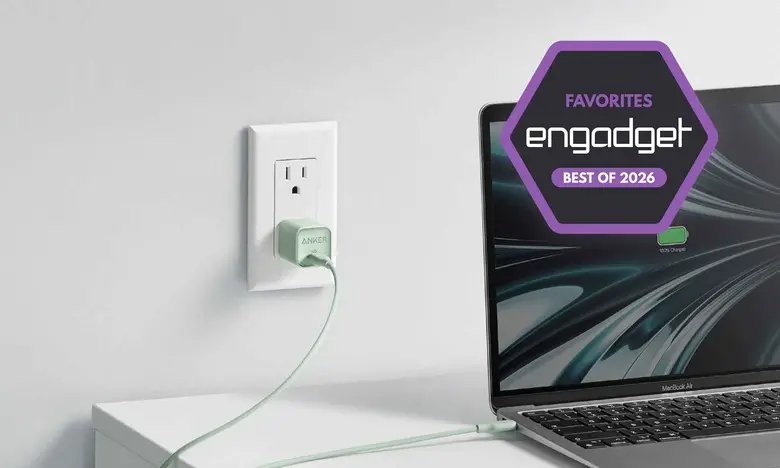
Fast chargers are no longer a nice-to-have item. With phones, tablets, laptops and wearables all competing for outlets, the right charger can make a difference in how quickly you get back to full power without worrying about overheating or long-term battery wear. Since many devices now ship without a power brick, choosing a charger with the right compatibility, ports and charging technology is just as important as raw speed.
Today's best fast chargers are designed to handle multiple devices at once, whether that's a phone, laptop, AirPods or even an Apple Watch. Many models combine Type-C ports with a USB-A charger option to support older cables like a Lightning cable, while newer designs focus on multi-port chargers that can intelligently distribute power across everything you plug in. Brands like Anker continue to refine their designs, with compact options such as an Anker charger that's easy to toss in a bag but powerful enough for everyday use.
With so many wattages, port layouts and standards to consider, finding the best fast charger depends on how and where you charge. Whether you want a simple wall adapter, a travel-friendly option or a desktop hub built to power everything at once, this guide breaks down the key facts you need for 2026.
Key facts to know before buying
- Many new phones, tablets and laptops no longer include a charger in the box.
- Match the charger's wattage to your device's maximum supported charging speed.
- USB Power Delivery (USB PD) is the most common universal fast-charging standard, but some phones rely on proprietary protocols.
- GaN chargers use gallium nitride to deliver higher power in smaller, cooler packages.
- Multi-port chargers split power intelligently, but not all ports deliver the same wattage at the same time.
- Travelers should prioritize compact size, foldable prongs and support for international voltages.
What to consider before buying a fast charger
Before you start looking at specific chargers, it's critical to determine three things: how many devices do you need to charge, how much power do they require and whether or not you're planning on traveling with any of them. This is especially true if you're charging a mix of devices that still rely on a Lightning cable alongside newer USB-C gear.
The reason for the first question is simple. If you only need to charge a single device, like an iPhone or Android phone, it's cheaper and usually more space-efficient to get a lower-wattage phone charger with one port instead of two or three. Next, it's critical to figure out how much electricity your gadgets need because it doesn't make sense to buy a power brick that pushes out more juice than your device can actually use. This may sound a bit tricky, but most major manufacturers will list a product's max charging speeds in its tech specs, which is typically denoted by a specific wattage (15W, for example) or a quick-charge rating.
Unfortunately, very powerful or large laptops like gaming notebooks can suck a ton of juice (more than 140 watts), which means they may rely on more traditional power adapters with barrel plugs. This may result in them not being compatible with universal chargers. Some of these PCs may also support charging over USB-C, so even if a specific adapter can't deliver its full power draw, it can still send over some energy — but it will do so at a slower rate compared to the laptop's included charger. To get the best performance, using a fast charging cable, such as a USB-C cable, can make a big difference in maintaining consistent power delivery.
For frequent travelers, size and weight are often important considerations, because the bigger and heavier a charger is, the more annoying it will be to lug around. You'll also want to think about other factors like support for international plugs, which can be a big help to anyone who regularly visits other countries. If you're already traveling with power banks or a charging station, choosing a compact GaN charger can help streamline your gear.
Finally, you'll want to figure out if your smartphone uses a proprietary charging standard or if it's compatible with the USB Power Delivery spec (USB PD). For example, the OnePlus 13's included SuperVOOC power adapter can send up to 100 watts to the phone. However, if you use a generic USB-PD charger, speeds top out at 45 watts. That's still pretty quick, but not nearly as fast as OnePlus' brick — and the same applies to devices with super fast charging support. Also, make sure your charging cable and connector are up to spec, as lower-quality accessories can bottleneck speeds or contribute to overheating during fast charging.
Understanding charger wattage and port layouts
Wattage is the most visible specification on a charger, but it doesn't tell the whole story. A 65W charger may look powerful, but if its only port outputs a maximum of 20W while charging a phone, it won't be the best choice for a laptop. Likewise, a 100W multi-port charger might only deliver 60W through one port when two or more devices are plugged in. That's why it's important to read the fine print on port-specific output ratings.
For phones, most modern devices support at least 18W to 25W fast charging, while flagship Android phones often accept 45W, 65W, or even 100W over USB-C. Apple's iPhone lineup, meanwhile, uses USB PD for fast charging, so a 20W or 30W USB-C charger is enough to get an iPhone from zero to around 50 percent in roughly half an hour. Tablets and ultraportable laptops typically need 30W to 65W, while larger laptops may demand 100W or more.
Port layout matters almost as much as total wattage. A charger with two USB-C ports and one USB-A port gives you flexibility for different cables, but the power distribution may change depending on which ports are occupied. Some chargers prioritize one port when multiple devices are connected, so a laptop may still get full power while a phone gets a slower top-up. Others split the load evenly, which can be frustrating if one device needs more juice than the rest.
Why GaN chargers are different
When looking for chargers, you may notice that some are marked as GaN, which stands for gallium nitride. This is an important distinction because, when compared to older adapters that use silicon switches, GaN-based devices support increased power efficiency and output, allowing manufacturers to create more compact bricks that run cooler and support higher wattages.
Depending on the specific power output, GaN adapters can be 30 to 50 percent smaller and lighter than silicon-based alternatives. That might not sound like much, but when they're sitting in a bag alongside a laptop and a half dozen other accessories you might have, cutting down on excess bulk and weight goes a long way.
GaN technology has also made it possible for chargers to combine high wattage with multiple ports in a package that used to be reserved for single-port chargers. A few years ago, a 100W charger was a heavy brick; today, many compact GaN chargers can deliver 100W or more from a cube roughly the size of a standard wall adapter. This makes GaN the go-to choice for travel and everyday carry.
Fast charger FAQs
What is GaN?
Gallium nitride is a semiconductor material that operates more efficiently than silicon at higher voltages and temperatures. In practical terms, GaN chargers waste less energy as heat, which allows them to be smaller while still delivering high power. The result is a charger that can fit easily into a pocket or backpack without sacrificing performance.
Do fast chargers affect battery life?
Technically yes, because the process of sending a ton of watts into a gadget and potentially generating additional heat while doing so can decrease battery health over time. That said, modern devices and chargers use various protocols to ensure temperatures and power levels stay within preset limits — in large part to avoid damaging the product or creating a safety risk. At a base level, simply charging a gadget regardless of speed will cause degradation over time (nothing stays perfect forever, you know?). So as long as you use compatible chargers and cables, the impact of fast charging is generally quite negligible.
What's the difference between a fast charger and a regular charger?
There isn't a single generally accepted definition of fast charging. However, with power adapters capable of sending as little as five watts or less, it's important to know how much juice your device is getting, especially if you need to recharge something quickly. So depending on who you ask (particularly when it comes to smartphones), any charger that can push out more than 15 to 18 watts is generally considered to be fast. That said, with some phones capable of receiving more than 100 watts and up to 240 watts for some laptops, it's more important than ever to consider what devices you own before buying a new fast charger.
In 2026, the best fast charger isn't necessarily the one with the highest wattage or the most ports. Instead, it's the charger that fits your devices, your daily routine, and your travel habits. A single 20W USB-C brick might be perfect for iPhone owners, while a 100W GaN multi-port charger is better for a household full of laptops, tablets, phones, and earbuds. By focusing on the key facts—output wattage, port flexibility, charging standards, and size—you can avoid wasting money and keep your gear powered up quickly and safely.
Source: Engadget News