

Key facts at a glance
- Volodymyr Zelenskyy has delivered a daily video address for a full year since Russia’s full-scale invasion began, a pace described as unmatched by any modern leader.
- Hours before the invasion on Feb. 23, 2022, he addressed Ukrainians and Russians in Russian, warning that Ukraine would defend itself if attacked.
- That message was the last time he appeared clean-shaven in a suit and tie before shifting to a wartime olive-green uniform.
- After Russia attacked, he remained in Kyiv despite reports that evacuation help was offered; the phrase “I need ammunition, not a ride” became a widely repeated symbol of his response.
- On the second day of the war, he recorded a nighttime video with senior officials outside the presidential compound to show leadership was still in the capital.
- His approval ratings rose from a prewar slump to roughly 80% to 90% during the first year of fighting.
- Before politics, Zelenskyy was a comedian, actor and producer; his 2019 election victory surprised many observers.
- Russian leaders initially dismissed him as inexperienced and unserious, a judgment that shaped Moscow’s expectation of a quick political collapse in Kyiv.
- His government has not been error-free, including high-profile resignations and a disputed missile incident on Polish territory in November 2022.
- He has used speeches, video calls and frontline visits to keep international attention on Ukraine and to press allies for weapons and support.
A presidency tested overnight
When Russia launched its full-scale invasion of Ukraine in February 2022, the war immediately became a test of leadership in Kyiv. Volodymyr Zelenskyy, a former comedian and political newcomer, had been elected president less than three years earlier. Many observers inside and outside Ukraine questioned whether he could manage a national emergency of that scale. The speed of Russia’s attack, the movement of troops toward the capital and the warnings from Western intelligence agencies created an atmosphere of extreme uncertainty. The expectation in Moscow, according to much of the early analysis, was that Ukraine’s government would struggle to hold together and that its president might leave the capital.
On Feb. 23, 2022, hours before Russia launched its attack, Zelenskyy recorded a special message to his compatriots and to Russian citizens. He tried to avert the conflict, called on Russians to take to the streets in protest and, speaking in Russian, warned that if Ukraine were attacked, if there were an attempt to take its land, freedom, lives and the lives of its children, Ukrainians would defend themselves. He added that if Russia attacked, Ukrainian forces would face the attackers rather than turn their backs. It was the last time Zelenskyy appeared on camera clean-shaven and wearing a suit and tie.
After the invasion began, Zelenskyy and his government remained in Kyiv even as Russian troops closed in on the capital’s suburbs. That decision came as a surprise in many quarters. Russian President Vladimir Putin had speculated that Zelenskyy would flee to western Ukraine or even abroad. Zelenskyy was reportedly offered help to evacuate, yet he turned the offer down. Reports later quoted him as saying, “I need ammunition, not a ride.” Although the exact wording is difficult to verify, the message was loud and clear. It generated sympathy abroad and helped strengthen the fighting spirit of Ukrainians at home.
In the weeks before Russia’s invasion, many Ukraine watchers had been puzzled by Zelenskyy’s behavior. When Western intelligence agencies and state leaders warned of an impending Russian invasion and pulled embassy staff from Kyiv, the Ukrainian president reacted angrily, expressing distrust and criticism. Later, he revealed that his reaction had been intended to stave off panic. Then Russia’s invasion changed everything. The political debate over warnings and intelligence assessments was overtaken by the immediate demands of war, and Zelenskyy’s public role shifted from that of a peacetime president to a wartime communicator.
The camera as a weapon
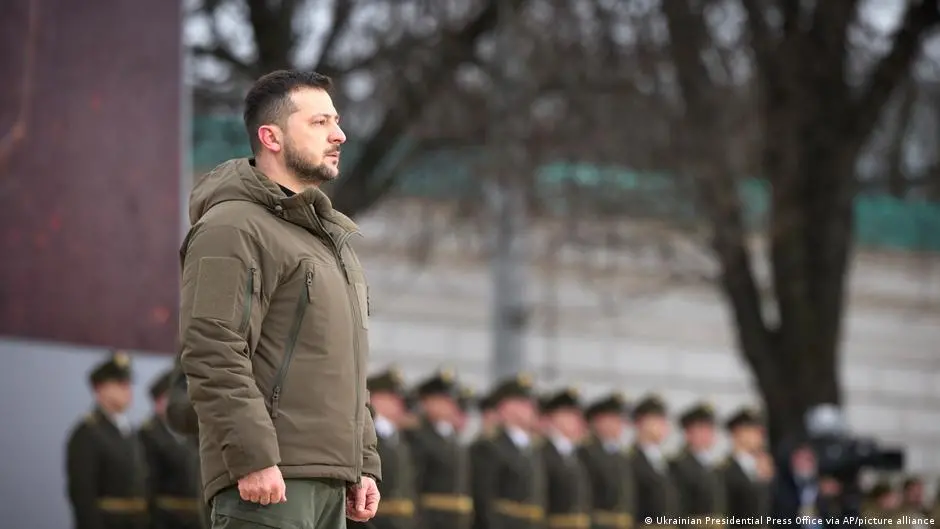
On the first day of the war, Feb. 24, Zelenskyy donned an olive green shirt. That military dress code became his signature style, along with his five o’clock shadow. It is how the world has come to know him during the war, and how he has appeared in countless interviews and on the covers of newspapers and magazines. The visual change was not merely a matter of fashion. It signaled that the president was presenting himself as part of a country at war, rather than as a distant political figure in a capital under attack.
On day two of the invasion, he recorded his most important and famous video. The clip shows Zelenskyy alongside the prime minister and other members of his leadership team outside Kyiv’s presidential compound at night. It sent a strong message that everyone was still in Ukraine and willing to fight. The image countered rumors of flight and collapse, and it gave supporters at home and abroad a clear visual answer to the question of whether Ukraine’s leadership remained in place.
Initially, Zelenskyy signaled openness to making concessions toward Russia, for instance regarding potential NATO membership. But when reports of Russian war crimes and the annexation of Ukrainian territory began surfacing, Zelenskyy hardened his stance, knowing most Ukrainians backed him. The shift reflected both the changing facts on the ground and the political reality inside Ukraine. As evidence of atrocities and territorial seizures mounted, the space for compromise narrowed, and Zelenskyy’s public language became more uncompromising.
Over the last year, Zelenskyy has focused on what he does best: communicate. The camera is his sharpest weapon. He has shot videos in Kyiv, spreading hope, finding the right words and coming across as very authentic. He has repeatedly visited the front lines, meeting soldiers in places like liberated Izium or besieged Bakhmut. Some of his clips feature footage recorded in Ukrainian cities devastated by the Russian army. His approval ratings, which had plummeted before the invasion, shot up once fighting began and have hovered around 80% to 90%. The question that followed was how Putin could underestimate his Ukrainian counterpart so dramatically.
From comedy stage to wartime leadership
Zelenskyy is not a career politician, and his 2019 presidential election win came as a surprise. Before entering politics, Zelenskyy was a successful comedian, actor and producer. He even performed once onstage in front of former Russian President Dmitry Medvedev, who was visiting Ukraine. His political rise shows parallels to the satirical television series in which he starred as a teacher who later becomes head of state. That background gave him a public profile and media skills that few traditional politicians could match, but it also encouraged his opponents to treat him as an entertainer rather than a serious statesman.
It is for this reason that the Russian leadership did not take Zelenskyy seriously, bristling when he refused to make major concessions. As a Russian-language comic, Zelenskyy often mocked Ukrainian ways and pro-Western politicians in the country. In fact, Zelenskyy went very light on Viktor Yanukovych, Ukraine’s former pro-Russian president, during his time in office. Zelenskyy had close ties to Russia and earned money performing there even after Russia annexed the Crimean Peninsula in 2014, something that some of his compatriots found irksome. Those details formed part of the broader assumption in Moscow that he could be managed, pressured or quickly sidelined.
The invasion of Ukraine, however, changed everything. Zelenskyy’s critics fell silent, and he won over many skeptics by remaining in Kyiv and not fleeing. This determination could be due to his upbringing. Zelenskyy grew up as the privileged son of a university professor in Kryvyi Rih, an industrial working-class city in southeastern Ukraine. Yet his generation faced the harsh, final years of the Soviet Union. Living through that time taught them not to shy away from conflict. When Putin attacked Ukraine, Zelenskyy could draw on this experience. The Russian leader underestimated his Ukrainian counterpart, treating him like an inexperienced weakling who could be easily defeated.
Not all smooth sailing
This does not mean it has been all smooth sailing for Zelenskyy. His government has made mistakes: some leading politicians were forced to quit, and close friends of Zelenskyy lost their posts. The president also sparked international anger when he claimed in November that a Russian missile had struck Polish territory and killed two people, yet according to US reports, the missile likely originated from a Ukrainian anti-aircraft battery. That episode remains a rare public disagreement between allies, and it showed how quickly wartime information can become diplomatically sensitive.
Above all, Zelenskyy regards his primary job as using media attention to attract help for his country. Over and over, he has appealed to Western politicians, asking, and some would say begging, for weapons. By and large, Zelenskyy has been successful, as more arms have been delivered to his country. He is also a record-holder in terms of the number of video addresses to governments, conferences and festivals around the world. His daily addresses, repeated frontline appearances and direct appeals to foreign legislatures have become a defining feature of Ukraine’s wartime leadership, shaping both domestic morale and the international debate over military aid.
Source: dw.com News