

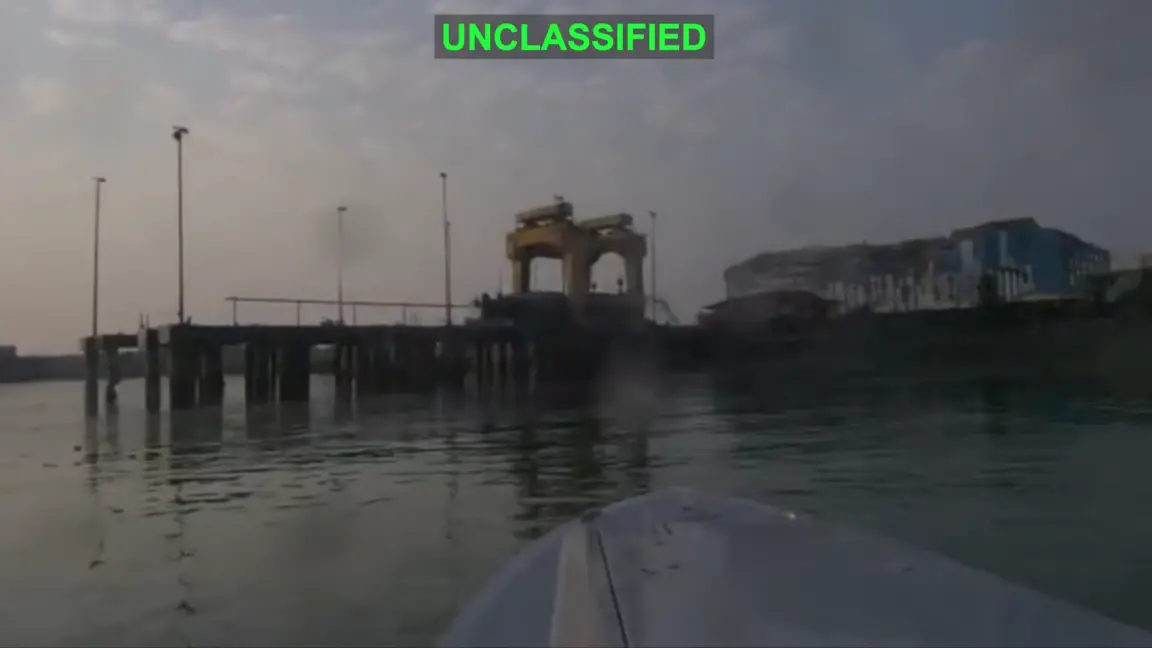
For the first time in its history, the US military sent explosive-laden drone boats into combat by attacking an Iranian midget submarine and naval port. The unprecedented use of such kamikaze sea drones by the United States comes nearly a decade after Iranian and Houthi forces first demonstrated similar weapons. The attack, which took place on the night of July 12, 2026, targeted Iran's Bandar Abbas Naval Base and involved three one-way attack surface drones that exploded after approaching their objectives.
US Central Command, the military command responsible for Middle East operations, confirmed in a social media post that this was the first time American forces had employed sea drones in combat operations. The drone boats were able to make a low-speed, uncontested approach to their targets before detonating, according to USNI News. One of the primary targets was identified as an Iranian Ghadir-class midget submarine that was out of the water and suspended from a gantry, making it a vulnerable and high-value target.
The Technology Behind the Strikes
The drone boats used in the operation were Saronic Corsair autonomous surface vessels, developed by Saronic Technologies, a defense company based in Austin, Texas. According to the company's specifications, these vessels are 24 feet in length and can carry up to 1,000 pounds of payload over a range of 1,000 nautical miles, with a top speed exceeding 34 knots. The Corsair drone boats are designed for autonomous operations, with the ability to navigate long distances, patrol areas, and loiter at specific positions without direct human control. They regulate power consumption and engine usage to maximize endurance.
While the Corsair is a multi-mission platform, for this specific strike it was likely loaded with explosives to function as a kamikaze drone. The US military's decision to use such assets reflects a broader shift toward cost-effective, unmanned systems that can be deployed in high-risk scenarios without endangering human operators. This is especially relevant in the context of the ongoing war with Iran, which began on February 28, 2026, with the United States and Israel launching coordinated attacks against Iranian military infrastructure.
Interestingly, this was the second notable use of drone boats by the US military during the conflict. On June 8, 2026, a Corsair sea drone rescued two US Army helicopter pilots off the coast of Oman after their AH-64 Apache helicopter was shot down by an Iranian Shahed drone. That rescue demonstrated the versatility of these unmanned surface vessels beyond offensive missions.
A History of Drone Boat Violence
The United States is far from the first country to use exploding drone boats, which are also called kamikaze or suicide drone boats. The first confirmed use of such weapons occurred on January 30, 2017, when the Houthi faction in Yemen struck the Royal Saudi Naval frigate Al Madinah with an unmanned remote-controlled boat. A US Navy commander noted that the Houthi weapon was likely developed with technical assistance from Iran, which has long supported the Houthi movement. That attack set a precedent that has since been followed by other state and non-state actors.
Since Russia launched its full-scale invasion of Ukraine in February 2022, the Ukrainian military has developed and deployed drone boats for asymmetric warfare at sea. Despite lacking a traditional navy, Ukraine has used a combination of aerial drones and explosive drone boats to strike Russian warships and tankers, forcing the Russian Black Sea Fleet to retreat to bases farther from Ukraine. Ukrainian drone boats have achieved several milestones in military history, including using missiles to shoot down Russian helicopters, deploying small flying drones to strike air defenses, and even landing an armed ground robot on contested coastal territory in an unprecedented amphibious operation. These innovations have proven that cheap, unmanned surface vessels can disrupt even the most powerful navies.
Implications for US Military Strategy
The US decision to deploy drone boats in combat marks a significant departure from its traditional reliance on expensive, crewed warships and aircraft. The Trump administration, which has escalated the war with Iran after the collapse of a ceasefire, appears to be embracing asymmetric tactics similar to those used by Iran and its proxies. The recent strikes on Iranian targets included not only drone boats but also conventional strikes by fighter aircraft and warships.
Moreover, the US military has been using one-way aerial attack drones—LUCAS drones, which are largely based on Iranian Shahed drones—for the first time in this conflict. The adoption of such weapons reflects a growing recognition that inexpensive drones can be highly effective against even advanced military forces, especially when used in large numbers. The US military has reportedly lost dozens of costly hunter-killer Reaper drones worth over $1 billion in the war against Iran, prompting a renewed push to acquire cheaper, more expendable surveillance and strike drones.
The use of drone boats and aerial kamikaze drones represents a fundamental shift in how the Pentagon approaches naval warfare. Traditional naval power projection relies on aircraft carriers, destroyers, and submarines that are extremely expensive and require extensive logistics support. In contrast, drone boats like the Corsair can be mass-produced at a fraction of the cost, deployed from small ships or shore bases, and used for a variety of missions including reconnaissance, patrol, and attack. The ability to operate autonomously reduces the need for continuous communication links, making them more resilient in contested electronic warfare environments.
As the war with Iran continues, the US military is likely to refine its tactics for using unmanned surface vessels. The success of the July 12 attack will probably lead to further integration of drone boats into naval doctrine, particularly for coastal operations and strikes against high-value stationary targets. The lessons learned from this conflict will also influence future procurement decisions, as the US military seeks to balance cutting-edge technology with cost-effectiveness.
The broader implications for global naval warfare are significant. If the United States, the world's dominant naval power, embraces kamikaze drone boats, other nations may accelerate their own programs. The technology is relatively simple and accessible, meaning that non-state actors and smaller countries could also develop similar capabilities. This could lead to a new arms race in unmanned surface vessels, with navies around the world adapting to the threat posed by cheap, autonomous attack boats.
While the US military has not yet revealed how it plans to continue deploying drone boats, it is clear that the era of unmanned naval warfare has arrived. The attack on the Iranian submarine and naval base is not just a tactical success; it is a strategic demonstration that even the most powerful military can benefit from the lessons of asymmetric warfare first taught by its adversaries.
Source: Ars Technica News