

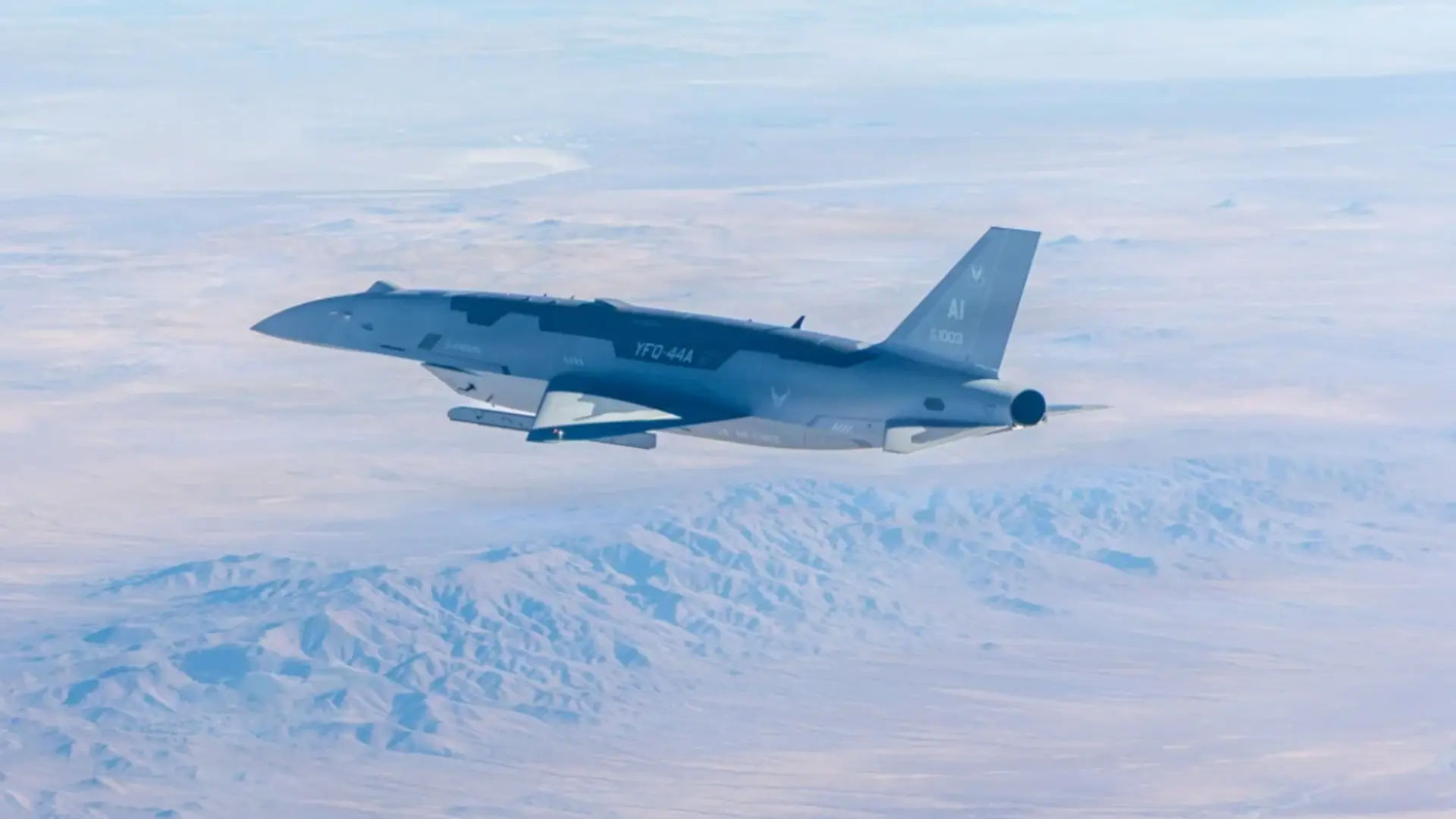
The United States Air Force has achieved a groundbreaking milestone in military aviation: an autonomous AI fighter drone fired a live AIM-120 Advanced Medium-Range Air-to-Air Missile (AMRAAM) for the first time in history. The test, conducted as part of the Air Combat Evolution (ACE) program, represents a major leap forward in the integration of artificial intelligence into combat aircraft and signals a new era of air warfare.
The event took place at the Eglin Air Force Base testing range in Florida, where an autonomous AI system operating on an experimental test aircraft successfully engaged a target drone using a real AMRAAM missile. The AI-controlled aircraft, often referred to as a 'loyal wingman' concept, executed the entire engagement from detection to missile launch without human intervention, though safety pilots were present to monitor the mission.
The Aircraft and AI System Behind the Test
The test aircraft involved is likely derived from the Air Force Research Laboratory's work on the XQ-58A Valkyrie, a stealthy, unmanned combat aerial vehicle designed to team with manned fighters like the F-35 and F-22. However, the specific platform used in this AMRAAM test has not been officially named. The AI system, developed under the ACE program, uses advanced machine learning algorithms to make tactical decisions in real time, including target identification, weapons employment, and defensive maneuvers.
This milestone builds on years of development. In 2023, the Air Force revealed that AI agents had successfully flown simulated dogfights against human pilots, winning decisively. The transition from simulated to live weapons release is a critical validation of the AI's reliability and lethality. The ACE program, led by the Air Force Research Laboratory and the Defense Advanced Research Projects Agency (DARPA), aims to enable manned and unmanned aircraft to operate together seamlessly in contested environments.
The AMRAAM Missile: A Proven Weapon in a New Context
The AIM-120 AMRAAM is the US military's primary beyond-visual-range air-to-air missile. It is a fire-and-forget weapon with active radar homing, capable of engaging targets at distances exceeding 50 miles. Firing a live AMRAAM from an AI-controlled aircraft demonstrates that the autonomous system can manage the complex sensor-to-shooter process, including radar lock, target tracking, and launch clearance, all without human input. This achievement confirms that AI can handle lethal engagement rules in a safe and controlled manner.
The test also highlights the continued evolution of the AMRAAM itself. The missile has been adapted for various platforms, including ground-based launchers (NASAMS) and naval systems. Its integration onto an AI drone paves the way for future networked warfare, where swarms of autonomous drones could employ AMRAAMs or other munitions based on data shared across the battlespace.
Implications for Air Combat and Military Strategy
The successful live-fire test has profound implications for the future of air combat. For decades, unmanned aircraft have been used primarily for surveillance and strike missions against ground targets, with limited autonomy. The ability to conduct air-to-air engagements autonomously shifts the paradigm. Future air battles could see AI-controlled 'loyal wingmen' flying alongside human pilots, acting as sensors and shooters to overwhelm enemy defenses while reducing risk to human life.
The ACE program envisions that human operators will supervise multiple autonomous aircraft, focusing on higher-level command decisions while the AI handles tactical execution. This manned-unmanned teaming (MUM-T) concept is central to the US Air Force's Next Generation Air Dominance (NGAD) family of systems. The AMRAAM test provides hard evidence that the technology is maturing quickly.
However, challenges remain. Trusting AI with lethal force is a contentious issue. The Air Force has emphasized that rigorous testing and safety protocols are in place, including human override capabilities. Ethical and legal considerations around autonomous weapons are debated at the UN and within the Pentagon. Yet this test is a clear signal that the US military is moving forward with AI-enabled combat systems, potentially spurring other nations to accelerate their own programs.
Historical Context and Future Steps
The journey to this milestone began decades ago. Early experiments with remotely piloted drones date back to World War I, but true autonomy in combat has been elusive. The ACE program, launched in 2018 by DARPA, brought together top AI researchers, military aviators, and defense contractors. The Simulated Air Combat Challenge in 2020 pitted AI algorithms against human fighter pilots, with the AI achieving decisive victories. Subsequent flight tests on the X-62A Variable Stability In-flight Simulator Test Aircraft (VISTA) proved the AI could control a real plane.
Now, with a live missile launch, the program has crossed a Rubicon. The next steps will likely involve more complex scenarios: multiple autonomous aircraft coordinating attacks, dealing with electronic warfare, and operating in contested communications environments. The Air Force plans to integrate these AI agents into the operational fleet by the late 2020s, possibly on the Collaborative Combat Aircraft (CCA) program, which aims to field affordable, attritable drones.
Competitors are also advancing. China and Russia have demonstrated loyal wingman prototypes and tested AI in simulation. The US maintains a lead in live-fire testing, but the technological race is accelerating. The AMRAAM test underscores the urgency for continued investment in AI, cyber-hardened datalinks, and adaptive tactics.
Industry partners such as Kratos Defense (which builds the XQ-58A) and Lockheed Martin (which produces the AMRAAM) are expected to benefit. The successful integration of AI with advanced weapons also opens new export opportunities, though such technologies will be carefully controlled under International Traffic in Arms Regulations.
In the end, the world first of an AI fighter drone firing a real AMRAAM is not just a technical achievement; it is a harbinger of how wars will be fought in the air. The ability to delegate lethal engagements to machines will transform pilot training, force structure, and allied interoperability. The event will be studied for years as the moment when autonomous air combat moved from simulation to reality.
Source: TechRadar News