

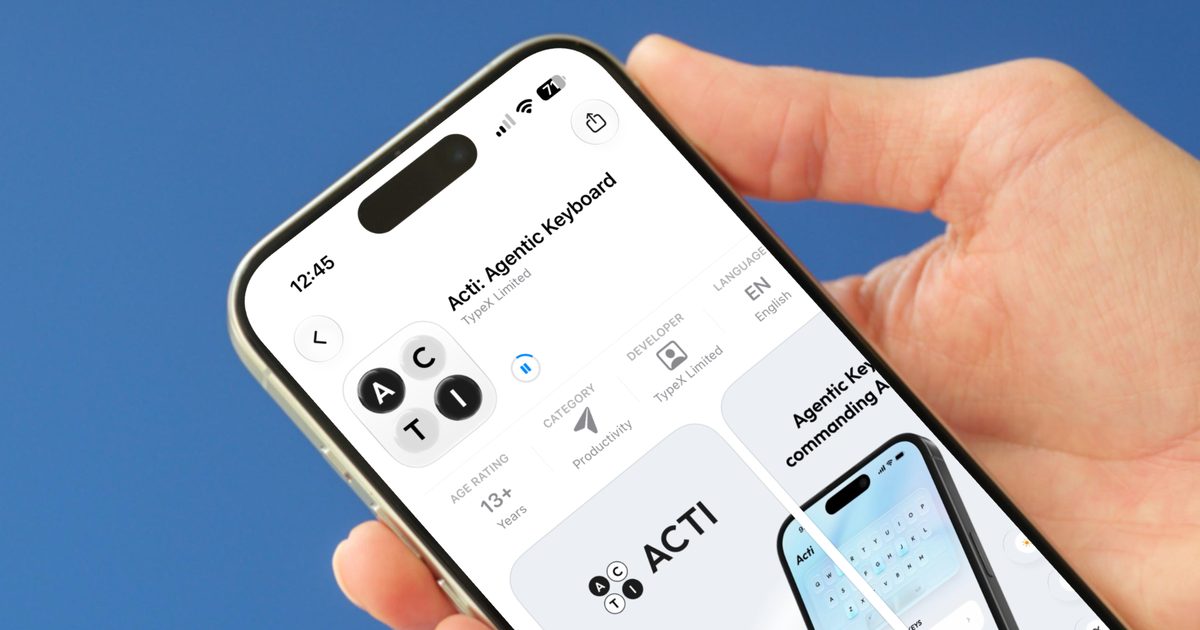
Your smartphone's keyboard is the thing you interact with the most, and yet, it has largely remained the same since it was introduced two decades ago. Yes, it has become better at understanding our typing habits and predicting text, but its function has largely remained unchanged. That is about to change with the arrival of Acti, an agentic keyboard from a Singapore-based startup that aims to turn the humble keyboard into a full-fledged AI assistant.
Keyboard technology has evolved slowly. From the physical keypads of early mobile phones to the virtual keyboards that dominate today, the core experience has always been about text input. Predictive text, autocorrect, and swipe-to-type have made typing faster, but the keyboard itself has never been designed to perform actions beyond typing. Acti challenges that by embedding an AI agent directly into the keyboard, allowing users to execute tasks without leaving the current app.
What makes Acti different?
Acti, short for "action," launched recently on both iOS and Android. Unlike traditional keyboards that only suggest the next word, Acti can actually perform tasks for you inside the apps you already use—whether that is your messages, email, or social media. The star of the show is the ActiBar, which replaces your humble space bar. Press it to type like normal, or hold it to trigger an action. For example, say a friend asks where you are. You can type the location in the chat, and hold the ActiBar. It will find that location and drop it into the chat. Similarly, you can use it to find scores, restaurants in the area, and much more. It even creates live mini apps to share things so the other party can easily browse what it found.
What makes Acti special is its ability to go beyond simple queries. The keyboard integrates with third-party apps via actions assigned to any key. For instance, you can hold the N key to summon a specific Notion document and drop it into your chat, or hold L to pull up a LinkedIn profile when someone suggests a name. This kind of context-aware action reduces the friction of switching between apps, which is a common pain point in mobile workflows. By living inside the keyboard, Acti becomes an always-available assistant that does not require opening another app or invoking a separate voice command.
The agentic keyboard concept
The idea of an agentic keyboard is not entirely new, but Acti is one of the first to bring it to mainstream mobile platforms. Agentic systems are those that can act on behalf of the user, making decisions and performing tasks autonomously or semi-autonomously. In the context of a keyboard, this means the keyboard can understand the context of your conversation, know what apps are available, and execute actions accordingly. This is a significant leap from traditional keyboard features like text prediction or autocorrect.
The underlying technology relies on a combination of on-device processing and cloud services for more complex tasks. Acti is designed to be local-first, meaning your personal data stays on your device unless a feature requires external help. This privacy-conscious approach is crucial for user trust, especially when the keyboard has access to sensitive content like messages and emails. The startup plans to offer free access with premium subscriptions for advanced features, though pricing details have not been fully disclosed.
Building custom shortcuts with Skills
Acti also lets users build their own shortcuts, called Skills, by simply describing what they want in plain language. This democratizes the creation of automations, allowing anyone to create custom workflows without coding. For example, a user could create a Skill that automatically generates a summary of a news article when they type a keyword, or one that checks the weather and suggests an appropriate response in a message. These Skills can be kept private or shared with the community, fostering an ecosystem of useful actions.
The Skill Builder uses natural language processing to interpret the user's intent and map it to available app integrations. This is similar to how platforms like IFTTT or Shortcuts work, but Acti embeds it directly into the keyboard environment. The result is a seamless experience: you think of an action, describe it, and it becomes available as a keyboard shortcut without ever leaving the app you're in. The potential for productivity is enormous, especially for professionals who frequently switch between communication apps and information sources.
Expanding the keyboard's role
The keyboard has long been a passive tool, but Acti's approach could redefine its role. With the rise of AI agents and chatbots, users are becoming accustomed to having assistants that can understand and execute commands. Acti brings that capability to the most fundamental input method on smartphones—the keyboard. By reducing the friction of performing common tasks, it could change how we interact with our devices.
Consider the scenario of planning a dinner with friends. Currently, you might type a message asking for restaurant suggestions, then switch to Google Maps to find options, then copy and paste a link back into the chat. With Acti, you can simply type "Find Italian restaurants nearby" while still in the messaging app, hold the ActiBar, and the results appear as a mini app embedded in the chat. The other person can browse the list without leaving the conversation. This kind of fluid integration could become the new standard for mobile multitasking.
Another area where Acti shines is in professional settings. For remote workers, the ability to quickly attach a file from cloud storage, pull up a calendar event, or insert a code snippet from a development tool can save significant time. Acti's key-binding feature allows power users to map their most frequent actions to specific keys, creating a personalized productivity matrix. Over time, the system may learn from usage patterns and suggest new actions, further automating repetitive tasks.
Technical foundation and limitations
Acti is built on a modern AI stack that includes large language models for understanding natural language and computer vision for interpreting screen content when needed. However, the company emphasizes that many operations are handled locally using Apple's Core ML and Android's TensorFlow Lite frameworks. This keeps latency low and protects privacy. For actions that require external data—like fetching live weather or stock prices—the app uses secure APIs with anonymized requests.
One limitation is that Acti requires granting accessibility permissions on both platforms, which some users may find concerning. Accessibility permissions allow the keyboard to read screen content and simulate taps, which are necessary for performing actions inside other apps. Acti states that it does not log or store any personal data from accessibility access, but the perception of risk remains. Similarly, the keyboard needs network access for certain Skills, which could raise bandwidth and privacy questions. The startup has published a privacy policy detailing data handling, but as with any new AI tool, user caution is advised.
Another challenge is competition. Major tech companies like Google and Apple have been enhancing their own keyboard offerings with AI features. Google's Gboard already includes a built-in assistant with search, translate, and smart reply capabilities, though it is not as extensible. Apple's QuickType keyboard leverages on-device intelligence for predictions and dictation, but it does not offer third-party integrations or customizable actions. Acti's edge lies in its openness and focus on actions rather than just text. Still, it remains to be seen whether users will adopt a third-party keyboard over the default options, especially given the friction of changing input methods on iOS.
Broader implications for mobile interaction
The rise of agentic keyboards could herald a shift in how we think about mobile user interfaces. For years, the phone has been dominated by the app model—each app is a silo, and switching between them requires leaving one context and entering another. Keyboard-based agents like Acti offer a way to break down these silos by acting as a universal control plane. Instead of learning dozens of app-specific shortcuts, users can rely on one intelligent keyboard that understands their intent and executes actions across apps.
This concept aligns with the broader trend of ambient computing, where the device anticipates needs and reduces explicit commands. If successful, Acti could inspire competitors to build similar functionality, leading to a new category of mobile productivity tools. However, the path to mass adoption is fraught with challenges: user education, platform restrictions, and the inherent difficulty of making AI reliable in unpredictable contexts. Acti's early demos show promise, but real-world usage will test its robustness.
The keyboard's location on the screen—always present during text input—makes it an ideal spot for an assistant. Unlike a standalone AI app that requires opening and typing every command, the keyboard can be invoked instantly by tapping a text field. This low-friction access is why voice assistants have struggled to gain a foothold on phones; they require speaking aloud, which is not always appropriate. A keyboard-based agent works silently and discretely, respecting social norms while still providing powerful automation.
In summary, Acti represents a bold reimagining of a tool we use every day. By turning the keyboard into an AI assistant that can perform tasks inside apps, it addresses a long-standing inefficiency in mobile workflows. With its custom Skills, local-first privacy, and ease of use, it has the potential to change how we interact with our smartphones. The only question is whether users will embrace a new way of typing—one where holding down the space bar does much more than just add a space.
Source: Digital Trends News