

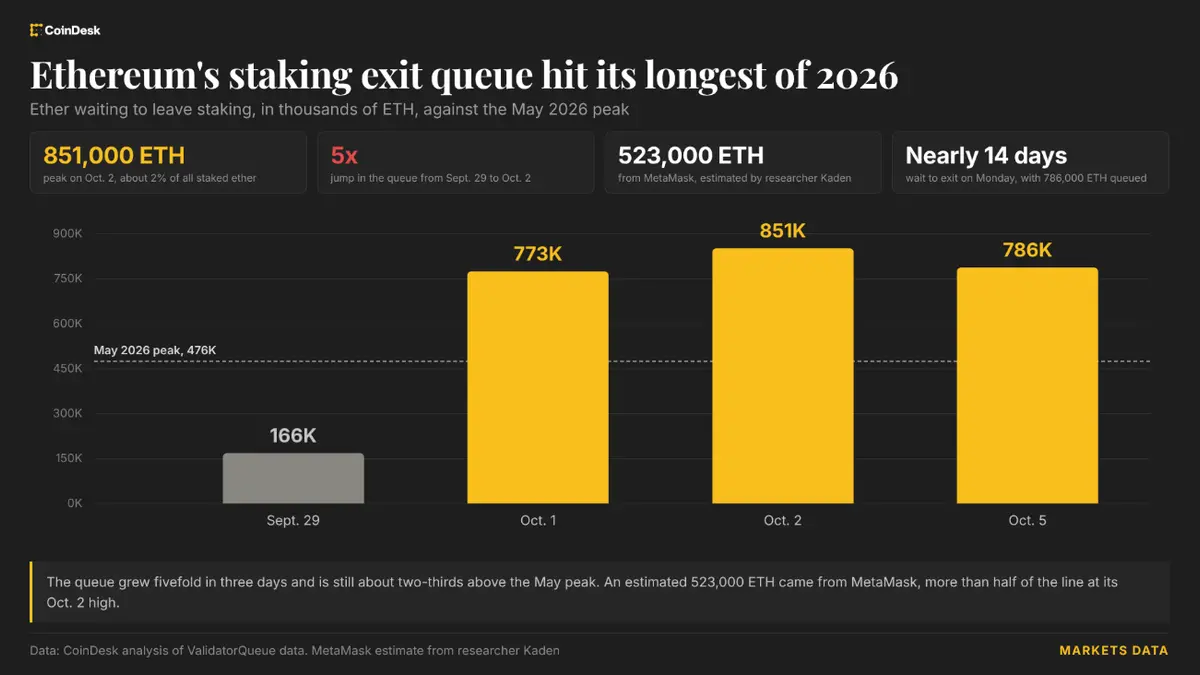
Ethereum's staking exit queue has become a bottleneck for investors seeking to withdraw ether, with the line stretching to nearly two weeks and reaching its longest wait of 2026. The backlog formed after a surge of validator withdrawals, led by MetaMask following a security incident. The queue is not a sign that Ethereum has stopped processing withdrawals; it is a built-in safety mechanism that limits how quickly validators can leave the network. But for holders, the practical effect is a waiting period that can feel much longer than a typical crypto transaction.
What triggered the 2026 exit queue spike
Ether waiting to leave Ethereum staking surged more than fivefold in three days. By Oct. 2, about 851,000 ETH was queued for exit, up sharply from earlier levels. The catalyst was MetaMask, which began withdrawing validators after a security incident. MetaMask said it found no evidence that wallets or customer funds were affected. Even so, the wallet provider moved to exit validators as a precaution, and that decision rippled through Ethereum's staking mechanics.
By Monday, roughly 786,000 ETH remained in the exit queue. At an ether price of about $2,499.89, that backlog was worth more than $2 billion. The estimated wait was nearly 14 days, meaning validators that joined the queue could not expect to receive their staked ether and rewards until the queue cleared. The exit queue's length is determined by Ethereum's protocol rules, not by any single company's withdrawal request.
Why Ethereum makes validators wait
Ethereum uses a proof-of-stake consensus model. Validators lock at least 32 ETH to help secure the network, propose blocks, and attest to the chain's state. In return, they earn rewards. The system is designed to keep the validator set stable. If validators could enter and exit instantly and without limits, the network could face sudden changes in the amount of stake securing it. That could create security risks, especially if a large group tried to leave all at once.
To prevent that, Ethereum enforces activation and exit queues. Both queues process validators at a controlled rate. The rate is tied to the total number of active validators and is adjusted through protocol parameters. The exact daily throughput varies, but the goal is always the same: smooth out changes to the validator set. This is why a withdrawal request that looks simple on the surface can take days or even weeks to complete.
The same mechanism also affects new validators waiting to enter. Earlier in 2026, entry queues were a bigger story. But by early October, the dynamic had flipped. Ether waiting to enter staking had fallen by more than a quarter since early September. At the same time, the exit queue hit its longest of 2026. That divergence told a clear story: new staking demand was cooling while existing validators were rushing for the exits.
The MetaMask withdrawal and its ripple effects
MetaMask is one of the most widely used crypto wallets, and its staking service gives users a way to participate in Ethereum validation without running their own hardware. When MetaMask began withdrawing validators, it added a large block of exits to the queue. The company's statement that wallets and customer funds were not affected was important for users, but it did not remove the operational decision to withdraw validators.
Security incidents in crypto often lead to precautionary moves. Even when funds are safe, teams may choose to reduce exposure, rotate infrastructure, or pause certain services. In this case, the validator withdrawals became visible on-chain through the exit queue. That visibility is one of the strengths of public blockchains: market participants can see the queue building in real time and adjust their expectations.
The withdrawal wave also highlighted how interconnected staking has become. MetaMask's validators are part of a broader ecosystem that includes liquid staking protocols, institutional staking providers, and individual node operators. When one major participant exits, the queue lengthens for everyone behind it. That can affect withdrawal timelines for unrelated validators, because the queue is first-come, first-served at the protocol level.
Lido and the 45-day restaking plan
Lido, a major liquid staking protocol, expects the withdrawn ether to be gradually restaked in a process that could take up to 45 days. That timeline matters because it suggests the ETH leaving validators may not all flow into the open market. If the ether is restaked, it will return to securing Ethereum rather than being sold. That could reduce the immediate sell pressure that some traders feared when they saw the exit queue balloon.
The 45-day estimate also shows how long it can take to normalize staking flows after a shock. Restaking is not instantaneous. Validators must go through the entry queue, and the protocol must manage its validator set carefully. Lido's plan implies a staged approach, likely designed to avoid creating a new bottleneck in the opposite direction. In other words, the exit queue may be long now, but the entry queue could become busier later if large amounts of ETH are restaked.
What the backlog means for ETH holders
For ETH holders, the exit queue has several implications. First, staked ether is not instantly liquid. Even if a validator requests an exit, the ETH remains locked until the queue processes the request. That can matter for traders who want to sell, for institutions managing liquidity, and for protocols that rely on staking withdrawals for redemptions.
Second, a long exit queue can influence market sentiment. Some observers view a growing queue as a bearish signal, assuming that validators plan to sell. Others view it as a neutral or even temporary event, especially if the withdrawals are driven by a security precaution rather than a change in long-term conviction. The truth is usually more nuanced. Not every validator that exits will sell its ETH. Some will restake, some will move to different providers, and some will hold.
Third, the queue can affect staking yields. When fewer validators are active, rewards can rise for those who remain. When more validators join, rewards can fall. The recent drop in the entry queue suggests that new staking demand has weakened, which could eventually support yields if the active validator set shrinks. But the exit queue itself does not immediately change the validator count; it only changes it as withdrawals are processed.
Ethereum price context
At the time of the queue spike, ether was trading around $2,499.89, up about 0.16%. The modest price move suggested that the market was not treating the exit queue as an immediate crisis. That may be because the withdrawals were tied to a security precaution rather than a fundamental rejection of Ethereum staking. It may also be because large queues have become a familiar feature of Ethereum since withdrawals were enabled.
Still, the size of the backlog was notable. More than $2 billion worth of ETH waiting to exit is a meaningful amount of potential liquidity. If even a fraction of that ETH is sold after withdrawal, it could weigh on prices. If most of it is restaked, the impact could be minimal. The market's reaction will depend on what happens after the queue clears, not just on the queue's length.
Historical context: queues are part of Ethereum's design
Ethereum did not always allow staking withdrawals. When the network moved to proof of stake, validators could deposit ETH but could not withdraw it. That changed with a later upgrade that enabled withdrawals. Once withdrawals went live, exit queues became a regular part of staking. Early queues formed as validators who had been locked for years finally gained the ability to leave. Later, entry queues dominated as staking demand grew.
The 2026 queue is different because it was triggered by a specific operational event. It is also notable for its timing. The entry queue had been falling since early September, which meant fewer new validators were waiting to join. That made the exit queue's surge stand out even more. A balanced market might see entries and exits offset each other. Instead, the two queues moved in opposite directions, creating a one-sided backlog.
Ethereum's queue system is often described as a safety valve. It prevents sudden changes to the validator set, but it also creates delays during periods of stress. Those delays can be frustrating for users, especially when they compare Ethereum withdrawals to centralized exchange withdrawals. But the trade-off is intentional: the network prioritizes security and predictability over instant liquidity.
Key facts at a glance
- Ether waiting to leave Ethereum staking surged more than fivefold in three days, reaching about 851,000 ETH on Oct. 2.
- The trigger was MetaMask beginning to withdraw validators after a security incident.
- About 786,000 ETH, worth more than $2 billion, remained in the exit queue Monday.
- The estimated wait was nearly 14 days because Ethereum limits how quickly validators can leave.
- Ether waiting to enter staking had fallen by more than a quarter since early September.
- MetaMask said it found no evidence that wallets or customer funds were affected.
- Lido expects the withdrawn ether to be gradually restaked in a process that could take up to 45 days.
- Ether was trading around $2,499.89, up about 0.16%, as the queue remained elevated.
Why the queue could clear slowly
The exit queue is not a simple line that moves at a constant speed. It depends on how many validators are active and how the protocol's churn limit is calculated. As validators leave, the active set changes, which can affect the rate at which the remaining queue is processed. That makes precise predictions difficult. The nearly 14-day estimate was just that: an estimate based on conditions at the time.
If more validators join the queue, the wait could lengthen. If some validators cancel their exit requests, the wait could shorten. Validators can sometimes choose to remain active, and liquid staking protocols may adjust their validator sets based on demand. Those decisions are not fully visible in advance, which adds uncertainty for anyone waiting to withdraw.
The queue also interacts with restaking. If Lido and other providers restake withdrawn ether, those ETH will eventually need to go through the entry queue. That could create a new backlog on the entry side, even as the exit queue clears. The net effect would be a rotation of stake rather than a permanent reduction. For the network, that is a healthier outcome than a large exodus. For traders, it means the supply of ETH available to sell may be smaller than the raw exit queue suggests.
What to watch next
The most important number to watch is the exit queue length. If it starts to fall steadily, the backlog is clearing. If it continues to rise, more validators are trying to leave than the protocol can process. The entry queue is equally important. A recovering entry queue would suggest that staking demand is returning, possibly as providers restake withdrawn ETH.
Another key signal is the behavior of large staking providers. MetaMask's withdrawal decision set off the queue, but the response from other providers will determine how long the effects last. If other validators stay put, the queue may clear without broader disruption. If they follow with their own withdrawals, the backlog could grow.
Finally, the price of ether will be a real-time gauge of market sentiment. A stable price during a long exit queue would suggest that holders are not panicking. A sharp drop would suggest that the market expects the withdrawn ETH to be sold. The initial reaction was muted, with ETH up slightly. But the queue is a slow-moving event, and its full impact may not be visible until withdrawals are processed.
Source: Coindesk News