

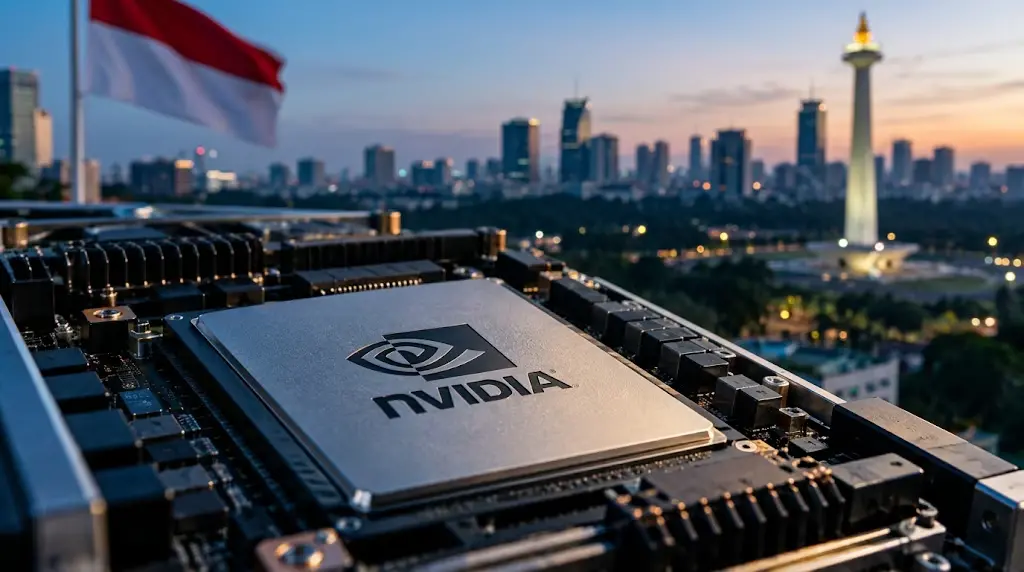
Indonesia is moving aggressively to convert its artificial intelligence ambitions into physical infrastructure. Zankore, an AI infrastructure platform launched by Indosat Ooredoo Hutchison in collaboration with Ooredoo Group, Nvidia, and Nokia, has secured a senior term loan facility of up to $3.1 billion. The financing will support the acquisition and deployment of advanced Nvidia GPU infrastructure for an AI cloud platform. The initial phase is designed to deliver 100 megawatts of Nvidia AI infrastructure in Indonesia, but the platform’s longer-term target is far larger: up to 1 gigawatt of Nvidia DSX AI Factory capacity. Citi served as exclusive debt adviser on the facility.
Key Facts at a Glance
- Zankore secured a senior term loan facility of up to $3.1 billion.
- The platform is building an initial 100 MW of Nvidia AI infrastructure in Indonesia.
- Long-term target: up to 1 GW of Nvidia DSX AI Factory capacity.
- Approximately 200 MW of AI capacity is targeted for the first half of 2027.
- Nvidia GB300 NVL72 systems are expected to power that phase.
- Construction in Batang, Central Java, is targeted to begin in the first half of 2027.
- The project is intended to serve AI companies, enterprises, startups, developers, and institutions in Indonesia and Southeast Asia.
Indonesia’s AI Ambitions Take Shape With $3.1 Billion Financing
Indonesia has spent years positioning itself as one of Southeast Asia’s most important digital economies. With a population of more than 270 million, a rapidly growing startup ecosystem, and rising enterprise demand for cloud and analytics, the country has become a natural target for data-center investment. The Zankore financing adds a new layer: large-scale accelerated computing designed specifically for AI. The project is not merely another colocation facility. It is an AI cloud platform built around Nvidia GPU infrastructure, intended to serve AI companies, enterprises, startups, developers, and institutions in Indonesia and elsewhere in Southeast Asia.
The size of the facility matters. A senior term loan of up to $3.1 billion signals that lenders see the project as bankable, not speculative. The involvement of Citi as exclusive debt adviser adds further weight. For Indonesia, the financing moves the country’s AI hub ambitions from a long-term policy target toward funded deployment. The Ministry of Communication and Digital Affairs has described Zankore as a major step toward making Indonesia a regional AI hub and has projected that the platform could reach up to 1 GW within three years.
Zankore’s Buildout: From 100 MW to 1 GW
Zankore’s current financing announcement focuses on an initial 100 MW of Nvidia AI infrastructure. That capacity will be used to acquire and deploy advanced Nvidia GPUs for the AI cloud platform. But the platform’s ambitions extend well beyond that first block. When Zankore was launched in August, Indosat, Ooredoo Group, Nokia, and Nvidia announced a target of up to 1 GW of Nvidia DSX AI Factory capacity. Approximately 200 MW of AI capacity is targeted for the first half of 2027, with Nvidia GB300 NVL72 systems expected to power that phase.
There is a slight difference in how the phases have been described. The Ministry of Communication and Digital Affairs said construction in Batang, Central Java, is targeted to begin in the first half of 2027, with the broader first phase expected to reach approximately 200 MW. Zankore’s newer financing announcement separately describes an initial 100 MW of Nvidia AI infrastructure. That suggests a staged buildout: an initial 100 MW block supported by the new loan, followed by additional capacity as the project advances toward the 200 MW first phase and, eventually, the 1 GW long-term target.
Why Nvidia DSX and GB300 NVL72 Matter
The project is being designed around Nvidia DSX, the company’s architecture and operational framework for building large AI factories. DSX is not just a hardware reference. It brings together accelerated computing, networking, power, cooling, and operations into a single design philosophy. For a project of this scale, that integration is essential. AI factories are different from traditional data centers because they concentrate enormous compute density into relatively small footprints, requiring specialized power delivery, liquid cooling, high-speed networking, and orchestration software.
Zankore also plans to incorporate Nvidia DSX MaxLPS. According to Nvidia, DSX MaxLPS can enable up to 40% more compute within the same power budget by dynamically optimizing power across GPU fleets. That capability could become increasingly important as Southeast Asia absorbs more AI infrastructure. Power grids, land availability, water for cooling, and sustainability rules are all becoming limiting factors. If MaxLPS can deliver more compute per megawatt, it gives operators more flexibility in markets where electricity capacity is constrained or expensive to expand.
The GB300 NVL72 systems expected for the 200 MW phase represent the next generation of rack-scale AI computing. These systems are designed to train and serve very large AI models, including foundation models, multimodal systems, and enterprise AI applications. For Indonesia, hosting such systems locally could reduce dependence on compute located in other countries and support domestic AI development across government, finance, healthcare, education, and industry.
Batang, Central Java: The Physical Site of the AI Race
Construction in Batang, Central Java, is targeted to begin in the first half of 2027. Batang has emerged as an important industrial area in Indonesia, with government support for infrastructure, energy, and manufacturing investment. Locating an AI factory there connects the project to national industrial policy, not just technology policy. It also spreads digital infrastructure beyond Jakarta, where most of Indonesia’s data-center capacity has traditionally been concentrated.
The choice of Central Java raises practical questions about power, connectivity, and cooling. AI factories require reliable, high-voltage electricity and fiber-optic links to major population centers and international networks. They also need water or advanced cooling systems, depending on design. Indonesia’s grid is still heavily reliant on coal, although the country has significant renewable energy potential. How Zankore powers its AI factory will shape the project’s environmental profile and its long-term operating costs.
Financing Details and Market Implications
The $3.1 billion senior term loan facility is one of the largest disclosed financing packages for AI infrastructure in Southeast Asia. It will support the acquisition and deployment of advanced Nvidia GPU infrastructure. The loan is a senior term facility, meaning it sits at the top of the capital structure and is backed by the project’s cash flows and assets. The involvement of Citi as exclusive debt adviser suggests a structured, bankable approach rather than a speculative venture.
The platform’s customer base is expected to include AI companies, enterprises, startups, developers, and institutions. That mix is important. Pure AI research labs need massive training clusters. Enterprises need inference capacity for production applications. Startups need on-demand GPU access without building their own data centers. Governments and universities need sovereign compute for research and public services. A platform that can serve all these segments could become a critical piece of Indonesia’s digital economy.
The regional context is equally important. Malaysia has attracted large-scale data-center investment, and OpenAI has secured dedicated capacity at two planned AI data centers there that are expected to use Nvidia Vera Rubin systems. Singapore is making at least 200 MW of additional data-center capacity available through its second Data Centre Call for Application, balancing growing AI demand with energy-efficiency and sustainability requirements. Philippine electronics exports could reach up to $54 billion in 2026, with industry leaders citing AI and data-center demand as key growth drivers.
Southeast Asia’s AI Race Is Increasingly Measured in Megawatts
Southeast Asian markets are competing not just on AI adoption but on the physical capacity to host AI workloads. That competition is measured in GPUs, data-center square footage, electricity, cooling, connectivity, and capital. Countries that can provide these inputs quickly and reliably will attract AI investment. Those that cannot may find their businesses and developers relying on infrastructure elsewhere.
Singapore’s approach shows how sustainability rules can shape the race. Its second Data Centre Call for Application makes at least 200 MW of additional capacity available, but with energy-efficiency requirements. Malaysia has moved faster on large-scale data-center parks, attracting major international AI players. Indonesia, with lower land and labor costs and a large domestic market, is trying to carve out its own position. Zankore is designed to give Indonesia a route into that competition: build enough advanced computing capacity locally to support enterprises and developers while eventually serving customers across the wider region.
Power may become as important as processors. The infrastructure boom is reaching beyond data centers themselves, into power generation, transmission, cooling systems, and network links. Several major technology companies have pledged to cover the full energy costs of their data centers, reflecting growing scrutiny of AI’s electricity demand. For Indonesia, the challenge is to expand power capacity while meeting sustainability expectations. For Nvidia and its partners, the opportunity is to deploy more efficient systems that squeeze more compute out of every megawatt.
Domestic Compute, Regional Ambitions
Indonesia wants domestic AI computing capacity for several reasons. Local compute can reduce latency for real-time applications, keep sensitive data within national borders, support local language models, and give startups and researchers access to scarce GPUs. It can also anchor a broader technology ecosystem, including cloud services, data engineering, model development, and AI consulting.
Zankore’s regional ambition is also clear. The platform is intended to serve customers beyond Indonesia, positioning the country as a supplier of AI compute to Southeast Asia. That would mark a shift from being primarily a consumer of foreign technology to becoming a provider of advanced digital infrastructure. The project still has a long way to go before reaching its 1 GW ambition. Zankore has not publicly identified anchor customers or disclosed how quickly capacity beyond its initial phases will be deployed.
Yet the $3.1 billion financing moves the project beyond a long-term infrastructure target and toward funded deployment. As AI demand grows, Southeast Asia’s role in the industry may increasingly depend not just on who adopts AI fastest, but on which countries can provide the GPUs, electricity, cooling, connectivity, and capital needed to run it. Indonesia’s bet is that by building the physical layer of AI, it can secure a place near the center of the region’s digital future.
Source: eWeek News