

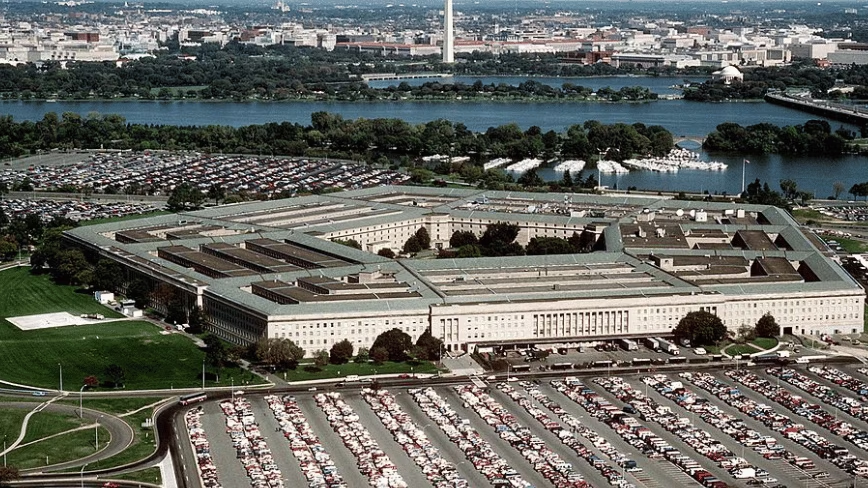
Pentagon Signs Classified AI Agreements with Seven Companies After Anthropic Ejection
On May 1, the Pentagon announced it had finalized classified agreements with Nvidia, Microsoft, Amazon Web Services, and Reflection AI for advanced artificial intelligence on secret military networks. These join previously signed deals with SpaceX, OpenAI, and Google, bringing the total to seven companies authorized to operate on classified military systems under what the Defense Department calls “lawful operational use.” This phrase is a deliberate replacement for the restrictions that Anthropic—the creator of the Claude AI model—sought to impose on military applications.
Anthropic had insisted on contractual prohibitions against mass domestic surveillance and fully autonomous weapons systems in its $200 million Pentagon contract awarded in July 2025. When the Pentagon refused to accept these limits during renegotiations in late 2025 and early 2026, Anthropic held firm. In response, the Defense Department designated the company a supply chain risk in February 2026—a label previously applied to Chinese firms like Huawei and ZTE—and effectively voided the contract. The Pentagon then moved quickly to replace Anthropic with competitors willing to sign broader terms.
The Terms: 'Lawful Operational Use'
The “lawful operational use” clause gives the Pentagon wide latitude to deploy AI for targeting assistance, intelligence synthesis, and operational planning on secret and top-secret networks, without the specific prohibitions Anthropic sought. Defense officials have stated that the new agreements allow the military to “potentially use powerful advanced AI technologies for secret combat operations, including to assist with targeting.” The Pentagon’s statement describes these deals as a step toward “establishing the United States military as an AI-first fighting force.”
The urgency of the deals was underscored by the Pentagon negotiating its AWS agreement late into the previous Thursday evening. An AWS spokesperson, when asked to comment, referred to the Defense Department as “the Department of War”—its pre-1947 name—and expressed enthusiasm for supporting its modernization.
The Seven Companies
The seven companies now operating on classified Pentagon networks represent nearly the entire American AI infrastructure: Nvidia supplies chips; Microsoft and AWS provide cloud infrastructure; Google offers Gemini; OpenAI provides GPT; SpaceX contributes satellite communications and AI models from its xAI acquisition; and Reflection AI specializes in AI for classified and intelligence applications. Smaller defense-focused AI firms also exist, but the Pentagon’s priority is clearly the largest providers.
Defense officials have said the diversification across seven suppliers ensures the military “avoids depending on any one single company or set of limitations”—a direct reference to the Anthropic fallout. The Pentagon does not want a single AI company’s ethical red lines to constrain military operations. Instead, all seven providers have agreed to terms that exclude the restrictions Anthropic demanded.
The Anthropic Precedent
Anthropic’s ejection establishes a clear precedent: any AI company that sets specific limits on military use of its technology will be replaced by one that does not. The Pentagon’s message is that it will not negotiate the scope of military AI use with the companies that build it. “Lawful operational use” means the military decides what is lawful and operational; companies merely provide the technology. Whether AI assists with targeting or autonomous lethal decisions is not a question to be resolved through commercial contracts.
Despite the loss of its Pentagon contract, Anthropic has not suffered commercially. Its valuation has risen to approximately $900 billion, up from $380 billion in February 2026, and its revenue run rate is about $30 billion. Its largest compute deal, with Google and Broadcom, far exceeds the Pentagon contract. However, the symbolic impact is significant: the Pentagon has shown it will not tolerate vendor-imposed constraints on military AI.
Practical Implications
AI deployed on Impact Level 6 and 7 classified networks will assist intelligence analysis, operational planning, and data synthesis from classified sources. The Pentagon states these tools will “streamline data synthesis, elevate situational understanding, and augment warfighter decision-making.” In practice, AI will help analysts process intelligence faster, commanders understand battlefields in near real-time, and targeting teams identify objectives. SpaceX’s integration of AI capabilities from xAI adds a unique dimension: a satellite communications company also building AI models, operating on networks that process targeting data.
The speed of the Pentagon’s pivot is striking. Five months ago, Anthropic held a $200 million contract. Today, seven competitors have signed agreements that render Anthropic’s military contribution replaceable. The Pentagon has answered a question debated since Google employees protested Project Maven in 2018: whether AI companies will have a say in how their technology is used by the military. The answer, delivered across seven contracts in a single week, is no.