

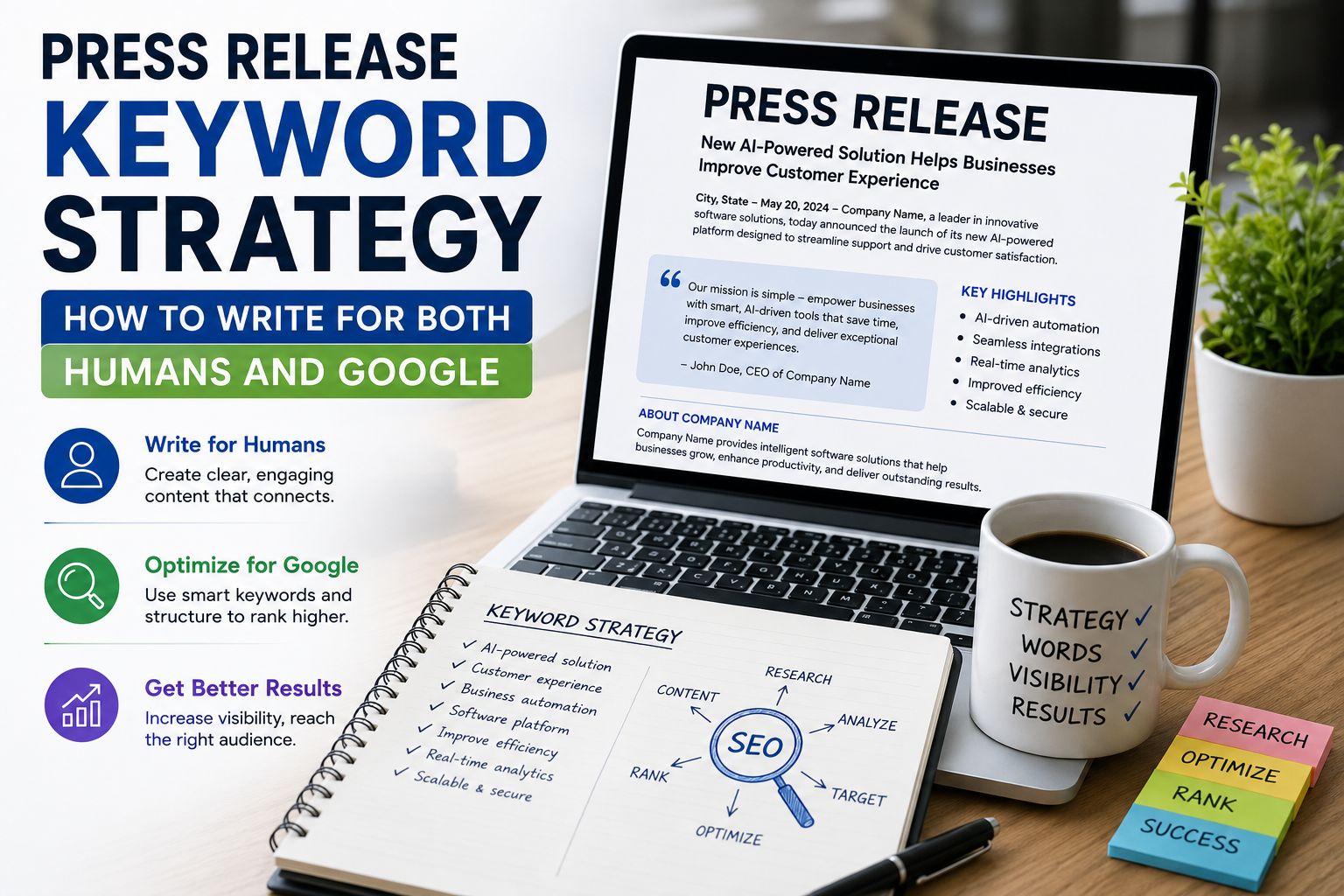
Writing a press release used to be fairly simple. Add a headline, mention your company a few times, insert some keywords, and distribute it. That formula doesn’t work nearly as well anymore.
Search engines have evolved. Readers have too.
If you want your content to rank today, you need a press release keyword strategy that works for both humans and Google. That means writing naturally, organizing information clearly, and understanding how modern search systems interpret context instead of just matching phrases.
Here’s the thing: many press releases fail because they sound robotic. They’re overloaded with repetitive keywords and corporate jargon that nobody actually speaks. I’ve seen brands with genuinely interesting announcements get ignored simply because their content felt unnatural.
Good optimization isn’t about tricking algorithms anymore. It’s about making information easy to understand.
What Is a Press Release Keyword Strategy?
Press Release Keyword Strategy — A structured approach to using keywords naturally in press releases so search engines and readers can clearly understand the topic and purpose of the content.
A keyword strategy helps search engines connect your press release with relevant searches. But modern SEO goes beyond repeating the same phrase over and over.
Google now evaluates:
- Context
- Search intent
- Readability
- Semantic relevance
- User engagement
- Informational quality
That changes how press releases should be written.
For example, if your press release discusses AI customer support software, Google expects related contextual language too:
- automation
- customer service efficiency
- workflow improvement
- response times
- AI-powered tools
This broader understanding is why keyword stuffing usually hurts performance now instead of helping it.
Why keyword intent matters
Search intent is one of the biggest ranking factors many beginners overlook.
A person searching:
“best AI customer support software”
has different intent than someone searching:
“how AI customer support reduces response times”
Your press release should match the likely intent behind your target keyword.
That’s where strategy becomes important.
Human readability now affects SEO
Honestly, this is probably the biggest shift in modern optimization.
Search engines increasingly reward content that people actually enjoy reading. If users bounce quickly because your press release feels awkward or repetitive, rankings can suffer.
In my experience, conversational writing almost always performs better than stiff corporate language.
Why Press Release Keyword Strategy Matters in 2026
Search is changing faster than many businesses expected.
AI-generated summaries, conversational search, and answer engines now shape how users discover information online. Press releases that rely on outdated SEO methods often struggle to gain traction.
Google understands topics better now
Years ago, exact-match keywords mattered heavily.
Today, Google understands relationships between words, concepts, and topics. That means your press release should focus on topical relevance instead of mechanical repetition.
For instance, a release about ecommerce automation doesn’t need to repeat “ecommerce automation software” fifty times.
Natural supporting terms strengthen relevance more effectively.
AI-driven search favors clear explanations
Google increasingly prioritizes content that answers questions directly.
Press releases written with clear explanations have a better chance of appearing in:
- AI-generated summaries
- featured snippets
- voice search results
- answer-based search experiences
What most people overlook is this: Google wants content it can summarize confidently.
Confusing writing creates problems for AI interpretation.
Keyword strategy improves visibility and conversions
Strong keyword targeting doesn’t just improve rankings. It attracts the right audience.
That matters because traffic alone isn’t enough anymore.
A well-optimized press release can help attract:
- journalists
- investors
- customers
- industry professionals
- potential partners
But only if the messaging matches what those people are searching for.
Expert Tip
Don’t optimize for the broadest keyword possible. Specific search intent usually converts better and faces less competition.
How to Build a Press Release Keyword Strategy — Step by Step
1. Start with search intent, not keywords
This sounds backward, but it matters.
Before choosing keywords, ask:
“What is the audience actually trying to learn?”
For example:
- Are they researching?
- Comparing options?
- Looking for breaking news?
- Searching for solutions?
Your press release should match that intent naturally.
I’ve seen companies target high-volume keywords that generated traffic but almost no engagement because the audience expectations didn’t align with the content.
Traffic without relevance doesn’t help much.
Understand informational vs transactional intent
Informational searches seek answers:
“How AI improves customer support”
Transactional searches seek action:
“best AI support software”
Most press releases perform better targeting informational intent because they focus on announcements and explanations rather than direct selling.
2. Choose one primary keyword and supporting terms
One major mistake businesses make is targeting too many unrelated keywords in a single release.
That creates confusion.
Choose:
- One primary keyword
- Two or three secondary keywords
- Several naturally related phrases
For this topic, examples could include:
Primary keyword:
- press release keyword strategy
Secondary keywords:
- press release SEO
- keyword optimization
- SEO press release writing
Related semantic phrases:
- search visibility
- AI search
- Google rankings
- search intent
- keyword placement
This creates topical consistency.
Avoid forcing exact-match repetition
Google understands variations now.
Instead of repeating:
“press release keyword strategy”
you can naturally use:
- keyword planning for press releases
- optimizing press release keywords
- keyword-focused press releases
That feels more human.
Because it is.
3. Place keywords where they matter most
Keyword placement still matters.
Your primary keyword should appear naturally in:
- Title
- First paragraph
- One H2 heading
- Meta description
- Closing section
Secondary keywords can appear throughout the article where relevant.
Headlines are especially important
A headline helps search engines identify the topic immediately.
Weak headline:
“Exciting New Marketing Announcement”
Better headline:
“Press Release Keyword Strategy for Better Google Rankings”
Specificity improves visibility and click-through rates.
Don’t overload introductions
This is where many writers go overboard.
An introduction stuffed with repeated keywords usually feels unnatural instantly.
Instead, prioritize readability first.
4. Write for humans before algorithms
This advice sounds cliché now, but honestly, many brands still ignore it.
Search engines increasingly reward engagement signals:
- time on page
- readability
- interaction
- click-through behavior
That means content needs to feel useful and natural.
Use conversational language
Corporate phrasing often hurts readability.
Compare these examples:
Corporate:
“The organization remains committed to maximizing operational outcomes.”
Human:
“We wanted to help teams save time and reduce repetitive work.”
One feels easier to process immediately.
Vary sentence structure
AI-generated content often sounds repetitive because sentence patterns remain too consistent.
Human writing has rhythm changes.
Some sentences are short.
Others explain ideas more deeply with additional context and nuance. That variation improves readability naturally.
Expert Tip
If your press release sounds uncomfortable when read aloud, rewrite it. Readers notice awkward phrasing faster than most writers realize.
5. Optimize headings for search and readability
Good headings improve both SEO and user experience.
Instead of vague headings, use descriptive sections that answer questions directly.
Examples:
- What Is a Press Release Keyword Strategy?
- Why Does Keyword Placement Matter?
- How Do You Avoid Keyword Stuffing?
- What Keywords Should Be Used in Press Releases?
This structure helps:
- Google understand content hierarchy
- readers scan information quickly
- AI systems summarize sections accurately
Keep sections self-contained
Each section should make sense independently.
That’s increasingly important because AI systems may pull individual sections into summaries or snippets.
6. Include supporting context and examples
Thin content struggles in modern SEO environments.
Google favors depth and contextual relevance.
That doesn’t mean adding filler. It means adding useful supporting information.
Use realistic examples
For instance:
A software startup once targeted only branded keywords in press releases. Visibility stayed limited because nobody searched those terms yet.
After shifting toward problem-focused phrases like:
“AI onboarding automation”
and
“customer workflow efficiency”
organic traffic improved significantly.
That change aligned the content with real search behavior.
Add specific details
Specificity increases trust.
Compare these statements:
Generic:
“Our tool improves productivity.”
Specific:
“Our platform reduced onboarding completion time from four days to six hours.”
Specific information feels more credible to both readers and search engines.
The Biggest Mistake in Press Release SEO
Most businesses still think more keywords equal better rankings.
That’s outdated.
Keyword stuffing often damages readability, trust, and engagement.
Why over-optimization backfires
Google now evaluates semantic quality rather than simple repetition counts.
A press release overloaded with repetitive phrases feels unnatural quickly.
Readers notice it too.
Honestly, some SEO-focused press releases sound bizarre when spoken aloud.
That’s usually a sign the optimization went too far.
Counterintuitive reality
Using fewer exact-match keywords can actually improve rankings.
That surprises people.
But natural language helps Google understand broader contextual relevance more effectively than forced repetition.
Another common mistake: targeting broad keywords only
Broad terms often face intense competition.
Specific niche phrases usually perform better because they align with clearer user intent.
For example:
Broad:
“marketing software”
Specific:
“AI workflow software for ecommerce support teams”
Specific intent creates stronger relevance.
What Actually Works for Modern Press Release SEO
After years of watching algorithm changes, one thing remains consistent:
Useful content outperforms manipulative optimization over time.
Focus on informational value
Your press release should answer real questions.
Ask yourself:
“What would a reader genuinely want to know?”
That mindset changes writing quality dramatically.
Build topical authority gradually
One optimized press release won’t transform visibility overnight.
Consistent topical relevance matters more.
Brands publishing clear, useful announcements around related subjects gradually strengthen authority in Google’s eyes.
Write with clarity first
Simple communication usually wins.
Not simplistic. Clear.
That distinction matters.
A readable press release helps:
- search engines interpret meaning
- readers stay engaged
- journalists understand the story
- AI systems generate summaries accurately
Personal opinion
Honestly, I think many SEO writers still underestimate readability. They focus heavily on technical optimization while forgetting that confusing content rarely performs well long term.
Search engines increasingly reward usefulness. That trend probably continues from here.
Expert Tip
Before publishing, ask someone outside your industry to read the press release. If they quickly understand the announcement, your structure is probably strong.
How AI Search Is Changing Keyword Strategy
AI-powered search systems now evaluate meaning more deeply.
That changes optimization significantly.
Semantic relevance matters more now
Google understands topic relationships rather than isolated keywords alone.
For example, a press release about cybersecurity might naturally include:
- threat detection
- network monitoring
- data protection
- security automation
- incident response
These supporting concepts strengthen topical relevance naturally.
AI summaries reward concise explanations
Search systems increasingly pull short informational passages into AI-generated results.
That means clear explanations matter more than ever.
Long-winded introductions usually perform poorly in AI-driven search environments.
Conversational search is growing
People increasingly search using natural questions:
- “How does AI customer support work?”
- “What is workflow automation software?”
- “How can small businesses improve onboarding?”
Press releases written conversationally align better with those search behaviors.
People Most Asked About Press Release Keyword Strategy
How many keywords should a press release target?
Usually one primary keyword and a few related secondary terms work best. Trying to target too many unrelated phrases can confuse search engines and weaken relevance.
Does keyword density still matter?
Not the way it used to. Natural language and semantic relevance matter far more now than exact repetition percentages.
Where should keywords appear in a press release?
Your primary keyword should appear naturally in the title, introduction, one heading, meta description, and closing section.
Can keyword stuffing hurt rankings?
Yes. Overusing keywords often reduces readability and may weaken search performance because Google prioritizes natural language quality.
Are long-tail keywords better for press releases?
In many cases, yes. Long-tail phrases often align with clearer search intent and face lower competition than broad keywords.
Should press releases sound conversational?
Usually yes. Conversational writing improves readability, engagement, and AI interpretation without sacrificing professionalism.
How does AI search affect keyword strategy?
AI search focuses more on meaning, context, and user intent. That means topical depth and clarity matter more than repetitive optimization tactics.
How often should brands publish SEO press releases?
Quality matters more than frequency. Publish when you have meaningful updates, useful insights, or genuinely newsworthy announcements.
Final Thoughts
A successful press release keyword strategy is no longer about squeezing keywords into every paragraph. It’s about creating content that readers and search engines can understand easily.
Google increasingly rewards clarity, relevance, topical depth, and natural communication. Press releases written with those principles tend to perform better over time — especially as AI-driven search continues evolving.
And honestly, that’s probably better for everyone. Readers get more useful information, and brands that communicate clearly gain stronger visibility naturally.