

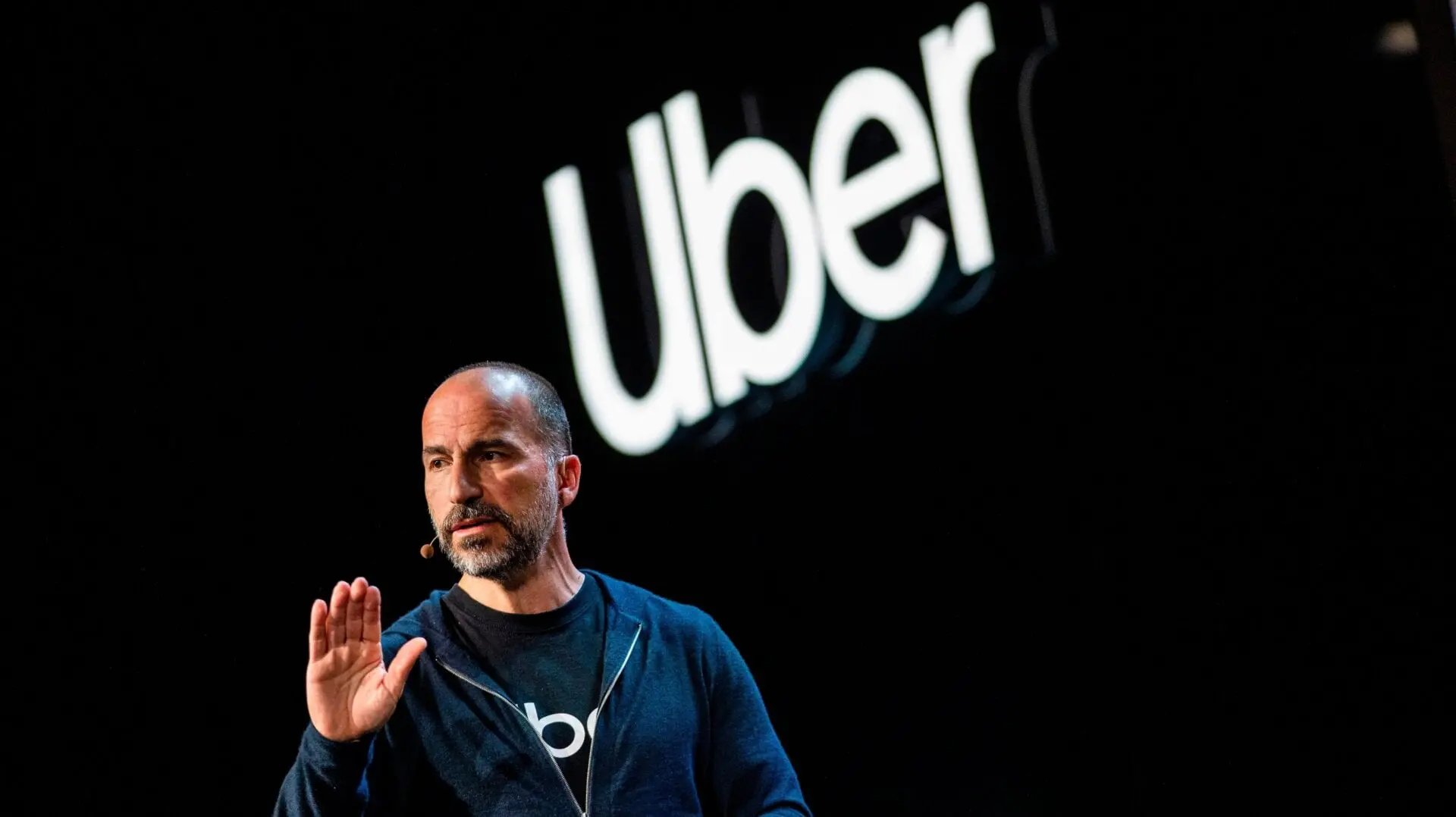
Uber is the latest Silicon Valley company to blame too much bureaucracy for job cuts, and the numbers are stark. CEO Dara Khosrowshahi sent a memo to staff Wednesday announcing that the ride-hailing company was cutting about 10% of its workforce as part of a major reorganization. The company confirmed reports that roughly 3,300 employees, primarily middle managers, were being let go.
“We are removing layers, simplifying team structures, refining our global location strategy, and focusing our people and investments against the biggest opportunities ahead of us,” Khosrowshahi wrote in the memo.
The layoffs come just weeks after Uber reported $14.2 billion in quarterly revenue and $2.4 billion in net income, both significantly higher than a year earlier. Despite those healthy finances, Khosrowshahi argued that the company’s “growth has also brought complexity,” including more layers, coordination, and fragmented ownership that no longer serve the company well. As part of the overhaul, Uber is reducing the number of employees who sit seven or more layers below the CEO by about 20%. It is also cutting the number of “micro-teams,” teams with just one or two direct reports, by nearly 50%.
A familiar refrain in tech
Khosrowshahi’s memo echoes comments from other tech executives at companies like Amazon and Meta, who have cut jobs while arguing their companies have become too unwieldy to move and innovate quickly. The language of “flattening” and “removing layers” has become a recurring theme in Silicon Valley since the post-pandemic hiring boom turned into a wave of layoffs and cost discipline. For many observers, the Uber announcement is another sign that the era of hypergrowth in tech has given way to a focus on operational efficiency.
Uber’s cuts are especially notable because the company has been consistently profitable for recent quarters after years of heavy losses. In the past, Uber executives emphasized expansion into new regions and verticals, from food delivery to freight. That expansion led to a sprawling organizational structure, with overlapping managers and teams that needed multiple layers of approval for even routine decisions. Khosrowshahi’s memo suggests that the company now believes complexity is undermining its ability to respond quickly to competitive threats and technological shifts.
One of those shifts is the rapid rise of autonomous vehicles, particularly Alphabet’s Waymo. Waymo is now providing fully autonomous rides in 14 U.S. cities and is quickly expanding into more. In Atlanta, where Waymo rides are booked through Uber, some Uber and Lyft drivers told Axios that they have seen lower earnings, fewer ride requests, and longer waits between rides since Waymo launched in the city last year. Waymo’s growth represents an existential challenge to the traditional ride-hailing model, which depends on a massive network of human drivers.
The AI question
AI could also be part of the equation, even though Khosrowshahi’s memo does not mention it at all. Bloomberg reported in June that Uber had put spending caps on some AI tools after blowing through its annual AI budget in just a few months. Meanwhile, Khosrowshahi said earlier this year that about 10% of Uber’s code was being built by AI agents, while employees in other departments like legal and marketing were also increasingly using AI. At the time, the company said it would slow down hiring because of the growing benefits of AI, according to Bloomberg.
That timeline suggests AI may have accelerated a restructuring that Uber had already intended to make. If AI agents can write code, draft legal documents, and create marketing content, then fewer managers are needed to oversee those tasks. Khosrowshahi has been publicly enthusiastic about AI’s potential, but he has also been careful not to frame layoffs as a direct consequence of automation. Instead, he has pointed to “bureaucracy” and “overhiring” as the root causes—a framing that avoids the politically awkward suggestion that machines are replacing workers.
Uber is not the first tech company to link AI to a push for smaller, flatter teams. When Block cut more than 4,000 jobs earlier this year, CEO Jack Dorsey wrote in a company memo that its intelligence tools were making it possible to operate with “smaller and flatter teams.” Other tech leaders, including Meta’s Mark Zuckerberg, Amazon’s Andy Jassy, and Alphabet’s Sundar Pichai, have also emphasized efficiency gains from AI. The result is a profound shift in how tech companies view head count: managers who were once seen as necessary coordinators are now often viewed as costly layers of friction.
What overhiring looks like
Uber’s hiring spree during the pandemic is well documented. As lockdowns eased and delivery demand surged, Uber added tens of thousands of workers across many departments. In 2020, the company had around 22,600 employees. By the end of 2023, that number had swelled to roughly 33,000, and it continued climbing in subsequent years. This explosive growth created what analysts call “shadow hierarchies”—chains of managers whose primary job was to manage other managers. Over time, decision-making became slower, and accountability became diffuse.
Khosrowshahi’s plan targets these middle layers directly. By cutting the number of employees seven or more layers below the CEO by 20%, Uber is effectively trying to ensure that top executives have clearer visibility into day-to-day operations. Similarly, halving the number of micro-teams encourages small teams to consolidate, reducing unnecessary meetings and handoffs. Employees who survive the cuts may find themselves with broader responsibilities and more direct access to senior leaders, but they will also face greater expectations to produce visible results.
Investing in autonomy
Uber’s reorganization is not just about internal efficiency. Khosrowshahi made clear that the cuts would give Uber more capacity to invest in drivers, couriers and merchants, as well as to “build the autonomous future.” Uber has been investing billions into its own robotaxi efforts. The company has struck partnerships with several companies including Lucid, Nuro, and Rivian to build its robotaxi fleet and has said it plans to invest more than $10 billion to “bring AVs to market at scale.”
The race to autonomous ride-hailing is intense. Waymo has a first-mover advantage in many markets, and other companies like Tesla, Cruise, and Zoox are also pushing to expand their own fleets. Uber’s strategy has been to partner with multiple AV developers rather than develop its own vehicles from scratch. That approach allows Uber to maintain its platform dominance while avoiding the enormous costs and technical risks of manufacturing autonomous cars.
But the pressure is mounting. If Waymo and other robotaxi services become more common, Uber’s human driver network could become a liability rather than an asset. Human drivers are expensive, inconsistent, and prone to strikes and lawsuits. Autonomous vehicles, once perfected, promise lower marginal costs and around-the-clock availability. Uber has already had a complicated relationship with drivers, many of whom protest fare cuts and working conditions. A successful autonomous fleet could theoretically reduce Uber’s dependence on a restless gig workforce—but it also threatens the livelihoods of millions of drivers who currently make the platform function.
The middle manager paradox
Middle managers often bear the brunt of layoffs because they are seen as the most expendable layer in a corporate hierarchy. But many management experts warn that slashing middle management without careful planning can backfire. Middle managers are frequently the ones who implement strategy, mentor junior employees, and translate high-level directives into actual work. If too many are removed, companies may lose institutional knowledge and find that remaining employees are overworked and burned out.
Khosrowshahi’s memo tries to address this concern by linking the cuts to a broader simplification of team structures. In theory, if there are fewer layers and fewer micro-teams, fewer managers are needed to coordinate between them. But critics of the tech industry’s recent layoffs say that executives are too quick to blame “bureaucracy” when the real problem is a slowing economy, pressure from shareholders to maintain profit margins, and a bet that AI can replace human coordination.
There is also a question of timing. Uber is making these cuts in September 2026, more than a year after regulators and unions began scrutinizing the tech industry’s wide-scale layoffs. Some lawmakers have called on companies like Uber to use their record profits to retain workers rather than fatten executive bonuses. However, tech companies have largely resisted that pressure, arguing that they need to remain lean and competitive in an uncertain global environment.
What happens next
For the roughly 3,300 employees being laid off, the immediate future involves severance packages, outplacement services, and a difficult job market in a sector that has shed tens of thousands of positions over the past two years. Uber has not publicly provided details on the compensation terms, but the company has historically offered at least four weeks of pay plus additional weeks based on tenure, along with continued health benefits for a limited period.
The announcement is also likely to add fuel to the ongoing debate over AI and employment. At the same time that companies like Uber are cutting jobs, they are hiring for AI-related roles and investing more heavily in data centers, chips, and model development. The net effect on the broader labor market remains uncertain, but it is already clear that the tech industry’s internal structure is evolving. Flatter organizations, enabled by AI tools, are becoming the new norm.
Uber’s own financial health suggests this isn't a distress-driven layoff. The company’s revenue and net income have been climbing, and its mobility and delivery segments remain strong. This is a repositioning—an effort to preserve Uber’s dominance in ride-hailing and delivery by shedding costly administrative layers and doubling down on autonomy and AI. In his memo, Khosrowshahi wrote that the cuts would give Uber more capacity to invest in drivers, couriers and merchants, as well as to “build the autonomous future.”
Still, some analysts wonder whether cutting middle management is enough to beat Waymo and other autonomous vehicle competitors. Waymo’s robotaxis are already operating in 14 cities, and the Alphabet subsidiary has the deep pockets and technical infrastructure of its parent company. Uber’s partnerships with the likes of Lucid, Nuro, and Rivian are valuable, but they are also fragmented. Building an autonomous fleet from a patchwork of partnerships may prove slower and more complicated than Waymo’s vertically integrated approach.
There is also the risk that AI tools will not deliver the productivity gains that companies like Uber are counting on. Despite impressive advances in coding assistants and chatbots, many enterprise AI applications remain unproven at scale. If AI agents make mistakes that require human experts to correct, the cost savings could be smaller than expected. But Khosrowshahi and other tech leaders appear willing to bet on those tools anyway.
Uber’s announcement is another landmark in the ongoing transformation of the technology workforce. The phrase “doing more with less” is now a core principle at companies responsible for some of the world’s most popular services. Whether that principle translates into better outcomes for customers, shareholders, and (perhaps) employees is still to be determined. What is certain is that the massive hiring waves of the early 2020s have given way to a more cautious and measured approach, one where organizational simplicity is prized above expansion for expansion’s sake.
The affected employees will begin leaving Uber in the coming weeks, according to sources familiar with the plan. Managers are expected to inform their direct reports of the layoffs in individual meetings, and some employees may be offered the chance to apply for different internal positions. But with middle management being deliberately thinned out, many of those roles will likely disappear entirely.
As Uber pivots toward autonomous vehicles and AI-enabled efficiency, the traditional human-centric ride-hailing business that made the company famous is changing rapidly. Drivers who have depended on Uber for their livelihoods may eventually face a platform that prioritizes robots over people. For now, Khosrowshahi insists that humans remain essential to Uber’s day-to-day operations and that the company will continue to invest in the driver experience. Yet Wednesday’s memo makes it clear that Uber’s future is geared toward autonomy, simplification, and artificial intelligence—whether its workforce is ready or not.
Source: Gizmodo News