

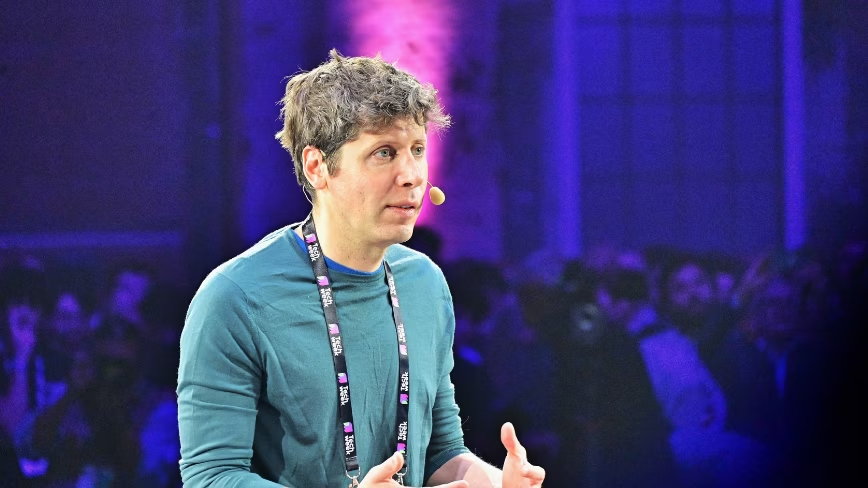
In November 2023, Sam Altman made a bold declaration: he wanted OpenAI to become the first major corporation led by an artificial intelligence chief executive. Speaking on the Conversations with Tyler podcast, he said it would be an embarrassment if his company failed to achieve this. Yet, just eight months later, Altman has completely reversed his position. In a recent interview on the Invest Like the Best podcast, the OpenAI CEO now insists that the market and society at large prefer a human in the corner office. This about-face reveals deep tensions within the AI industry and raises profound questions about the future role of artificial intelligence in corporate leadership.
The Original Vision: AI as CEO
Altman’s original statement was more than just a casual remark; it was a vision for the future of corporate governance. He imagined a world where AI systems could make strategic decisions, allocate resources, and manage teams with superhuman efficiency. This vision aligned with OpenAI’s mission to ensure that artificial general intelligence (AGI) benefits all of humanity. If AI could run a company better than any human, why not let it? Altman framed the race to an AI CEO as a competitive advantage, hinting that the first company to achieve this would set a new standard for the industry. His words were met with a mix of excitement and unease, as many debated whether machines could truly replace human leadership traits like empathy, intuition, and moral reasoning.
The Walk Back: Why Humans Still Matter
Fast forward to July 2024, and Altman’s tone has changed dramatically. “The world wants to know about the person that’s going to be responsible for the decisions of a company,” he said. “And they don’t really want an AI CEO.” This reversal is not isolated; it fits a broader pattern of Altman softening the maximalist predictions that once defined his public persona. He previously warned that AI would eliminate entire classes of jobs, but now he claims to be “delighted to be wrong” about the short-term impact on entry-level work. This shift appears to be a strategic response to growing public anxiety about AI replacing human workers. Altman’s explanation is simple: people still prefer people. “I definitely would much rather engage with a person than engage with an AI for almost everything,” he said, giving the example of art. “You read a novel, you want to know about the person behind it.”
The Pattern: Conviction or Convenience?
Altman’s reversal introduces an obvious tension. On one hand, he leads OpenAI, the company behind the most aggressive and widely adopted AI tools in the world. On the other hand, he now downplays the very capabilities that his products are designed to enhance. Critics argue that this is not intellectual evolution but strategic convenience. By emphasizing human irreplaceability, Altman deflects blame from the job displacement and content saturation caused by his own technologies. At the same time, he acknowledges a genuine limitation: AI still struggles with the kind of nuanced judgment that experienced managers and artists bring. “The world may need a new kind of word for the kind of judgment that people are very good at, that AIs seem to really deeply struggle with,” he admitted. This concession is significant coming from a man who, just months earlier, wanted to hand over his own job to a machine.
Background: Altman’s Rise and the AI Industry’s Promise
To understand this shift, it’s worth examining Altman’s background and the evolution of OpenAI. Sam Altman became CEO of OpenAI in 2019 after serving as president of Y Combinator, one of the most influential startup accelerators. Under his leadership, OpenAI transitioned from a non-profit research lab to a capped-profit company, raising billions of dollars from Microsoft and other investors. The launch of ChatGPT in late 2022 catapulted OpenAI to global prominence, sparking a massive wave of investment in generative AI. Altman became the face of the AI revolution, testifying before Congress, meeting with world leaders, and making bold predictions about the future. His early statements about an AI CEO were part of this grand narrative: AI would not just assist humans but eventually lead them.
The Debate Over AI in Leadership
Altman’s reversal reflects a broader debate within the tech community. Some experts argue that AI could indeed make better CEOs because it can process vast amounts of data without the biases that plague human decision-making. Others counter that leadership requires qualities AI cannot replicate: vision, emotional intelligence, and the ability to inspire trust. A study by McKinsey found that while AI can optimize operational decisions, C-suite roles rely heavily on stakeholder management, culture-building, and crisis intuition. Altman’s change of heart may be a response to real-world data showing that employees and investors are wary of a machine-controlled top floor. Moreover, recent high-profile incidents, such as the brief ousting and reinstatement of Altman himself from OpenAI in November 2023, underscore the importance of human relationships in corporate governance.
Implications for the AI Industry
Altman’s statements carry weight because OpenAI sets the pace for the entire AI sector. If its own CEO doubts the feasibility of an AI leader, it could slow down the development of autonomous management systems. Competitors like Google DeepMind, Anthropic, and xAI are also exploring AI agents, but they may now reconsider marketing them as replacements for humans. Altman’s shift could also affect public perception. For years, tech leaders have promoted AI as a panacea for inefficiency. Now, one of them is openly acknowledging its shortcomings in leadership. This may lead to more realistic expectations and a greater focus on human-AI collaboration rather than full automation.
Altman’s remarks also highlight the need for new vocabulary to describe the qualities that make humans effective managers. Terms like “wisdom,” “judgment,” and “intuition” are often used but poorly defined. As AI becomes more integrated into corporate decision-making, understanding these human traits will be crucial for designing systems that complement rather than replace leadership. The industry may need to develop new frameworks for evaluating when to trust AI and when to rely on human instinct.
Historical Context
Altman’s reversal is reminiscent of other tech leaders who changed their views after pushing aggressive automation. For example, Elon Musk once warned that AI could lead to a “digital god,” but later founded xAI to compete in the space. Similarly, early AI researchers often oscillate between hype and caution as they confront the real-world consequences of their creations. Altman’s journey from wanting an AI CEO to championing human leadership is part of a maturing perspective. It also reflects the cyclical nature of tech predictions: what seems inevitable today may be reconsidered tomorrow.
As OpenAI continues to develop more powerful models, the question of whether an AI could ever run a company remains open. Altman’s current stance may not be his final one. He has shown a willingness to adapt his rhetoric to changing circumstances. For now, the corner office belongs to humans, but the pressure to automate will only grow. The industry watches to see whether Altman will once again change his mind, or whether the value of human leadership will prove enduring.