

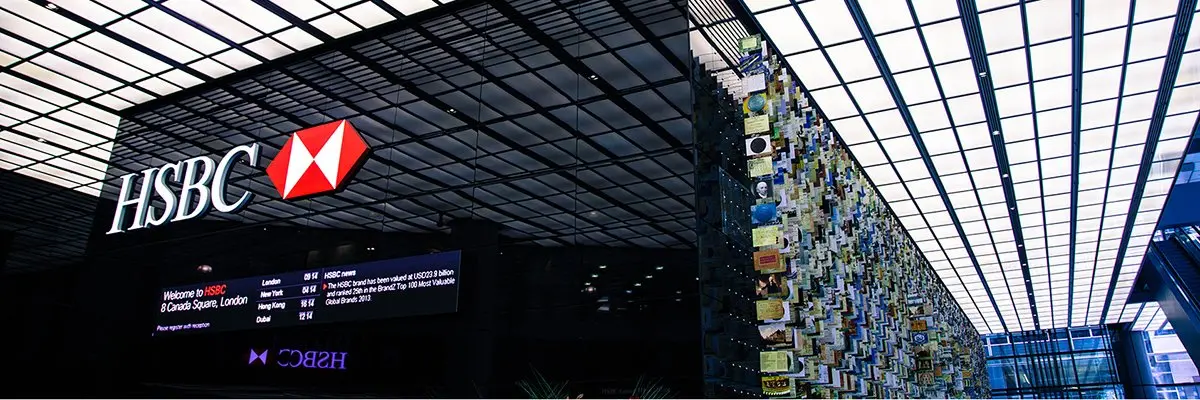
HSBC will establish a global artificial intelligence centre of excellence in Singapore, creating around 100 specialist roles and positioning the city-state as a hub for the bank's expanding AI programme. The centre is set to begin developing AI capabilities in the second half of this year, with the work intended to be rolled out across HSBC's global operations.
The move underscores how global banks are racing to embed AI into customer service, risk management, payments and internal operations. HSBC, one of the world's largest banking groups, has signalled that AI is central to its strategy for improving efficiency and personalising services. The new Singapore centre will form part of the team led by David Rice, the bank's first chief AI officer.
Key facts
- HSBC is launching a global AI centre of excellence in Singapore.
- The centre will create around 100 AI specialist roles.
- It will begin developing AI capabilities in the second half of this year.
- The team will sit under David Rice, HSBC's first chief AI officer.
- Initial focus areas include customer wealth journey conversations, agentic treasury functionality and AI-enabled digital payments.
- HSBC has a separate multi-year AI deal with Google Cloud covering more than 200 AI use cases.
- The bank expects hundreds of millions of pounds in revenue and efficiency gains.
- The centre will build talent in natural language processing, data science, AI governance and human-centred design.
Singapore as a global AI base
Singapore has become a magnet for AI investment in Asia, supported by a developed digital infrastructure, a skilled workforce, strong intellectual property protections and government-backed initiatives to promote responsible AI adoption. For HSBC, locating a global centre of excellence there provides access to regional talent and a regulatory environment that encourages innovation while maintaining high standards of governance.
The centre will focus on supporting staff in using AI to deliver customer services. That emphasis reflects a broader shift in banking, where AI is no longer viewed only as a back-office automation tool. It is increasingly being used to assist relationship managers, contact centre agents, analysts and product specialists in real time.
Leadership and mandate
HSBC appointed David Rice as its first chief AI officer in March, a sign that the technology has moved into the highest levels of planning at the bank. Rice previously served as chief operating officer at HSBC's corporate and institutional bank. His appointment was part of a wider effort to embed AI across the company, rather than confine it to isolated innovation teams.
Georges Elhedery, group CEO of HSBC, said the Singapore centre will help drive the bank's global AI vision: to empower colleagues to use AI to create a personalised experience for each customer, deliver it safely, in real time and at scale, while keeping human judgement, decision-making and accountability at the core. That statement captures a central tension in banking AI: the desire for speed and scale, balanced against the need for trust, explainability and human oversight.
Initial focus areas
The centre will kick off with three main areas: customer wealth journey conversations, agentic treasury functionality and AI-enabled digital payments. Each area points to where banks see near-term value.
In wealth management, AI can help advisers prepare for client conversations, summarise portfolios, identify life events and suggest relevant products. It can also support customers directly through conversational tools, although regulated advice must still involve appropriate human safeguards.
Agentic treasury functionality refers to AI systems that can carry out multi-step tasks with greater autonomy. In treasury operations, this could include monitoring liquidity, flagging anomalies, preparing reports or helping corporate clients manage cash flow. The term agentic signals a move beyond simple chatbots toward software that can act on behalf of users within defined limits.
AI-enabled digital payments could improve fraud detection, streamline transaction processing and create more personalised payment experiences. Banks are under pressure from fintechs and payment platforms, and AI is seen as a way to defend market share while reducing operational costs.
Google Cloud partnership
The Singapore centre follows a major AI-focused deal between HSBC and Google Cloud. Under that agreement, HSBC plans to create more than 200 AI use cases across its business in the next two years. The bank had already been running around 600 applications on Google Cloud, but the expanded arrangement adds a large portfolio of AI initiatives.
HSBC expects the work to generate hundreds of millions of pounds in revenue and efficiency gains. It has said it will prioritise initiatives with the highest value, particularly those where estimated value exceeds $100m. The bank will also gain access to Google Cloud and Google DeepMind engineers, as well as Google's agentic AI capabilities.
Initial areas of focus include highly personalised customer experiences, using AI to manage financial crime risk and expanding the reach of an AI agent used by staff. The combination of cloud scale and advanced AI models can help banks process vast amounts of data, detect patterns and automate decisions at speed.
Talent, governance and human-centred design
The Singapore centre will build a pipeline of talent across natural language processing, data science, AI governance and human-centred design. It will work with educational institutions and government bodies in Singapore to develop skills and strengthen the local AI ecosystem.
AI governance is especially important for banks. Financial institutions must comply with rules on data privacy, model risk management, fair lending, anti-money laundering and consumer protection. A centre of excellence can help standardise how AI models are developed, tested, deployed and monitored across different markets.
Human-centred design is also significant. Banks have learned that AI tools are more likely to succeed when they are built around the workflows of employees and the needs of customers, rather than imposed as standalone technology projects. Training, change management and clear accountability are essential if staff are to trust AI systems.
Industry context: banks doubling down on AI
HSBC is not alone in increasing its AI investment. Banks around the world are testing generative AI, machine learning and agentic systems across areas such as customer service, coding, compliance, risk and fraud detection. The promise is substantial: faster processes, lower costs, better insights and more tailored products.
Industry trackers have noted HSBC's leading position among UK banks in AI adoption. In one index that monitors financial services AI adoption, HSBC was the only UK bank in the top 10. That ranking reflects both the scale of its technology estate and the breadth of its AI experiments.
Consultancies have estimated that AI could reduce banking operating costs by up to 20%. However, those savings must be weighed against the cost of implementing and maintaining the technology. One analysis warned that banking industry profits could fall by as much as 9% as customers move money based on AI agent recommendations. If AI agents become trusted intermediaries, they may direct customers toward better rates or products, intensifying competition.
The same analysis noted that cost savings, while welcome, may not last. As with earlier waves of innovation, competition is likely to erode the gains for banks, with most benefits accruing to customers over time. That view suggests AI will be necessary just to keep pace, rather than a permanent source of excess profit.
Surveys of financial institutions have shown rapid adoption. In one sentiment survey, 59% of surveyed firms reported AI-driven productivity gains in the past 12 months, compared with 32% in the previous year. The jump indicates that AI has moved from experimentation to measurable operational impact in many organisations.
Why Singapore matters for HSBC's global AI vision
Singapore offers HSBC a strategic base for several reasons. It is a major wealth management hub, a leading centre for treasury and trade finance, and a growing location for technology talent. It also has a regulatory approach that seeks to balance innovation with safety, which is attractive for banks deploying AI in sensitive areas.
By creating a centre of excellence, HSBC can concentrate expertise, share best practices and accelerate deployment across markets. Instead of each country team building its own AI capabilities from scratch, the Singapore hub can develop reusable tools, standards and governance frameworks. That model can reduce duplication and help the bank scale successful use cases faster.
The centre also signals HSBC's commitment to Asia, a region where it has deep historical ties and significant business interests. As competition for AI talent intensifies, having a dedicated hub in Singapore can help the bank attract specialists who want to work on global problems from a dynamic regional base.
Implications for customers and staff
For customers, the most visible changes may come through more personalised service, faster response times and smarter digital tools. AI could help banks anticipate needs, offer relevant information and resolve issues without lengthy waits. Yet customers also expect privacy, fairness and a clear route to human help when decisions matter.
For staff, AI is likely to change roles rather than simply replace them. Relationship managers may use AI to prepare for meetings and identify opportunities. Operations teams may use AI to handle routine tasks and focus on exceptions. Compliance and risk professionals may use
Source: ComputerWeekly.com News