

Christopher Nolan, fresh off his Oscar triumph with "Oppenheimer," is already facing intense scrutiny over his next ambitious project: "The Odyssey." The fantasy epic, based on Homer's ancient Greek poem, is set for release on July 16, 2026, with a budget of approximately $250 million. It marks Nolan's first foray into full fantasy territory, though he has dabbled in science fiction and historical drama. The film uses massive sets, practical effects, and boasts a sprawling cast including Matt Damon as Odysseus, Anne Hathaway as Penelope, Tom Holland as Telemachus, Robert Pattinson as Antinous, Zendaya as Athena, Charlize Theron as Calypso, Jon Bernthal as Menelaus, and Benny Safdie as Agamemnon. Additionally, Lupita Nyong'o will portray both Helen of Troy and her sister Clytemnestra.
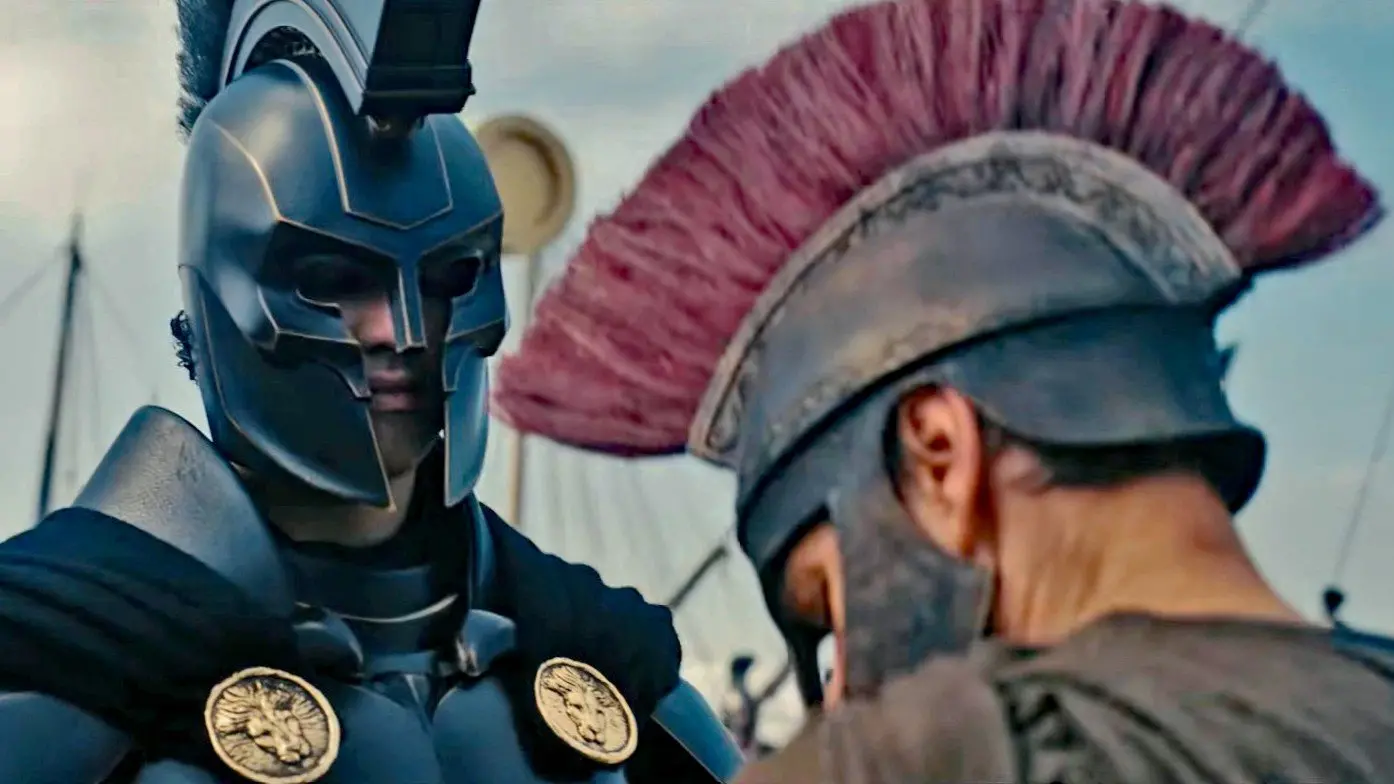
Despite the excitement, the first trailer sparked significant online backlash. Critics pointed to modern-sounding dialogue, armor designs that some compared to the Batsuit from Nolan's own "Dark Knight" trilogy, and the unexpected appearance of rapper Travis Scott as a bard. In interviews with Time Magazine (via Variety), Nolan and his creative team addressed these criticisms directly, offering detailed explanations rooted in historical research and artistic intent.
The Armor Controversy: Mycenaean Bronze vs. Batsuit
One of the most persistent complaints revolved around the armor worn by the warriors, particularly Agamemnon's suit. Some fans argued it looked too sleek and futuristic, evoking the iconic superhero costume rather than ancient Greek battle gear. Nolan defended the design, explaining that the team relied on archaeological evidence. "There are Mycenaean daggers made of blackened bronze. The theory is that they were able to blacken bronze back then," he said. "You take bronze, add more gold and silver, and then use sulfur... With Agamemnon, our costume designer Ellen Mirojnick is trying to communicate how much he stands apart from everyone else. That is achieved through materials that would have been very costly."
This attention to historical minutiae is a hallmark of Nolan's filmmaking process. For "Interstellar," he hired theoretical physicist Kip Thorne to ensure the black hole visualization was scientifically plausible. For "The Odyssey," Nolan consulted archaeologists and historians to reconstruct Mycenaean culture, including their metalworking techniques, clothing, and weaponry. The result is a deliberate aesthetic choice that prioritizes authenticity over popular expectations of ancient Greece.
Travis Scott's Casting: Oral Poetry Meets Rap
The casting of Travis Scott as a bard also raised eyebrows. Nolan, however, saw a natural connection between Homeric oral tradition and modern rap music. "I cast him to allude to the idea that this story was passed down as oral poetry, which is a parallel to rap," Nolan explained. "Both are rhythmic, improvisational forms that rely on memory and performance." This decision aligns with Nolan's pattern of selecting actors for their symbolic resonance — such as using real scientists in "Interstellar" or casting unknown actors in "Dunkirk" to emphasize historical anonymity.
Travis Scott's role is not a cameo; he appears as a bard reciting verses of the Odyssey, serving as a narrative device that links the ancient storytelling tradition to contemporary culture. Nolan's willingness to provoke debate is well-known. From the ambiguous ending of "Inception" to the nonlinear timeline of "Tenet," his films often divide audiences and critics alike.
Modern Dialogue: A Deliberate Anachronism?
The accusation that the dialogue sounds too modern was another point of contention. Nolan defended this choice by comparing it to his approach in "Interstellar." "With 'Interstellar,' you ask: 'What is the best speculation about the future?' When dealing with the ancient past, it's essentially the same. 'What is the best speculation, and how can I use it to create a world?'" He argues that language evolves, but the emotional core of the Odyssey — longing, cunning, resilience — is timeless. By using accessible modern English (or in this case, English-speaking audiences hear a translation), the film aims to bridge the gap between Homer's world and contemporary viewers.
Nolan acknowledged that not everyone will be satisfied. "Hopefully, they will enjoy the film even if they don't agree with everything. We had many scientists who complained about 'Interstellar.' But you just don't want people to think you approached the material casually." This sentiment reflects his dedication to rigorous preparation, even if the final product deviates from strict historicity.
Technical Achievement: First Film Shot Entirely with 70mm IMAX
"The Odyssey" is also a technical marvel. It is the first feature film shot completely with 70mm IMAX cameras, a format Nolan has championed for years. IMAX's large negative size provides unprecedented detail and clarity, crucial for capturing the sweeping landscapes of the Mediterranean and the intricate costumes. Nolan pushed the cameras to their limits, using them for intimate close-ups and epic battle sequences alike. The 250-million-dollar budget allows for massive practical sets, including a full-scale Trojan horse and a replica of Odysseus's palace.
This commitment to analog filmmaking sets Nolan apart in a digital age. He has consistently argued that film stock offers superior color depth and dynamic range, and his insistence on practical effects ensures a tangible realism that CGI often lacks. For "The Odyssey," the team built hundreds of props, handcrafted armor, and created real fire effects for the cyclops sequence.
Context: Nolan's Journey from Indie Darling to Epic Spectacle
Nolan's career has been marked by a progressive escalation in scale. From the nonlinear indie thriller "Memento" to the dark superhero deconstruction of "The Dark Knight" trilogy, and then to the mind-bending heist film "Inception" and the space epic "Interstellar," each project has pushed boundaries. "The Odyssey" represents his first attempt at mythological storytelling, a genre that demands both spectacle and soul. The original poem, composed around the 8th century BCE, has been adapted countless times, but rarely with Nolan's trademark combination of intellectual rigor and visual grandeur.
The film's cast features multiple Oscar winners and nominees, including Matt Damon, Anne Hathaway, Charlize Theron, and Lupita Nyong'o. The screenplay, written by Nolan himself, adheres closely to the source material while introducing original elements that explore Odysseus's internal struggle — not just his physical journey. The story follows the Greek king of Ithaca as he tries to return home after the Trojan War, facing monsters, gods, and temptations. Penelope, his wife, resists suitors back home, while their son Telemachus ventures out to find his father.
Reception and Anticipation
The online backlash, though loud, represents only a fraction of the audience. Many fans are excited about Nolan's interpretation. The trailer has millions of views, and early reactions from film critics who attended promotional events have been cautiously positive. Social media debates about armor and dialogue are likely to intensify as the release date approaches. Nolan's response, however, shows that he stands by his choices. He concluded: "I ask the audience to trust the process. We've done our homework, and we're telling this story in a way that feels honest to both the ancient text and the modern medium."
With a runtime reportedly exceeding 180 minutes, "The Odyssey" promises to be one of the longest and most ambitious films of Nolan's career. The IMAX release will be complemented by standard digital formats, but Nolan recommends seeing it in 70mm for the full experience. Whether it becomes another masterpiece or a divisive epic remains to be seen, but it's clear that Nolan is not backing down from the challenge of bringing Homer's Odyssey to the big screen.
Source: KINO News