

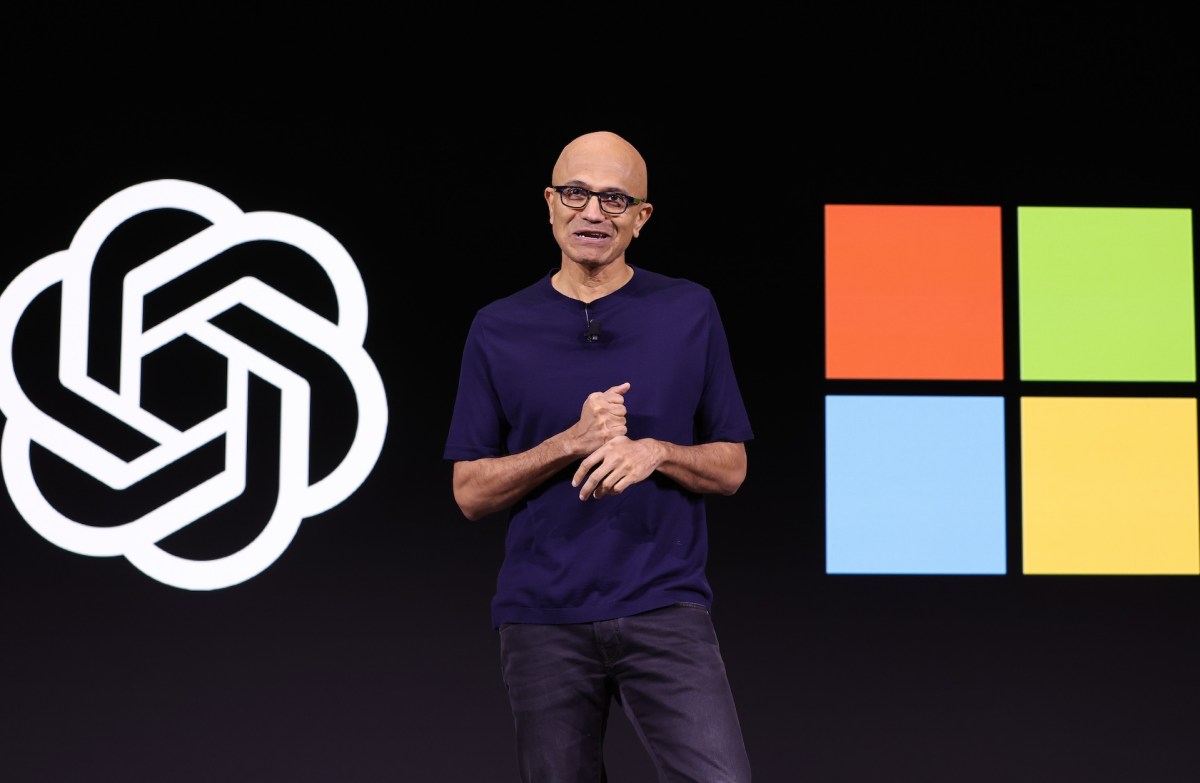
Of all the debates raging about the potential downsides of artificial intelligence, one concern has been causing the most hand-wringing among AI enthusiasts in Silicon Valley. Their fear is that the giant AI labs that sell proprietary models are acting like Trojan horses, gaining access to their customers' most sensitive business information. This concern has been voiced by venture capitalists like Jason Calacanis and Palantir CEO Alex Karp. Now, in a surprising blog post published recently, Microsoft CEO Satya Nadella has joined the chorus, issuing a stark warning to companies that use AI.
Nadella argues that AI users, whom he calls the 'buyers,' are essentially paying twice. They knowingly spend money on AI token usage, but they also, often obliviously, hand over valuable data in the process. 'You essentially pay for intelligence twice, once with money, and again with something even more valuable: the proprietary knowledge you must reveal to make that intelligence useful. The better you want the model to perform, the more of that knowledge you have to feed it!' he writes. This is particularly dangerous because enterprises are literally teaching the models about the nuances of their businesses. Models learn from 'exhaust'—the prompts people write, the tools agents use, and especially the corrections people make when the model is wrong. Every correction becomes distilled into institutional know-how, the kind of knowledge a competitor could never buy.
Nadella's solution is to urge companies to retain ownership of their data, including prompts and feedback. He recommends building proprietary learning environments on the cloud, which conveniently could mean Microsoft's Azure. He also advocates for orchestration layers that allow easy switching between AI models from different providers, avoiding lock-in. Tools like AI gateways have become increasingly popular for this purpose. While Nadella does not explicitly mention open source, it is an obvious subtext. He points out the irony that model makers freely train on public data but then impose restrictive terms on distillation—the practice of using a model's own outputs to learn how it works and train a cheaper model.
The enterprise AI landscape is shifting rapidly. Large companies that still maintain some on-premises data centers are already moving to open source models installed on their own premises. Idit Levine, founder and CEO of Solo.io, a company that makes networking and security software for managing AI systems, says she sees this trend among her customers. After experimenting with proprietary model makers, they ask themselves: 'Can I take an open source model and run it on-prem? It will do almost 90% of what the big one's doing. It will cost way less. They understand that, and they can control it.' Solo.io's technology was selected to power the Linux Foundation's Agentgateway project, and its customers include T-Mobile, ADP, and SAP. Levine believes on-premise open source models represent the next big wave in enterprise AI use.
This shift is not isolated. Vercel, a platform for building and hosting websites that recently added AI model-switching tools, and OpenRouter, a company helping developers route requests across different AI models, are both seeing a surge in traffic to open source models. Last month, open models accounted for 29% of all traffic routed through Vercel's gateway. With Microsoft's CEO, whose company has invested heavily in both OpenAI and Anthropic, now openly warning about proprietary models, this trend is likely to accelerate. Nadella concludes his post by stating, 'In consuming intelligence, you are creating intelligence. And what you create should belong to you.'
To fully understand the implications, it is helpful to review Nadella's background and Microsoft's role in AI. Satya Nadella became Microsoft's CEO in 2014, succeeding Steve Ballmer. Under his leadership, Microsoft shifted from a Windows-centric strategy to a cloud-first, AI-infused approach. One of his most significant moves was the multi-billion dollar investment in OpenAI, starting in 2019, which gave Microsoft exclusive access to OpenAI's GPT models and later a substantial stake. Microsoft also integrated OpenAI's technology into products like Azure OpenAI Service, GitHub Copilot, and Microsoft 365 Copilot. Additionally, Microsoft has invested in other AI labs, including Anthropic, the maker of Claude. This makes Nadella's warning particularly notable, as he is effectively cautioning customers against potential risks from partners his own company supports.
The core issue Nadella raises is data sovereignty. When enterprises use proprietary AI models, they typically send prompts and receive outputs. However, many AI providers reserve the right to learn from customer usage data—prompts, feedback, and corrections. This data can be used to improve models, but it also means that trade secrets, strategic plans, and proprietary processes are being absorbed by the model. If an AI lab later becomes a competitor, either by launching its own products or by licensing the model to a rival, the enterprise's knowledge is effectively transferred. Nadella argues that this is akin to handing over the keys to one's competitive advantage. He suggests that enterprises should build their own learning environments where data is retained and used solely for their benefit, not for the model provider's advantage.
The concept of distillation is central to Nadella's argument. Distillation is a technique where a smaller, more efficient model is trained using the outputs of a larger, more expensive model. In February, Anthropic accused Chinese open source models of sending millions of prompts to Claude as a way to improve their own models, urging the U.S. government to crack down on export controls. Nadella points out the hypocrisy: model makers freely scrape the internet to train their models, yet they restrict others from doing the same. He writes, 'While the great innovation that comes from model providers having fair use rights to train models on public data is needed, I find it ironic that the status quo is to then turn around and impose restrictive terms on distillation.'
The alternative that Nadella advocates is essentially a form of open source AI. By using open source models, enterprises can run them on their own infrastructure, control data flow, and even modify the models to suit their needs. Open source models like Meta's Llama, Mistral, and others have become increasingly capable, often performing close to proprietary models for specific tasks. Enterprises also benefit from lower costs, as they avoid per-token charges. However, open source comes with its own challenges, such as the need for specialized expertise to deploy and maintain models, and potential security vulnerabilities if not properly managed.
Nadella's warning is timely as the AI industry faces regulatory scrutiny. Governments in the U.S., EU, and elsewhere are considering laws to address data privacy, algorithmic bias, and market concentration. If enterprises heed Nadella's advice, they may reduce reliance on a few dominant AI labs, fostering a more decentralized and competitive market. This could also affect Microsoft's own position, as Azure OpenAI Service is a major revenue driver. Yet, Nadella appears to prioritize long-term trust over short-term gains, perhaps anticipating that enterprises will demand greater control over their data regardless.
The trend toward on-premises open source AI is already visible. Companies in finance, healthcare, and defense, where data sensitivity is paramount, are leading the charge. They are deploying models behind their own firewalls, using tools like Solo.io's gateways to manage traffic. These organizations often have existing data center investments and can leverage them for AI workloads. The cost savings are significant: one enterprise reported a 70% reduction in inference costs after switching to an open source model. Moreover, they gain the ability to fine-tune models on proprietary data without exposing it externally.
In summary, Nadella's blog post has sparked renewed debate about the trade-offs between convenience and control in enterprise AI. His message is clear: companies can no longer afford to blindly trust proprietary AI providers with their most valuable asset—knowledge. Instead, they must take active steps to retain ownership, explore open source alternatives, and build infrastructure that protects their intellectual property. As he wrote, 'You pay for intelligence twice, but you only get to keep what you create.' The industry is now watching whether enterprises will follow his counsel and reshape the AI landscape accordingly.
Source: TechCrunch News