

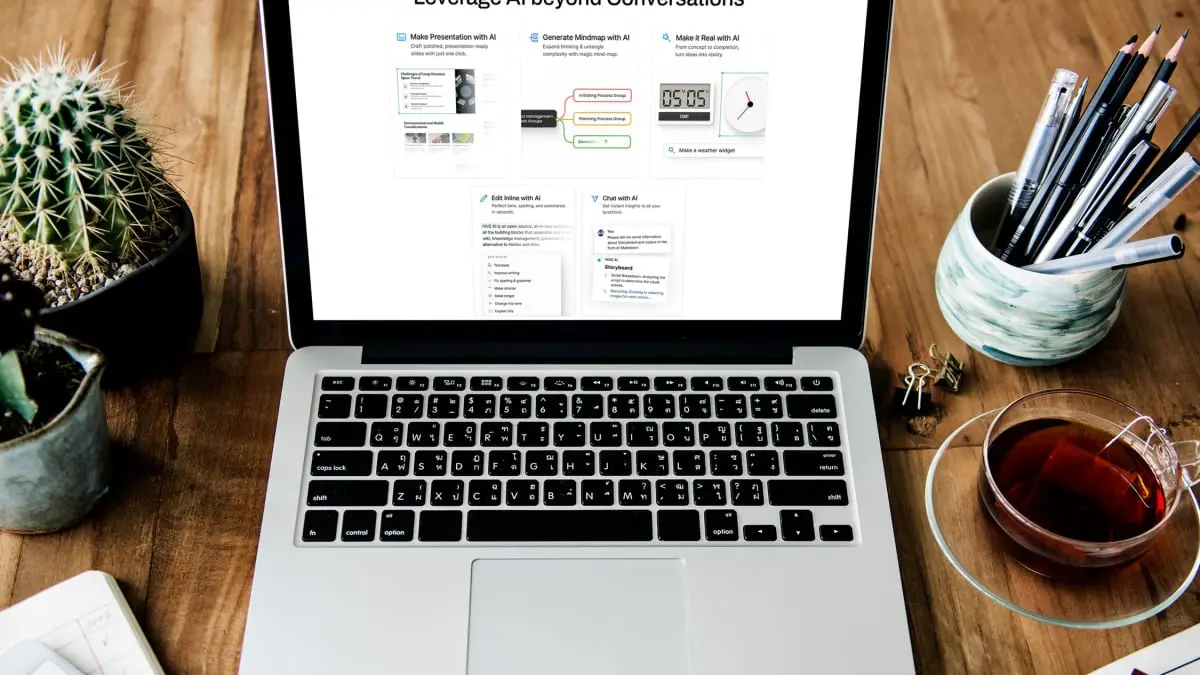
Every knowledge worker knows the pain: a browser window stuffed with dozens of tabs, each representing a different task, document, or source. Switching between them eats up mental energy, slows down decision-making, and makes it nearly impossible to maintain deep focus. The average professional toggles between applications and browser windows hundreds of times a day, costing significant time and cognitive overhead. This phenomenon, known as tab overload, has become one of the most insidious productivity drains of the modern digital workplace.
Enter a new class of workspace tools designed to unify these scattered elements. One particularly compelling option is an AI-powered workspace that promises to consolidate your projects, notes, tasks, and communications into a single, intelligent interface. Instead of juggling Notion for notes, Asana for tasks, Slack for communication, and countless browser tabs for references, this tool aims to be the central hub where everything connects. The key differentiator is its built-in AI, which can automatically organize content, surface relevant information, and even generate summaries or draft responses, all without leaving the platform.
The tool itself functions as a combination of a project dashboard, a note-taking app, and a knowledge base, all loosely coupled with an AI engine. When you start a project, you can drop in documents, web links, and task lists. The AI then analyzes the material, extracts key points, and suggests next steps. It can create a map of related concepts, highlight deadlines, and even pre-emptively pull in data from connected services like Google Drive or Outlook. The result is a highly personalized workspace that reduces the friction of context-switching.
Perhaps the most attractive aspect for budget-conscious professionals and small business owners is the pricing. While many productivity suites charge monthly subscriptions that quickly add up—some exceeding $30 per month—this AI workspace offers a lifetime license for a one-time payment of $50. That’s a fraction of what you’d pay over two years for typical software-as-a-service models. For anyone tired of recurring fees and looking to invest in a sustainable productivity solution, this deal represents exceptional value.
To understand why such a tool is necessary, it helps to examine the underlying causes of tab overload. Modern work is fragmented. We rely on email for formal communication, instant messaging for quick questions, cloud storage for files, project management tools for tasks, and web browsers for research. Each platform competes for attention, and the brain pays a heavy switching cost every time it moves from one to another. Studies show that it can take over 23 minutes to regain focus after a distraction. Multiply that by the dozens of interruptions a typical worker faces daily, and the lost productivity is staggering.
AI workspaces address this by acting as a unifying layer. They pull data from multiple sources into one view, using AI to contextualize and prioritize. For example, if you are working on a marketing campaign, the workspace might display your project brief, related emails, key task deadlines, and relevant web bookmarks—all on a single screen. The AI can even suggest which tasks to tackle next based on deadlines and dependencies. This reduces the need to keep multiple tabs open because the information is aggregated centrally.
Moreover, the AI component goes beyond simple aggregation. It can actually learn from your behavior over time. It might notice that you check certain reports every Monday morning and automatically prepare a summary for you. It could identify that you frequently reference a particular document and keep it pinned to the top of your workspace. It can even help you draft emails or meeting notes based on context, further minimizing the need to open separate applications. This personalized automation is what distinguishes modern AI workspaces from earlier, static productivity tools.
The $50 lifetime deal is particularly timely as more workers seek to reduce their monthly software expenses. Many subscription services have quietly raised prices, and the cumulative cost of using four or five different tools can easily exceed $100 per month. By consolidating functionality and paying once for lifetime access, users can achieve long-term savings while also simplifying their tech stack. This aligns with a broader trend toward "subscription fatigue" and the desire for more sustainable ownership models.
Of course, no tool is a silver bullet. The effectiveness of any workspace software depends on how well it integrates with existing workflows and how willingly users adopt it. However, for those who are willing to invest a little time in setup and customization, the payoff can be substantial. The AI gradually becomes more attuned to your specific needs, making the workspace smarter over time. Early adopters have reported significant reductions in tab counts—some from over 50 open tabs down to under 10—and noticeable improvements in daily productivity.
The technology behind such workspaces relies on natural language processing and machine learning models that can understand context and intent. When you drag a URL into the workspace, the AI doesn't just store the link; it parses the webpage, extracts the main content, and categorizes it based on the project. If you add a task, the AI can suggest subtasks, set reminders, and even estimate time requirements based on similar tasks completed in the past. These capabilities make the workspace feel less like a static repository and more like a proactive assistant.
In the context of a rapidly evolving digital landscape, tools that reduce cognitive load are not just nice to have—they are essential. The rise of remote and hybrid work has exacerbated the fragmentation problem, as workers now rely on even more disjointed digital tools to collaborate across time zones. An AI workspace that consolidates information and automates routine tasks can help bridge those gaps, enabling teams to focus on high-value work rather than administrative overhead.
It is also worth noting the broader shift toward AI augmentation in everyday software. Just as Grammarly uses AI to improve writing, and Copilot helps with code, these intelligent workspaces are bringing AI into the daily flow of project management and personal productivity. The $50 lifetime deal makes this cutting-edge technology accessible to freelancers, students, and small teams who might otherwise be priced out of premium suites. As competition in this space heats up, we can expect even more powerful features—such as automatic meeting transcription, real-time collaborative editing enhanced by AI, and deeper integration with third-party APIs—to become standard.
The decision to purchase a lifetime license also protects against future price hikes. With the ongoing evolution of AI models and the increasing costs of cloud compute, many software companies are migrating toward higher-priced subscription tiers. Locking in lifetime access now ensures that you benefit from future updates without any additional cost. This is especially valuable given that the AI models powering these workspaces are likely to improve dramatically over the next few years, offering even greater value to early adopters.
Ultimately, the promise of an AI-powered workspace is simple: reduce the chaos, increase the signal. By eliminating the need to keep dozens of tabs open across multiple windows, and by using AI to take over some of the organizational heavy lifting, workers can reclaim mental bandwidth for creative and strategic thinking. And at $50 for life, the financial barrier to entry is remarkably low. For anyone struggling with tab overload and looking for a sustainable, long-term productivity solution, this is an opportunity worth seizing.
The workspace is designed to be intuitive, requiring minimal learning curve. Upon first launch, you are guided through the process of connecting your existing accounts—email, cloud storage, calendar, and task managers. The AI immediately begins indexing your data and building a unified timeline of your activities. Within minutes, you can see all your upcoming deadlines, recent files, and pending messages in one clean interface. Over the next few days, the AI refines its suggestions as it learns your work patterns. Users commonly report that after a week, they rarely open more than a handful of tabs, because everything they need is already displayed in the workspace.
Security is also a consideration. The tool uses end-to-end encryption for stored data and complies with major data protection regulations like GDPR and CCPA. All AI processing can optionally be performed on-device or in a secure cloud environment, with the user retaining full control over their information. This makes it suitable for use in corporate environments where data sensitivity is paramount.
In summary, the problem of tab overload is real and costly. An AI-powered workspace offers a pragmatic, cost-effective solution. The current lifetime deal at $50 is an exceptional entry point for anyone looking to streamline their digital life and boost productivity. With AI capable of organizing, summarizing, and automating routine tasks, this tool positions itself as a cornerstone of a more focused and efficient workday.
Source: Mashable News