

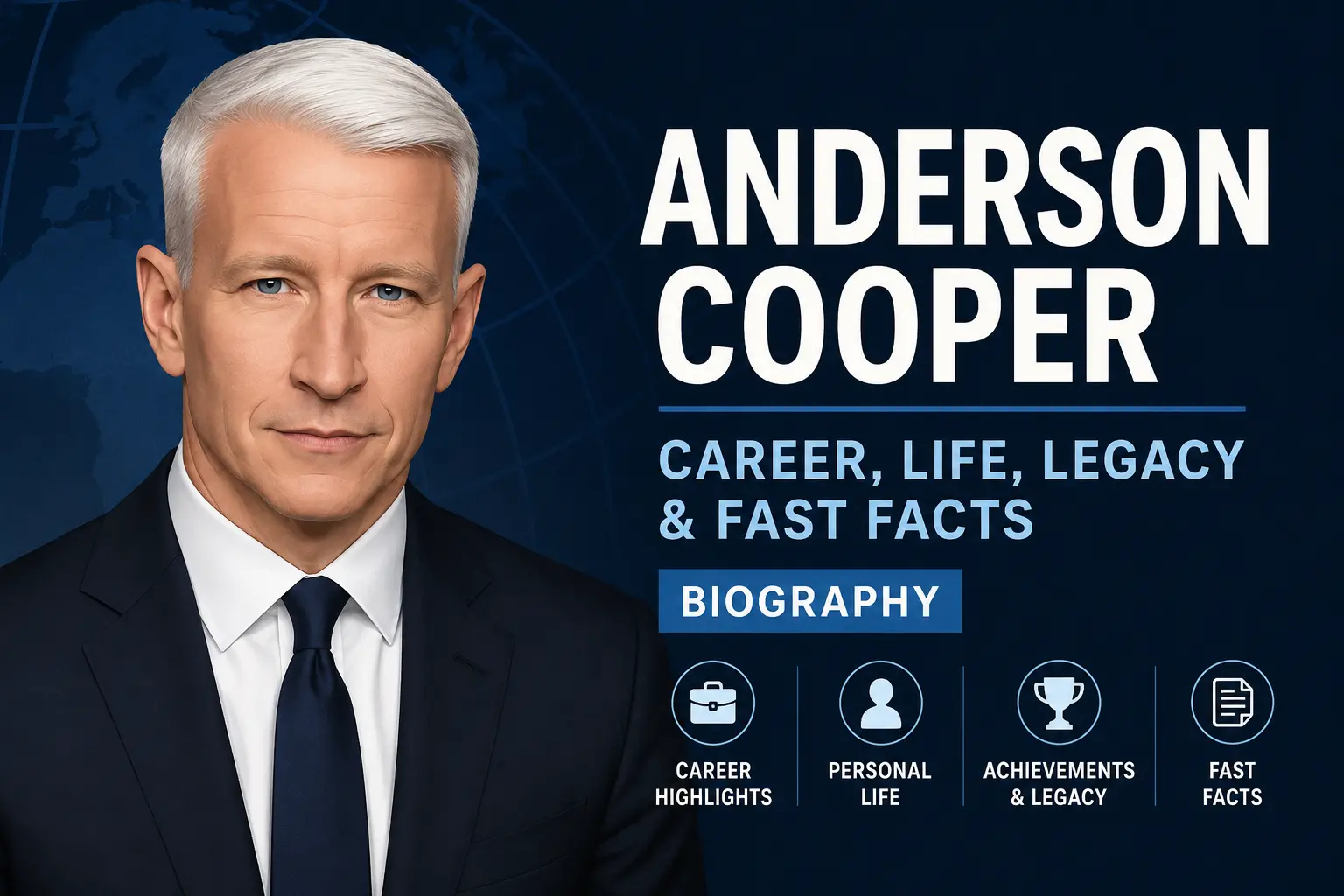
ANDERSON COOPER - FACT SHEET AT A GLANCE
| Category | Details |
|---|---|
| Full Name | Anderson Hays Cooper |
| Date of Birth | June 3, 1967 |
| Age (2026) | 58 years old |
| Birthplace | Manhattan, New York City, USA |
| Nationality | American |
| Education | The Dalton School (NYC); Yale University, B.A. Political Science, 1989 |
| Height | 5 feet 10 inches (1.78 m) |
| Parents | Gloria Vanderbilt (mother), Wyatt Emory Cooper (father) |
| Sibling | Carter Cooper (brother; died 1988) |
| Children | Wyatt Morgan Cooper (b. 2020), Sebastian Luke Maisani-Cooper (b. 2022) |
| Co-parent | Benjamin Maisani (former partner) |
| Sexual Orientation | Openly gay (came out publicly in 2012) |
| Primary Employer | CNN (since 2001) |
| Signature Show | Anderson Cooper 360° (CNN, since September 8, 2003) |
| Previous Network | ABC News (1995–2001), CBS 60 Minutes (2007–2026) |
| Net Worth (2026) | Estimated $60 million |
| Annual CNN Salary | Approximately $18 million |
| Emmy Awards | 18–23 (various sources; ongoing career) |
| Peabody Awards | 2 |
| Books Written | 4 (Dispatches from the Edge, The Rainbow Comes and Goes, Vanderbilt, Astor) |
| Podcast | All There Is with Anderson Cooper |
| Major Awards | Edward R. Murrow Award, DuPont Award, Haiti's National Order of Honour and Merit, Goldsmith Career Award for Excellence in Journalism (2025) |
| Countries Reported From | Nearly 80 |
| Left 60 Minutes | May 17, 2026 |
INTRODUCTION: AMERICA'S MOST TRUSTED ANCHOR
For more than two decades, Anderson Cooper has been a fixture in American living rooms — a silver-haired, silver-tongued presence who makes sense of chaos on television screens around the world. As the anchor of CNN's Anderson Cooper 360°, Cooper has covered virtually every major news event of the 21st century: wars in Iraq and Afghanistan, the devastation of Hurricane Katrina, the earthquake in Haiti, the Arab Spring, the COVID-19 pandemic, and multiple U.S. presidential elections. His style — direct, empathetic, deeply personal — broke the mold of the traditional detached anchor, and in doing so, he reshaped what television news journalism could look like.
Yet the story of Anderson Cooper is as compelling as any he has reported. Born into one of America's most storied dynasties, he was shaped not by inherited privilege but by personal tragedy, professional grit, and an insatiable curiosity about the world. His life has been a study in contrasts: the Vanderbilt heir who chose war zones over cocktail parties; the polished anchor who cried on live television during Katrina; the very private man who became a landmark figure for LGBTQ+ visibility. To understand Anderson Cooper, you must understand all of these layers at once.
EARLY LIFE: BORN INTO LEGEND
Anderson Hays Cooper entered the world on June 3, 1967, in Manhattan, New York City. From birth, he was surrounded by celebrity and wealth. His mother, Gloria Vanderbilt, was a socialite, heiress, artist, and fashion designer — a direct descendant of Cornelius Vanderbilt, the 19th-century railroad and shipping magnate whose fortune, adjusted for today's dollars, would be worth an estimated $185 billion. His father, Wyatt Emory Cooper, was a writer and screenwriter from the American South, known for his warmth and storytelling gifts.
The Vanderbilt name carried enormous social weight. By the time Anderson was three years old in 1970, he was already appearing on The Tonight Show alongside his mother, who loved the spotlight and often brought young Anderson along to public events. Between the ages of 10 and 13, he worked as a child model for companies including Calvin Klein and Macy's — an early, inadvertent education in public presence and media.
But beneath this gilded surface lay real pain. When Anderson was just 10 years old, in January 1978, his father, Wyatt Cooper, died during open-heart surgery. The loss was devastating. Cooper has spoken about how he never acknowledged Father's Day until he became a father himself, because the grief of losing his own dad was simply too overwhelming. Then, a decade later, in 1988, tragedy struck again: his older brother Carter Cooper, then 23, died by suicide after falling from the 14th-floor terrace of their Manhattan apartment — a moment that Anderson witnessed and that would haunt him for decades.
These losses are not incidental background details in the Anderson Cooper story. They are foundational. They explain why he gravitates toward stories of suffering and survival, why he listens with such evident empathy, and why he has said that grief is one of the most profound and underreported aspects of the human experience. He later channeled this directly into his podcast, All There Is with Anderson Cooper, which explores grief and bereavement through candid conversations.
Despite his family's wealth and name, Cooper was also shaped by the knowledge that the Vanderbilt fortune would not be waiting for him. Gloria Vanderbilt was known for spending lavishly throughout her life, and she made clear to Anderson from a young age that there was no trust fund, no golden safety net. When she died in June 2019 at the age of 95, she left him approximately $1.5 million — meaningful to most people, but a fraction of the dynasty's original glory. That awareness of impermanence drove Cooper to earn his place in the world entirely on his own terms.
EDUCATION AND EARLY CAREER: FINDING HIS WAY
Cooper attended the Dalton School in New York City, one of the city's most prestigious private institutions, before enrolling at Yale University, where he studied political science. During his time at Yale, he reportedly also studied Vietnamese at the University of Hanoi, a choice that speaks to his early international curiosity. He graduated with a Bachelor of Arts degree in 1989.
After graduation, Cooper found that breaking into major journalism was harder than he expected. Undeterred, he took matters into his own hands. At age 23, he talked his way into working for Channel One News — a school-based television network seen daily in more than 12,000 classrooms across the United States — and began producing his own footage of war-torn regions around the world. He bought a fake press pass, taught himself to use a camera, and headed to conflict zones including Myanmar (then called Burma), and soon after, Rwanda, Somalia, Bosnia, and beyond.
This self-funded, self-taught approach became the bedrock of Cooper's journalistic identity. He was never someone who waited for a big break to be handed to him. He manufactured his own opportunities and went where the stories were, regardless of personal risk. Channel One News eventually named him chief international correspondent, and he spent years reporting from crisis zones across Africa, Asia, the Middle East, and Eastern Europe.
In 1995, ABC News hired Cooper as a correspondent, where he eventually co-anchored the network's overnight news program World News Now, and contributed to World News Tonight and 20/20. However, his trajectory briefly veered in a surprising direction: in 2000, Cooper left hard news to host ABC's prime-time reality television program The Mole. He hosted two seasons of the show before the terrorist attacks of September 11, 2001 made him feel that he needed to be back where it mattered — in the newsroom, reporting the news.
CNN AND THE RISE TO PROMINENCE
Cooper joined CNN in 2001, initially co-anchoring American Morning alongside Paula Zahn. His energy, intelligence, and natural ease in front of the camera quickly attracted attention. By 2002, he was CNN's weekend prime-time anchor. On September 8, 2003, he officially became the anchor of Anderson Cooper 360° — a program that would become his signature and one of the defining news shows of its era.
Anderson Cooper 360° was designed from the outset to be different. Cooper was not interested in playing the role of the all-knowing oracle delivering news from on high. As he described his philosophy: "I think the notion of traditional anchor is fading away, the all-knowing, all-seeing person who speaks from on high. I don't think the audience really buys that anymore. As a viewer, I know I don't buy it. I think you have to be yourself, and you have to be real, and you have to admit what you don't know."
This philosophy — raw, present, self-aware — resonated powerfully with audiences. The show covered breaking news, investigations, political analysis, and in-depth reporting from around the world. Cooper anchored from the field whenever possible, believing firmly that stories were better told from the ground up.
HURRICANE KATRINA: THE MOMENT THAT CHANGED EVERYTHING
If there is one story that defined Anderson Cooper's public profile more than any other, it is Hurricane Katrina. In August 2005, when the storm devastated the Gulf Coast, Cooper went to New Orleans and witnessed firsthand the almost incomprehensible failure of government response. While officials made reassuring statements about the situation being under control, Cooper was filming bodies floating in floodwaters and desperate survivors who had been abandoned for days without food or water.
In a now-legendary moment, Cooper pushed back emotionally and directly against a U.S. senator who was praising the government's relief efforts. His voice cracking with barely-contained anger, he described what he was actually seeing on the ground. It was a departure from the conventional detached journalistic stance, and it connected with millions of viewers who were equally outraged. CNN's viewership reportedly spiked by 35 percent during his Katrina coverage.
Cooper later said: "It's hard not to get upset when brave people suffer." That line captured something essential about his reporting style — a journalism of witness, not just observation. His Katrina coverage helped lead CNN to win a Peabody Award, and it cemented Cooper's status as one of the most trusted journalists in America.
LANDMARK COVERAGE: A CAREER SPANNING HISTORY
Over the course of his career, Cooper has reported from nearly 80 countries and covered virtually every major news event of the 21st century. A few standout moments:
Haiti Earthquake (2010): Cooper was on the ground in Port-au-Prince after the devastating 7.0-magnitude earthquake, providing some of the most vivid and compassionate coverage of the disaster. At one point, he was filmed pulling a young boy to safety during street violence following the quake. For his coverage, he received Haiti's National Order of Honour and Merit — the highest honor the Haitian government grants to a foreign national. He also received two Emmy Awards specifically for this coverage.
The 2004 Indian Ocean Tsunami: Cooper's reporting from the tsunami-affected regions was so impactful that CNN won a DuPont Award for its coverage.
The Arab Spring (2011): Cooper reported from Egypt during the revolution, going live from Tahrir Square and being briefly caught up in pro-Mubarak mob violence. He continued reporting despite personal risk.
COVID-19 Pandemic: Cooper anchored CNN's coverage of the global pandemic, helping Americans make sense of fast-changing public health guidance, medical science, and political dysfunction. In April 2020, in the middle of his COVID reporting, he made an announcement live on air that was entirely different in tone: his son Wyatt had just been born via surrogacy.
Presidential Debates: In 2016, Cooper co-moderated the second presidential debate between Hillary Clinton and Donald Trump alongside Martha Raddatz, becoming the first openly LGBTQ+ person to moderate a general election presidential debate in U.S. history.
The Whole Story (2023–present): In April 2023, CNN launched The Whole Story with Anderson Cooper, a Sunday primetime series featuring long-form, immersive single-topic episodes on major news events — including the fentanyl epidemic, the Los Angeles wildfires, and the Washington D.C. helicopter collision.
60 MINUTES AND A MAJOR FAREWELL
For nearly two decades, alongside his CNN duties, Cooper also served as a correspondent for CBS's 60 Minutes, one of the longest-running and most respected investigative news programs in American television history. His segments ranged from celebrity profiles to in-depth investigative journalism to international affairs.
In February 2026, Cooper announced he would not be renewing his contract with 60 Minutes. His final appearance on the program aired on May 17, 2026, where he delivered an emotional farewell. His stated reason was a deeply personal one: he wanted to spend more time with his two young sons. In his departure statement, he said he wanted to ensure his children have as much of him as possible.
CBS News released a statement praising Cooper's two decades of contributions, calling his work with the program an extraordinary body of journalism. Cooper himself described his tenure on 60 Minutes as "one of the greatest honors of my career."
His departure came during a turbulent period for CBS News, with reported leadership changes and internal questions about editorial independence under new management. But Cooper was clear that his exit was about family, not internal politics.
PERSONAL LIFE: LOVE, LOSS, AND FATHERHOOD
Anderson Cooper publicly came out as gay in July 2012, in a letter published by journalist Andrew Sullivan. He wrote that he had always kept his personal life private, but felt that being quiet about his sexual orientation could be interpreted as implying that it was something to be ashamed of. His coming out made him, as widely reported at the time, the most prominent openly gay journalist on American television. He has since received multiple GLAAD Media Awards for his contributions to LGBTQ+ visibility.
Cooper was in a relationship with French businessman Benjamin Maisani for approximately a decade, from around 2009 until their romantic breakup in 2018. However, the two remained extraordinarily close, and when Cooper decided to become a father via surrogacy, Maisani became a central figure in that journey. Wyatt Morgan Cooper was born in April 2020, named after Anderson's late father. Sebastian Luke Maisani-Cooper was born in 2022. The two boys are co-parented by Cooper and Maisani, who continue to share parenting responsibilities and have described their arrangement as a modern family. Maisani later adopted both boys.
Cooper has spoken movingly about the experience of late-in-life fatherhood, describing his sons as giving him a sense of purpose he never anticipated. He has also said that becoming a father has made him think even more deeply about the world his children will inherit, an awareness that has informed his environmental and long-form documentary work.
His close friendship with Andy Cohen — the Bravo television personality and Watch What Happens Live host — has become one of the most celebrated friendships in American media. The two have co-hosted CNN's New Year's Eve coverage since 2017, and have taken their friendship on tour through the AC2: An Intimate Evening with Anderson Cooper and Andy Cohen stage show, which launched in 2015 and returned for dates at New York's Beacon Theatre in January 2026.
AUTHOR AND PODCASTER
Beyond television, Cooper has established himself as a serious author and audio storyteller. His books have all found large audiences:
Dispatches from the Edge: A Memoir of War, Disasters, and Survival (2006) was a New York Times bestseller, offering a candid account of his experiences covering conflicts and catastrophes around the world, intertwined with deeply personal reflections on loss.
The Rainbow Comes and Goes: A Mother and Son on Life, Love, and Loss (2016) was co-written with his mother, Gloria Vanderbilt, and became a beloved portrait of their complex relationship and shared reflections on life, grief, and family.
Vanderbilt: The Rise and Fall of an American Dynasty (2021), co-written with historian Katherine Howe, traced the full arc of the Vanderbilt family's extraordinary rise and gradual decline — a history that was deeply personal for Cooper.
Astor: The Rise and Fall of an American Fortune followed a similar formula, exploring another great American dynasty through meticulous research and compelling narrative.
His podcast, All There Is with Anderson Cooper, has explored grief in a way that has resonated deeply with listeners. Drawing on his own experiences of losing his father, his brother, and his mother, Cooper has conducted honest conversations about bereavement, memory, and how people carry loss through their lives.
NET WORTH AND FINANCIAL LIFE
Anderson Cooper's estimated net worth in 2026 stands at approximately $60 million, making him one of the wealthiest news personalities in America. His annual CNN salary is reported at around $18 million, placing him among the highest-paid news anchors in the country.
Despite his Vanderbilt heritage, the vast majority of Cooper's wealth is self-made. He has been open about the fact that he did not inherit significant money from his mother — she left approximately $1.5 million upon her death in 2019, a modest sum relative to the Vanderbilt dynasty's peak wealth. Cooper has described inherited wealth as a "motivation sucker" and has said he does not intend to leave his children a large financial windfall, preferring instead to ensure their education and their drive to build their own lives.
Beyond his CNN salary, Cooper's income streams include his bestselling books, significant speaking engagement fees, the AC2 stage tour with Andy Cohen, and a real estate portfolio that reportedly includes a converted firehouse in Manhattan, a historic Connecticut estate, and a property in Brazil.
AWARDS AND RECOGNITION
Anderson Cooper's journalism career is among the most decorated in the history of American broadcast news:
- Emmy Awards: 18 to 23 wins across his career (various sources; his American Academy of Arts and Sciences profile cites 23)
- Peabody Award: For Hurricane Katrina coverage (CNN team), and a second individual Peabody
- DuPont Award: For 2004 Indian Ocean tsunami coverage (CNN team)
- Edward R. Murrow Award: From the Overseas Press Club, 2011
- National Order of Honour and Merit: Granted by the Haitian government for his 2010 earthquake coverage — the country's highest honor for a foreign national
- GLAAD Media Awards: Multiple, for LGBTQ+ visibility and advocacy
- Goldsmith Career Award for Excellence in Journalism (2025): For decades of impactful global reporting
- First LGBTQ+ person to moderate a U.S. presidential general election debate (2016)
- Member, American Academy of Arts and Sciences
LEGACY AND CONTINUING IMPACT
Anderson Cooper turned 58 in June 2026. He remains at the anchor desk of Anderson Cooper 360° following a renewed CNN contract confirmed in late 2025, despite a challenging period for cable news in which CNN's primetime viewership declined significantly. His continued presence at the network reflects both his enduring value to CNN and his own stated commitment to the journalism he has practiced for more than 30 years.
What sets Cooper apart from most anchors of his generation is a combination of qualities that rarely appear together: genuine intellectual curiosity, physical bravery in the field, emotional authenticity on camera, a wide frame of cultural reference, and a personal history rich enough to fuel decades of storytelling. He is equally at home interviewing a world leader and comforting a grief-stricken parent in a disaster zone. He has laughed with Andy Cohen on New Year's Eve and wept at the sight of bodies in the water in New Orleans. He is, in the truest sense, a complete journalist.
His departure from 60 Minutes in 2026 signaled a shift in priorities — toward his children, toward his CNN work, and perhaps toward new projects that will define the next chapter of his career. Reports of interest from streaming platforms like Netflix and Apple TV+ for documentary projects suggest that Cooper's creative ambitions remain expansive.
But above all, Anderson Cooper's legacy is one of witness. For more than three decades, he has shown up where others might not go, stayed when it would have been easier to leave, and told the truth when others preferred comfortable fictions. In an era of fracturing media trust, that consistency is not just professionally impressive — it is genuinely rare.
TIMELINE OF KEY MILESTONES
- 1967 — Born June 3, Manhattan, New York City
- 1970 — First TV appearance at age 3 on The Tonight Show with mother Gloria Vanderbilt
- 1978 — Father Wyatt Cooper dies during heart surgery; Anderson is 10
- 1988 — Brother Carter Cooper dies; Anderson is 20
- 1989 — Graduates Yale University with B.A. in Political Science
- 1992 — Begins career at Channel One News; reports from war zones in Southeast Asia and Africa
- 1995 — Joins ABC News as a correspondent
- 2000 — Hosts ABC's reality show The Mole (two seasons)
- 2001 — Joins CNN following 9/11; co-anchors American Morning
- 2003 — Becomes anchor of Anderson Cooper 360°
- 2005 — Hurricane Katrina coverage catapults him to national prominence
- 2007 — Joins CBS's 60 Minutes as a correspondent
- 2010 — Covers Haiti earthquake; receives National Order of Honour and Merit from Haiti
- 2012 — Publicly comes out as gay
- 2016 — Moderates U.S. presidential general election debate; first openly LGBTQ+ person to do so
- 2019 — Mother Gloria Vanderbilt dies at 95
- 2020 — Son Wyatt Morgan Cooper born via surrogacy; April 2020
- 2022 — Son Sebastian Luke Maisani-Cooper born via surrogacy
- 2023 — Launches The Whole Story with Anderson Cooper on CNN
- 2025 — Awarded Goldsmith Career Award for Excellence in Journalism; renews CNN contract
- 2026 (May) — Signs off from 60 Minutes after nearly two decades as correspondent
Sources: Wikipedia, Britannica, CNN Profiles, American Academy of Arts and Sciences, Hollywood Life, Parade, Celebrity Net Worth, EBSCO Research Starters, and multiple verified news outlets.