

Should You Buy the Vision Pro?
The $3,700 Vision Pro is prohibitively expensive for many consumers, and reviews have made it clear that it is a device that does not easily fit into an existing workflow for most people. Some users have even regretted purchasing the headset. The Vision Pro is great for watching movies, viewing 3D videos, and using as a display for a Mac.
At over 1.3 pounds, the Vision Pro is heavy and fatigue can set in quickly, but Apple improved comfort with the Dual Knit Band that launched alongside the M5 chip. There is also an external battery pack to contend with, and the headset is not easy to travel with, especially with Apple's dedicated Travel Case.
The Vision Pro is undoubtedly Apple's most technically advanced product and an incredible feat of engineering. Those considering a purchase should try it at the Apple Store and do a lot of research on what can be done with it before making a purchase. The Vision Pro is excellent for watching movies and consuming content, plus it can be used as a display for a Mac, but it has a limited number of apps and games.
Apple refreshed the Apple Vision Pro with an M5 chip in October 2025, which means now is a good time to buy. Another update is not expected for at least two years, and development on a next-generation headset is currently paused. Apple raised the price of the Vision Pro from $3,499 to $3,699 in June 2026 because of the ongoing global memory crisis.
Apple Vision Pro Overview
Apple Vision Pro is Apple's augmented and virtual reality headset, a major new product category. The first version launched in February 2024, and an updated model with an M5 chip arrived in October 2025.
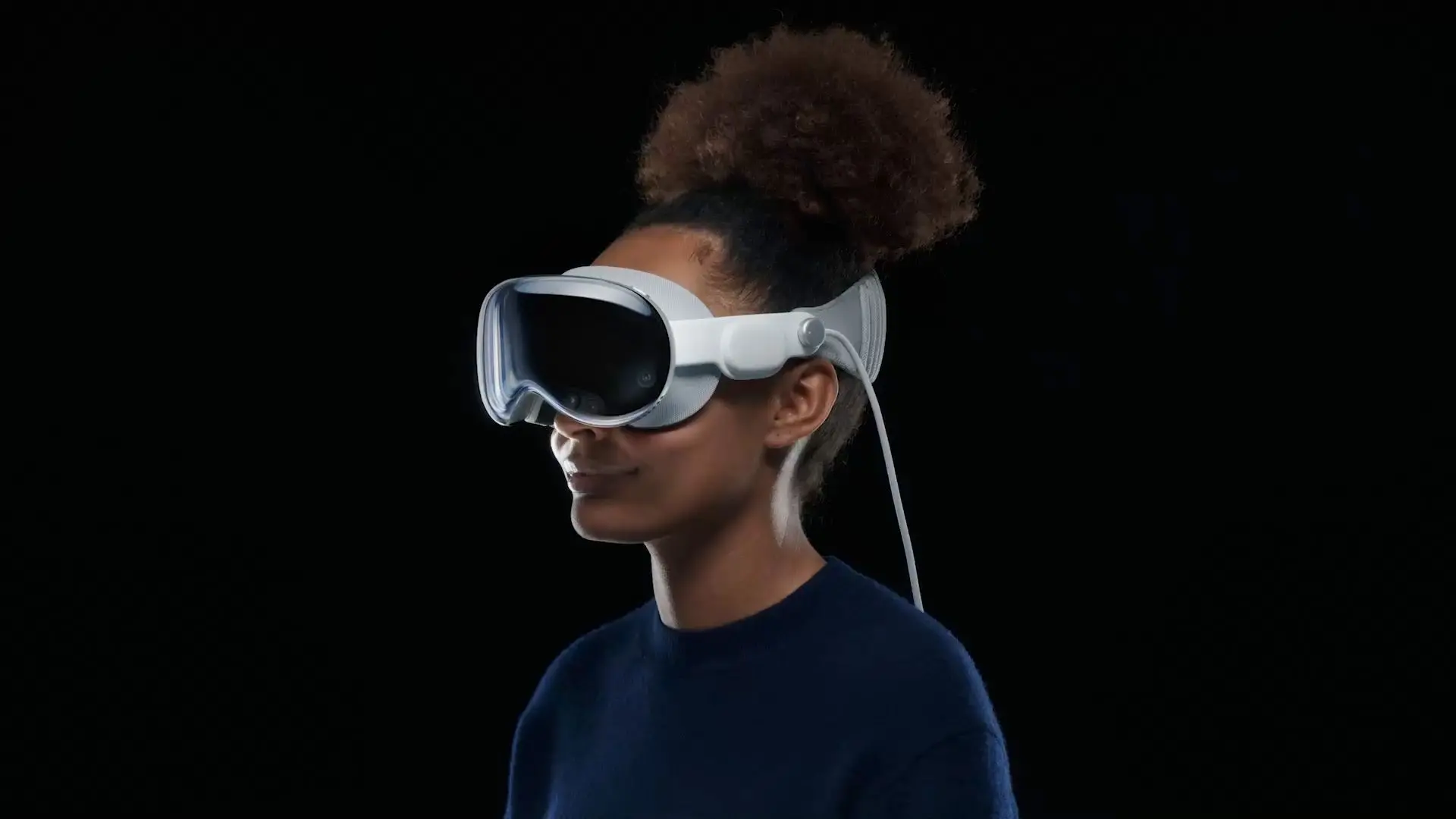
While it is definitely a headset, Apple calls it a spatial computer because of its ability to blend digital content with the physical world. It is a mixed reality headset that displays augmented reality content overlaid on the world around you and immersive entirely virtual content. The headset is not see-through; everything you see is digital. For augmented reality, cameras map out what's in front of you, translating that into a digital image augmented by virtual elements. For virtual reality, those cameras shut off, allowing you to focus solely on the headset's screens. A Digital Crown controls this shift.
Design
Design wise, Apple Vision Pro is not unlike a pair of ski goggles, featuring a singular piece of laminated glass for the front that melds into an aluminum alloy frame. A soft, fitted Light Seal attaches magnetically and conforms to your face to block out light. Two Audio Straps with built-in speakers deliver Spatial Audio and connect to a 3D knitted headband. The M5 model introduced a Dual Knit Band with a second strap over the top of the head, designed to be breathable, cushiony, and stretchy. A Fit Dial ensures a tight fit, and counterweights distribute weight more evenly.
Display and Lens Inserts
Inside the frame, two micro-OLED displays deliver over 4K resolution to each eye for a total of 23 million pixels. An external display called EyeSight projects an image of your eyes so others can tell if you're in immersive mode. For glasses wearers, custom prescription Zeiss Optical Inserts attach magnetically. The M5 version renders 10% more pixels and supports up to 120Hz refresh rates for crisper text and reduced motion blur.
Cameras and Sensors
More than a dozen cameras and sensors map the world around you and track hand and eye movements. Optic ID scans your iris for authentication, similar to Face ID. Navigation is done through eye tracking, hand gestures, and voice commands. A built-in 3D camera captures spatial photos and videos, with clear indicators when recording. An external camera enables 3D memories.
Audio
The speakers on either side feature dual-driver audio pods with Spatial Audio and adapt sound to the room. Six microphones handle calls and voice commands. AirPods Pro 2 (USB-C) and AirPods Pro 3 support lossless audio with ultra-low latency.
Processors and RAM
The Vision Pro uses two Apple silicon chips: the M5 (same as MacBook Pro) and the R1. The M5 has a 10-core CPU and 10-core GPU with improved Neural Engine for AI tasks. It works alongside the R1 chip, which processes camera, sensor, and microphone input with near-zero lag. The device has 16GB of RAM and storage options of 256GB, 512GB, or 1TB.
Battery Life
The M5 Vision Pro offers up to three hours of video playback and 2.5 hours of general use on a single charge of the external battery pack. Battery packs can be swapped, and the headset can run all day when plugged in.
visionOS
visionOS is the operating system with a full 3D interface navigated by eyes, hands, and voice. Apps can be placed anywhere in virtual space, resized, and arranged. The level of immersion adjusts with the Digital Crown. visionOS supports Mac Virtual Display, allowing the headset to serve as a 4K display. visionOS 26 added persistent widgets and improved Personas. visionOS 27 introduces Siri AI with generative capabilities, including conversational AI, visual intelligence, and custom voices. Other features include Image Playground, improved Safari, and enhanced accessibility tools like Dwell Control and Face Gestures.
Reviews and Pricing
Reviewers praised the Dual Knit Band for improved comfort and the M5 chip for consistent performance with no lag. The 10% pixel increase and 120Hz support offer crisper visuals. The Vision Pro starts at $3,700 for 256GB. Zeiss reading lenses cost $99, prescription lenses $149. No trade-in option exists for older M2 models.
What's Next for Vision Pro
Apple is reportedly developing AI-powered smart glasses similar to Meta Ray-Bans, without a display, expected in late 2026 or 2027. A cheaper enclosed headset is not in active development, with the next Vision Pro unlikely before late 2028 or 2029. Apple's long-term plans include AR glasses and health applications, such as using eye tracking for mental health diagnosis.
Source: MacRumors News