

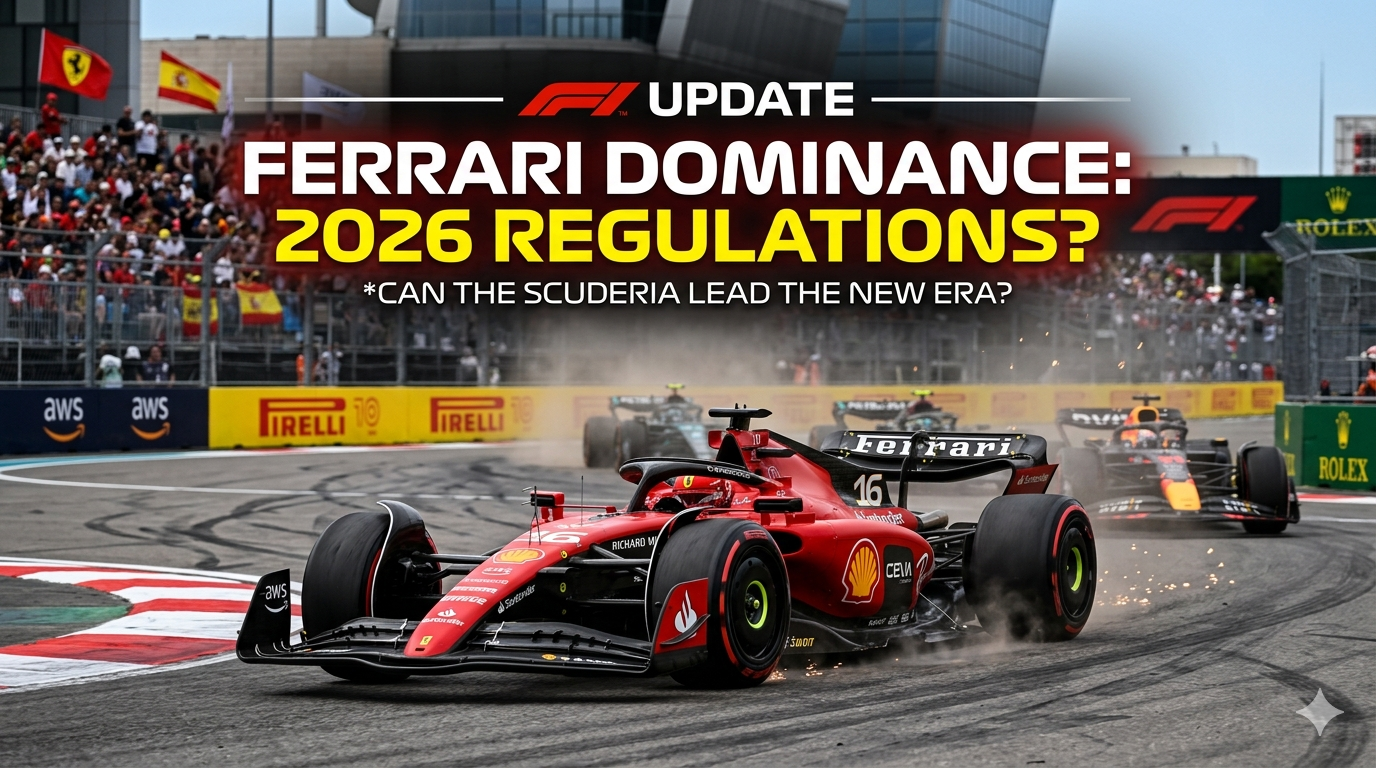
The Red Reset – Why 2026 Belongs to Maranello
Is the "Red Era" finally returning to Formula 1? For nearly two decades, the Tifosi have waited for a technical revolution that would play perfectly into the hands of the Scuderia. That moment has arrived. As the grid prepares for the shocking shift to the 2026 regulations, one team is already emerging as the clear winner in the simulation wars: Ferrari.
The 2026 F1 technical regulations aren’t just a minor tweak; they are a complete ground-up reboot of the sport. With a 50/50 power split between the Internal Combustion Engine (ICE) and electrical deployment, the removal of the MGU-H, and the introduction of "active aerodynamics," the hierarchy is being shaken to its core. While Red Bull grapples with its new Ford partnership and Mercedes tries to reclaim its 2014 magic, Ferrari has quietly built a powerhouse package that experts believe is the most "future-proof" on the grid.
Topic Overview: The 2026 Technical Earthquake
Today, the talk of the paddock isn't just about who wins the next race, but who wins the next decade. The 2026 regulations represent the most radical change in F1 history. The focus has shifted from pure aerodynamic downforce to total energy management.
Why does this matter? Because Ferrari has historically thrived when the rules allow for "engine-first" engineering. By simplifying the power unit (deleting the complex MGU-H) and tripling the electrical output of the MGU-K, the FIA has created a playground where Ferrari’s massive R&D resources and historical engine expertise can finally be unleashed without the "packaging" constraints of previous years.
Key Highlights & Quick Summary
If you’re looking for the must-watch details of Ferrari’s 2026 surge, here are the vital facts:
- 50/50 Power Split: Ferrari’s new ICE is reportedly achieving thermal efficiency levels that have left rivals worried.
- The Lewis Hamilton Factor: The 7-time champion didn't just move to Ferrari for the brand; he moved because of the 2026 engine data he saw in Maranello.
- Active Aero "Z-Mode": Ferrari’s chassis department has developed a revolutionary "active wing" system that integrates seamlessly with their high-torque electrical deployment.
- Weight Reduction: The SF-26 (project name) is rumored to be the only car currently hitting the new, lower minimum weight limit of 768kg in early simulations.
- Sustainable Fuel Mastery: Ferrari’s partnership with Shell has yielded a "drop-in" 100% sustainable fuel that minimizes the power drop-off seen by other manufacturers.
Deep Analysis: The Tactical Breakdown of Ferrari’s Dominance
The secret to Ferrari’s 2026 advantage lies in Integration. In the current era, Red Bull dominated because of Adrian Newey’s aerodynamic genius. However, in 2026, the engine is the chassis.
1. The Death of the MGU-H
The MGU-H (which recovered heat from the turbo) was the bane of Ferrari’s existence for years. It was complex, prone to failure, and restricted engine layout. Its removal allows Ferrari to return to a more "traditional" high-performance V6 turbo design where they can maximize the Internal Combustion component. Reports suggest Ferrari’s 2026 ICE is producing significantly more "raw" horsepower than the initial prototypes from Audi or Red Bull-Ford.
2. Electrical Supremacy (MGU-K)
With electrical power jumping from 120kW to 350kW, the car’s software must now decide exactly when to deploy that massive surge. Ferrari’s "predictive deployment" algorithms—tested extensively in their Hypercar (WEC) program—are said to be miles ahead. They are finding ways to harvest energy in corners where other teams are still struggling with "clipping" (running out of battery on long straights).
3. "X-Mode" and "Z-Mode" Mastery
The 2026 cars will feature Active Aerodynamics.
- Z-Mode: High downforce for corners.
- X-Mode: Low drag for straights. Ferrari has reportedly designed a "bending" floor concept that works in tandem with these modes, ensuring the car remains stable during the high-speed transition between modes—a problem that has allegedly caused "spin-outs" in rival simulations.
Key Factors That Will Decide the 2026 Outcome
Several "storyline drivers" will determine if Ferrari can actually convert this technical lead into a World Championship:
- Chassis-Engine Harmony: Unlike Red Bull-Ford (a new partnership) or Audi (a new entry), Ferrari builds everything under one roof. This "Single-Site" advantage is massive when trying to package a complex 350kW battery.
- Driver Input: Lewis Hamilton and Charles Leclerc provide the best feedback loop in the sport. Hamilton’s experience with the 2014 Mercedes transition is the "secret weapon" Ferrari needed to avoid the development dead-ends they hit in 2017 and 2022.
- The ADUO Rule: The FIA’s "Additional Development Upgrade Opportunities" could allow struggling teams to catch up. Ferrari must ensure they don't just start fast, but stay ahead of the regulatory "handicaps."
Expert Prediction: What to Expect in 2026
The Confident Call: Ferrari will enter the 2026 season with the fastest car in a straight line.
Multiple Scenarios:
- The "2014 Mercedes" Scenario: Ferrari finds a "loophole" in the energy recovery system that gives them a 0.5s per lap advantage, leading to a dominant Leclerc/Hamilton title fight.
- The "Close Fight" Scenario: Ferrari has the best engine, but Mercedes nails the "Active Aero" better, leading to a classic power-vs-downforce battle.
- The Reliability Gamble: Ferrari pushes the limits of the new sustainable fuels too far, leading to early-season DNFs despite having the fastest car.
Stats, Records & Trends: The Numbers Behind the Hype
Feature | 2025 Regulations | 2026 Regulations | Ferrari's Estimated Edge |
|---|---|---|---|
Electrical Power | 120 kW | 350 kW | +15% Efficiency |
Minimum Weight | 798 kg | 768 kg | ~3kg under limit |
Fuel | 10% Ethanol | 100% Sustainable | Higher Calorific Value |
Wheelbase | 3600 mm | 3400 mm | Increased Agility |
Historical Insight: Every time F1 has moved to a "Power Unit" centric set of rules (1980s Turbos, 2014 Hybrids), the teams with the most established engine infrastructure win. Ferrari is currently the only manufacturer that has continuously produced F1 engines since 1950.
Fan Reactions & Trending Buzz
The "Hamilton to Ferrari" move is already the most viral sporting event of the decade, but the 2026 technical leaks are sending social media into a frenzy.
- #ForzaFerrari is trending globally as simulation data "leaks" suggest a massive top-speed advantage for the SF-26.
- Reddit & X (Twitter): Technical analysts are obsessed with Ferrari’s "triangular" airbox design seen in early wind-tunnel mockups, suggesting a radical cooling solution for the new battery tech.
- The "Vasseur Effect": Fans are praising Team Principal Fred Vasseur for poaching top engineers from Mercedes and Red Bull specifically for the 2026 project.
A New Era of Red Dominance?
The 2026 regulations represent the biggest opportunity for Ferrari to reclaim its throne. By mastering the 50/50 power split and integrating Lewis Hamilton's championship-winning DNA into the SF-26, Maranello is no longer just "hoping" for a win—they are engineering one.
The technical battle is won in the factory years before it’s won on the track. If the current rumors are even half-true, the rest of the grid should be very, very afraid of the Prancing Horse.
What do you think? Will Ferrari dominate, or will Mercedes pull off another technical miracle? Let us know in the comments below!
People Also Ask
Who will win the 2026 F1 Championship?
While it is too early to be certain, Ferrari is the current favorite based on simulation data and engine development milestones. Their 2026 power unit is rumored to be the most advanced in the paddock.
Where to watch F1 in 2026?
F1 will be available on traditional broadcasters like Sky Sports (UK), ESPN (US), and the F1 TV Pro streaming service globally.
What time do F1 races start?
Most European races start at 3:00 PM local time (CET). However, 2026 will feature more night races in Las Vegas, Qatar, and Saudi Arabia with late-night start times.
Is the 2026 F1 car faster than the 2025 car?
The 2026 cars will have higher top speeds on straights due to "X-Mode" (low drag), but they may be slightly slower in corners due to reduced overall downforce and narrower tires.
What is Active Aero in F1?
Active Aero allows the car to move its front and rear wings during a lap to either increase grip in corners (Z-Mode) or reduce drag on straights (X-Mode).
Will Lewis Hamilton drive for Ferrari in 2026?
Yes, Lewis Hamilton has signed a multi-year deal with Ferrari that ensures he will be with the team for the start of the 2026 technical era.
Are the 2026 F1 engines louder?
By removing the MGU-H, which acted as a silencer in the exhaust stream, the 2026 engines are expected to have a higher, more aggressive exhaust note than current cars.
Why is Red Bull-Ford a risk?
Unlike Ferrari, Red Bull is building its first-ever internal engine. Partnering with Ford provides capital and electrical expertise, but the "integration" of a brand-new ICE is a massive technical hurdle.
Is DRS going away in 2026?
Yes, the traditional DRS is being replaced by "Active Aero" and a "Manual Override Mode," which provides a chasing car with an extra electrical boost instead of just opening a wing flap.
What fuel will F1 use in 2026?
F1 is switching to 100% sustainable "drop-in" fuels that are carbon-neutral and do not require changes to the internal combustion engine architecture.
How much power does a 2026 F1 car have?
The 2026 power units will still produce over 1,000 brake horsepower (bhp), but the power will be split almost equally between the engine and the battery.
Is Audi joining F1 in 2026?
Yes, Audi has officially taken over the Sauber team and will enter as a full "works" manufacturer with its own power unit in 2026.
Where can I stream F1 for free?
Official free streaming is rare, but some regions offer highlights on YouTube or local terrestrial channels like Channel 4 (UK) for the British GP.
What is the "Manual Override" button?
This is the 2026 version of "Push-to-Pass." If a driver is within one second of the car ahead, they get access to additional battery power to facilitate an overtake.