

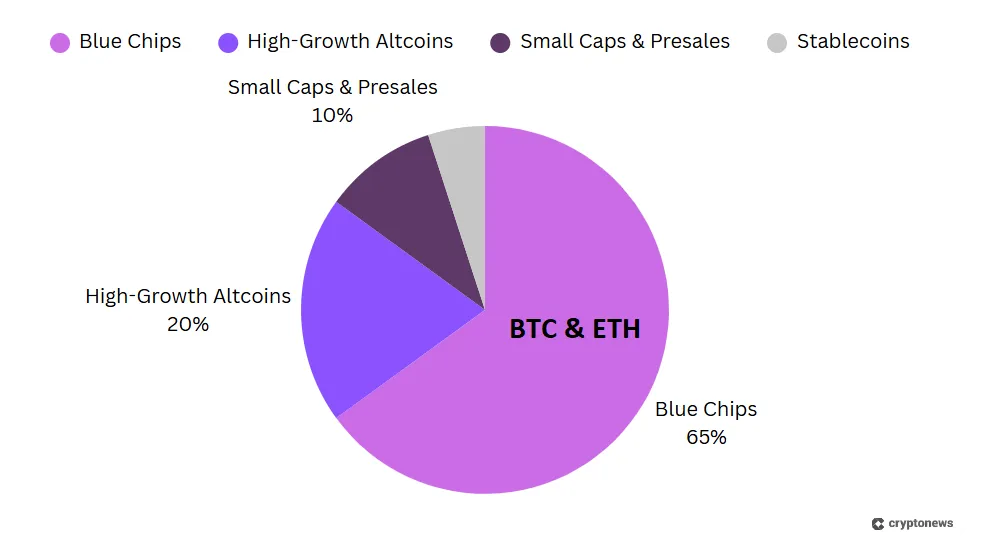
Building a diversified cryptocurrency portfolio in 2026 requires a strategic blend of stability and growth. The market remains highly volatile, with double-digit daily swings common, making diversification essential. A prudent approach allocates roughly 70% to stable blue chips and 30% to higher-growth assets, including small-cap presales and promising altcoins.
Portfolio Allocation Model
A recommended 2026 diversification model distributes funds across several categories. The largest portion—45%—goes to Bitcoin (BTC) as the core anchor, providing deep liquidity and long-term store of value. Smart contract platforms like Ethereum (ETH) receive 20%, powering DeFi, NFTs, and Web3. Bitcoin Layer-2 infrastructure accounts for 10%, with Bitcoin Hyper (HYPER) as a key example. A utility bridge segment (15%) includes Chainlink (LINK) for oracle infrastructure and real-world asset connectivity. Speculative alpha, such as meme coins like Maxi Doge (MAXI), gets 5%, while stablecoins like USDC make up the remaining 5% for rebalancing and capital preservation.
High-Risk/High-Reward Multiplier
The multiplier segment targets asymmetric upside. Bitcoin Hyper (HYPER) is the first Solana-based Layer-2 for Bitcoin-native DeFi, offering staking rewards and unlocking BTC liquidity. Maxi Doge (MAXI) is a meme token with up to 1000x leverage trading and high staking yields. BMIC Token (BMIC) provides a quantum-resistant wallet ecosystem, while LiquidChain (LIQUID) unifies liquidity across Bitcoin, Ethereum, and Solana. These presales carry high risk but significant potential for outsized returns.
Utility Bridge: AI, RWAs, and Real Usage
This category includes altcoins with strong fundamentals and real-world adoption. Hyperliquid (HYPE) leads decentralized perpetual trading with its own execution layer. Chainlink (LINK) secures most oracle-dependent DeFi value. Bittensor (TAO) powers decentralized machine learning through its subnet architecture. Uniswap (UNI) remains the largest DEX by TVL. Render (RENDER) offers a decentralized GPU marketplace for AI and rendering tasks. Arbitrum (ARB) scales Ethereum with robust developer activity. PAX Gold (PAXG) provides on-chain gold exposure as a macro hedge. Ondo (ONDO) tokenizes U.S. Treasuries for stable yield, and Polygon (MATIC) enables low-cost Ethereum scaling with high dApp activity.
Core Stability Layer: Blue Chips
Blue chips form the foundation. Bitcoin (BTC) with a $1.49 trillion market cap offers unmatched security and institutional adoption. Ethereum (ETH) at $243 billion drives DeFi and Web3 with a large staking ecosystem. XRP (XRP) facilitates fast cross-border payments, while Solana (SOL) boasts high throughput and low fees, attracting millions of daily users. BNB (BNB) benefits from deep exchange utility and a large DeFi ecosystem. Historical performance shows these assets deliver strong multi-year returns with lower volatility than smaller coins.
Sector Allocation and Risk Mitigation
Investors can further diversify by blockchain sectors: 50% Layer 1s, 10% DeFi, 10% AI & DePIN, 10% meme coins, 10% RWAs and stablecoins, and 10% presales. To manage risk, use stop-loss orders, limit presale exposure to 5–10% of total portfolio, prefer audited projects, and rebalance quarterly or when a coin exceeds its target allocation by 20%. Avoid emotional decision-making by sticking to predetermined rules. Historical data shows a diversified portfolio of 70% BTC/ETH and 30% altcoins outperformed Bitcoin alone by about 60% over five years, though with higher volatility.
Key Takeaways
Diversification remains the only free lunch in crypto investing. By combining blue-chip anchors, utility altcoins, and carefully selected presales, investors can achieve better risk-adjusted returns. The key is to maintain balance, stay informed on market narratives, and adjust allocations based on performance and sector trends. All data is as of May 2026, with prices and market caps subject to rapid change.
Source: Cryptonews News