

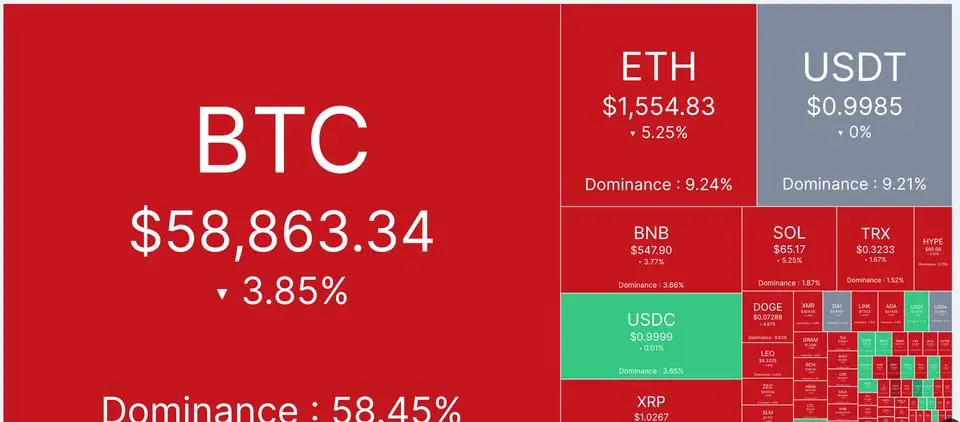
Bitcoin has now settled comfortably under the $60,000 threshold, spending a significant portion of the past two days below that psychological level. As of late Thursday, the leading cryptocurrency was trading at $59,500, actually higher by 0.4% over the past 24 hours, according to data from CoinMarketCap. The move comes as U.S. equities show mixed performance, with the Nasdaq down 0.4%, the S&P 500 flat, and the Dow Jones Industrial Average up 0.3%.
The current environment reflects a confluence of bearish factors that have been weighing on risk assets for weeks. Chief among them is the persistence of a hawkish Federal Reserve, which has markets pricing in two 25-basis-point rate hikes over the next eight months. The U.S. Dollar Index (DXY) has climbed above 101, further pressuring cryptocurrencies and other risk-sensitive instruments. The release of the core PCE inflation data, the Fed's preferred gauge, came in exactly as expected — 0.3% month over month and 3.4% year over year — confirming that inflation remains stubborn and providing no relief for bulls. Headline PCE printed slightly cooler at 0.4% month over month and 4.1% year over year.
Spot Bitcoin ETF Outflows Accelerate
Adding to the selling pressure, U.S. spot Bitcoin ETFs saw $469 million in net outflows on Wednesday, marking one of the largest daily redemptions since the products launched in January 2024. Cumulative net inflows have now retreated to $52.8 billion, a level last seen on July 14, 2025 — roughly $2.3 billion below the peak reached a few days later. BlackRock's IBIT alone shed $300 million, reflecting dwindling demand from institutional investors. The outflows have been consistent for the past several months, contributing to bitcoin's decline from above $65,000 earlier this week.
The withdrawal of ETF capital is compounded by thinning summer liquidity and a quarter-end options expiry scheduled for June 30, which traders say is keeping the market unstable. Major market-maker Wintermute had flagged $59,000 as the bear-market low to watch in its Tuesday note, and that level was briefly touched overnight. Bitcoin dropped to $59,175 before bouncing back to around $61,500 by Thursday morning. The dip triggered roughly $430 million in long liquidations on bitcoin-tracked futures, with nearly $1 billion in total liquidations across crypto majors such as ether, solana, and other tokens.
Micron’s Earnings Provide a Brief Reprieve
The bounce came from an unexpected source: Micron Technology. The memory chip giant reported quarterly earnings after the close that shattered analyst estimates, sending its shares sharply higher by more than 12% and lifting the broader AI chip complex. SK Hynix separately disclosed plans for a U.S. stock listing seeking roughly $29 billion, one of the largest offerings ever. Samsung and Kioxia rallied in Asian trading Thursday morning. The same AI chip trade that had sent South Korea's Kospi down 10% on Monday, on fears that the spending boom was stalling, is now steadying crypto. Micron's results are being read as confirmation that demand for AI memory is structural, not speculative.
However, the relief may be short-lived. The quarter-end remains the week's live risk. Bitcoin's $59,000 low held, but $1.6 billion in leveraged long positions sit clustered below $58,000, according to CoinGlass, meaning a break there would accelerate the drop. Thursday's PCE inflation print was the next major data point, and while it came in as expected, it does nothing to change the hawkish rate outlook.
Four-Year Cycle Debate Heats Up
In the midst of the sell-off, the debate over Bitcoin's four-year cycle has resurfaced with renewed intensity. The theory, based on the network's halving events, suggests a recurring pattern of boom and bust. After the April 2024 halving, the cycle typically sees a major bull run in the following year, a bear market peak, and a bottom about 12 to 13 months later — which in this case would point to roughly October 2026. So far, the pattern is playing out as expected by proponents.
Coinbase CEO Brian Armstrong waded into the discussion by replying "Yep" to a post on X from user levelsio, who wrote: "Bitcoin has always been operating in 4-year cycles where it crashes at the end. 2014, 2018, 2022, 2026. It's actually great because every 4th year people really get super sad and give up on it. There's also surely some sentiment pumping to push the price down so people can buy in cheap again. The next cycle up is 2027-2031." Critics, however, point out that with over 19 million bitcoin already in circulation, the halving events today have little effect on supply, so their impact on price should be minimal. Nevertheless, the current downturn fits the historical pattern eerily well.
Strategy Under Scrutiny
Michael Saylor's Strategy (formerly MicroStrategy) is facing intense pressure as its common stock (MSTR) fell 7.6% to a multi-year low of $87, while its preferred stock (STRC) hit a record low, down 5.1% to $76.70. Arkham Intelligence added its voice to the debate, reminding investors that "Strategy does not legally have to pay these dividends." Unlike Terra Luna, which collapsed in 2022, Strategy cannot be liquidated as STRC's value falls. "If it looks like Strategy won’t be able to raise capital and pay dividends, investors may sell STRC, but Saylor is not forced to spend money keeping the price up," Arkham explained. Still, the distress around Strategy is adding to the negative sentiment for bitcoin, as the firm holds nearly 850,000 BTC.
Other Notable Developments
In other news, OpenAI is reportedly leaning toward delaying its initial public offering until 2027, citing the recent dip in Elon Musk's SpaceX after its mega-IPO and general market choppiness. IREN signed a multiyear jersey sponsorship deal with the Golden State Warriors, replacing Rakuten. The company's shares were down 3% on the day. Apple hiked prices across its Mac and iPad lineup by 15% to 25%, blaming rising memory and storage chip costs. The company left iPhone prices unchanged for now but signaled further increases could follow.
Oil prices erased nearly all wartime gains, with Brent crude falling below $72.48 a barrel as tankers resumed open passage through the Strait of Hormuz. Cheaper oil eases inflation pressure, which could eventually shift the Fed's hawkish stance, but that sequence works with a lag of months, not days. Meanwhile, Aave's AAVE token surged 15% after Standard Chartered set a $3,500 price target for 2030, though that target requires the token to go five times past its all-time high of $661.
On the regulation front, Dubai is set for a crypto firm influx as the MiCA deadline pushes companies to reassess Europe. XRP held the $1 support level amid rising network activity. Tether traded at a 7% to 10% premium in India, which exchanges attribute to supply-demand dynamics. Bitcoin's 52-week correlation with USD/JPY hit -0.90, undercutting the 'carry trade' theory. And the Gnosis X account was hacked, with a fake rewards link posted; users are urged not to interact.
As the week draws to a close, all eyes remain on the $59,000 support level and the options expiry on June 30. The next few days could determine whether bitcoin finds a bottom or extends its slide toward the next major support zone around $55,000. The combination of Fed tightening, ETF outflows, and seasonal weakness creates a challenging environment for crypto bulls, but the four-year cycle believers are already looking ahead to 2027.
Source: Coindesk News